


Howdy folks, it’s the second week of November 2026, and welcome to This Week in The West.
I’m Seth Spillman, broadcasting from the National Cowboy & Western Heritage Museum in Oklahoma City.
On this podcast, we share stories of the people and events that shaped the history, art and culture of the American West—and those still shaping it today.
Let’s put together a Venn diagram. One circle holds the colorful characters who have roamed the halls of Congress: folksy braggarts and witty political fighters. In the other circle are the larger-than-life personalities found in the world of rodeo: Tough types full of cowboy wisdom.
Sitting in the middle of this diagram?
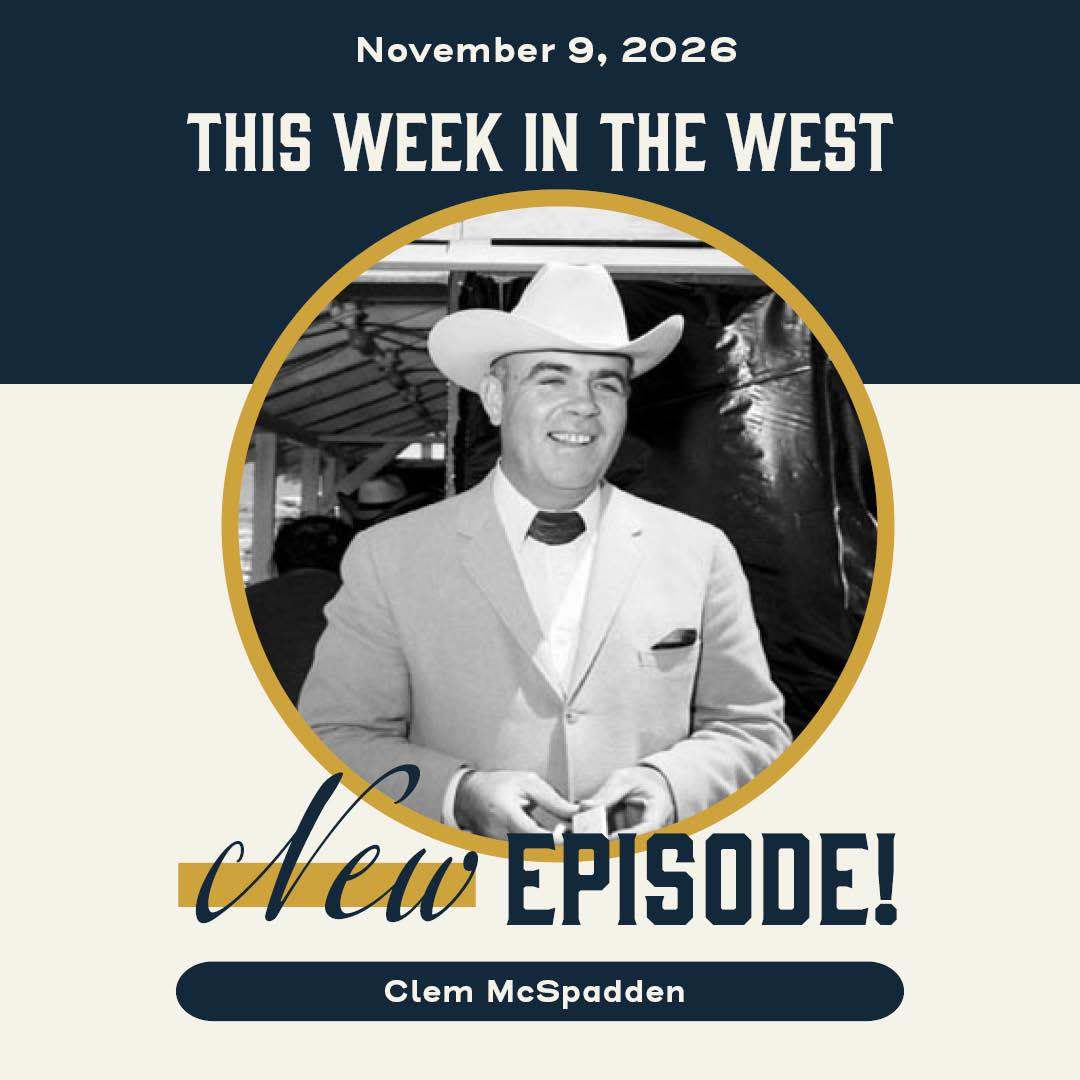
Clem McSpadden.
We remember him today on the week of his birth, November 9, 1925, as a National Rodeo Hall of Famer who served nearly two decades in the Oklahoma State Senate, represented Oklahoma in the United States Congress, and became one of the most recognizable voices in professional rodeo.
When someone once asked him about the similarities between politics and rodeo, McSpadden offered a wonderfully simple observation:
“There’s an amazing correlation … in that there’s bull in each profession.”
It was exactly the kind of observation you might expect from someone who happened to be the great-nephew of another famous Oklahoma cowboy philosopher: Will Rogers.
Like Rogers, McSpadden cast a long shadow, stretching from the red dirt of Oklahoma to rodeo arenas across the nation and into the halls of power.
McSpadden was born on a ranch near Bushyhead, Oklahoma.
His family connections practically guaranteed a Western upbringing. His great-uncle Will was already becoming one of America’s most beloved entertainers, and young Clem grew up around northeastern Oklahoma’s ranching traditions.
He attended school in Oologah and developed an early connection with horses, cattle and the cowboy way of life.
During World War II, McSpadden joined the United States Navy. After returning home, he completed his education and earned a degree from Oklahoma A&M (now Oklahoma State University) in 1948.
He would eventually pursue two careers. The first was rodeo.
McSpadden initially competed in calf roping and steer wrestling. But it soon became clear that his greatest talent wasn’t necessarily inside the arena; it was describing what happened there.
McSpadden became a rodeo announcer, developing a style that combined an encyclopedic knowledge of the sport with humor, personality and genuine affection for the competitors.
Eventually, that distinctive voice became the soundtrack to some of North America’s most important rodeos, including the Calgary Stampede and the National Finals Rodeo.
McSpadden was the first American announcer to work the Calgary Stampede in the 1960s.
While there, he even developed the unusual practice of announcing rodeo action from horseback. We guess sitting in an announcer’s booth just wasn’t quite Western enough.
As McSpadden’s rodeo career was flourishing, another opportunity emerged: Politics.
In 1954, at just 28, McSpadden was elected to the Oklahoma State Senate.
He served for nearly twenty years and eventually became president pro tempore. Throughout his political career, he maintained his demanding rodeo schedule. From the State Senate, McSpadden sought higher office. In 1972, McSpadden won election to the United States House of Representatives from Oklahoma’s Second Congressional District.
He helped establish the Congressional Rural Caucus and became one of the rare first-term representatives appointed to the powerful House Rules Committee.
He explained his unusual work schedule by saying he attended legislative sessions in winter and announced rodeos in summer.
McSpadden served one term in Congress before leaving to pursue the Democratic nomination for governor of Oklahoma in 1974.
He lost that contest to David Boren, who would ultimately become governor and later a United States senator.
But McSpadden’s departure from elected office hardly meant retirement. If anything, it gave him more time for rodeo.
For years, he was a guiding force at the National Finals Rodeo during its long run in Oklahoma City, serving as its general manager and becoming one of the sport’s most influential ambassadors.
Then he played a small but remarkable role in launching another Oklahoma legend’s career.
In 1974, McSpadden hired a young singer from southeastern Oklahoma to perform the National Anthem at the National Finals Rodeo. Her name was Reba McEntire.
He reportedly paid her ten dollars. It was an early break in her career.
More than 30 years later, in December 2005, McSpadden appeared before a packed National Finals Rodeo crowd in Las Vegas.
He reminded the audience of the young singer he once hired for ten dollars. Then he held up a ten-dollar bill and introduced Reba McEntire.
The crowd erupted.
Later that evening, according to a recollection shared by McSpadden’s wife, Donna, Reba greeted the couple with her own ten-dollar bill, crediting that early opportunity with helping launch her extraordinary career.
McSpadden also contributed to the Western lifestyle beyond the microphone.
He wrote The Cowboy’s Prayer, a beloved piece reflecting the values, faith and traditions of the rodeo community.
The prayer became a familiar part of rodeos and cowboy gatherings, and McSpadden recited it countless times, including at the funeral of legendary bull rider Freckles Brown, who had asked McSpadden to read it.
In 1989, he was inducted into the National Rodeo Hall of Fame at the National Cowboy & Western Heritage Museum. The following year, he entered the ProRodeo Hall of Fame and the Oklahoma Hall of Fame.
The Cowboy would honor him again with our very first Ben Johnson Memorial Award in 1998.
Rodeo journalist Ted Harbin recalled that McSpadden could turn a quick conversation into an hour of storytelling.
Wrote Harbin on a blog following McSpadden’s death: “Each time we’d gather, Clem would ask about my life. He genuinely cared about me, but that was Clem McSpadden with literally hundreds of people. His heart was the biggest and best thing about him. His stories weren’t far behind … He was a wealth of knowledge on so many subjects, and he wasn’t afraid to give you his honest opinion – about the state of politics today or about his concerns for the Professional Rodeo Cowboys Association.”
Clem McSpadden died July 7, 2008, at the age of 82, following a battle with cancer.
As McSpadden wrote in his Cowboy’s Prayer: “So, when we make that last ride, that we know is inevitable, to the country up there — where the grass is green and lush and stirrup high, and the water runs crystal clear and deep, You will tell us, as we enter that Arena, our entry fees are paid.”
And with that, we’ve stepped up to the microphone (but not on horseback) for another episode of “This Week in the West.”
Our show is produced by Chase Spivey and written by Mike Koehler.
Follow us and rate us on Apple Podcasts or wherever you hear us. That helps us reach more people.
Come visit us in Oklahoma City! You can now buy tickets online at thecowboy.org/tickets
Got a question or a suggestion? Drop us an email at podcast@thecowboy.org
We leave you today with the words of National Rodeo Hall of Famer Roy Cooper: “Clem was the Godfather of all of ‘em. He was the voice of rodeo. Clem McSpadden has done more for our sport than any other individual.”
Much obliged for listening, and remember, come Find Your West at the National Cowboy & Western Heritage Museum.