



Welcome to the blog about our podcast “This Week in the West.” We’ll share the show’s scripts on our blog each week. If you want to listen, click above, subscribe on your favorite podcast app or check back here every Monday.
If you have questions, ideas or feedback about the podcast, you can reach out to podcast@thecowboy.org
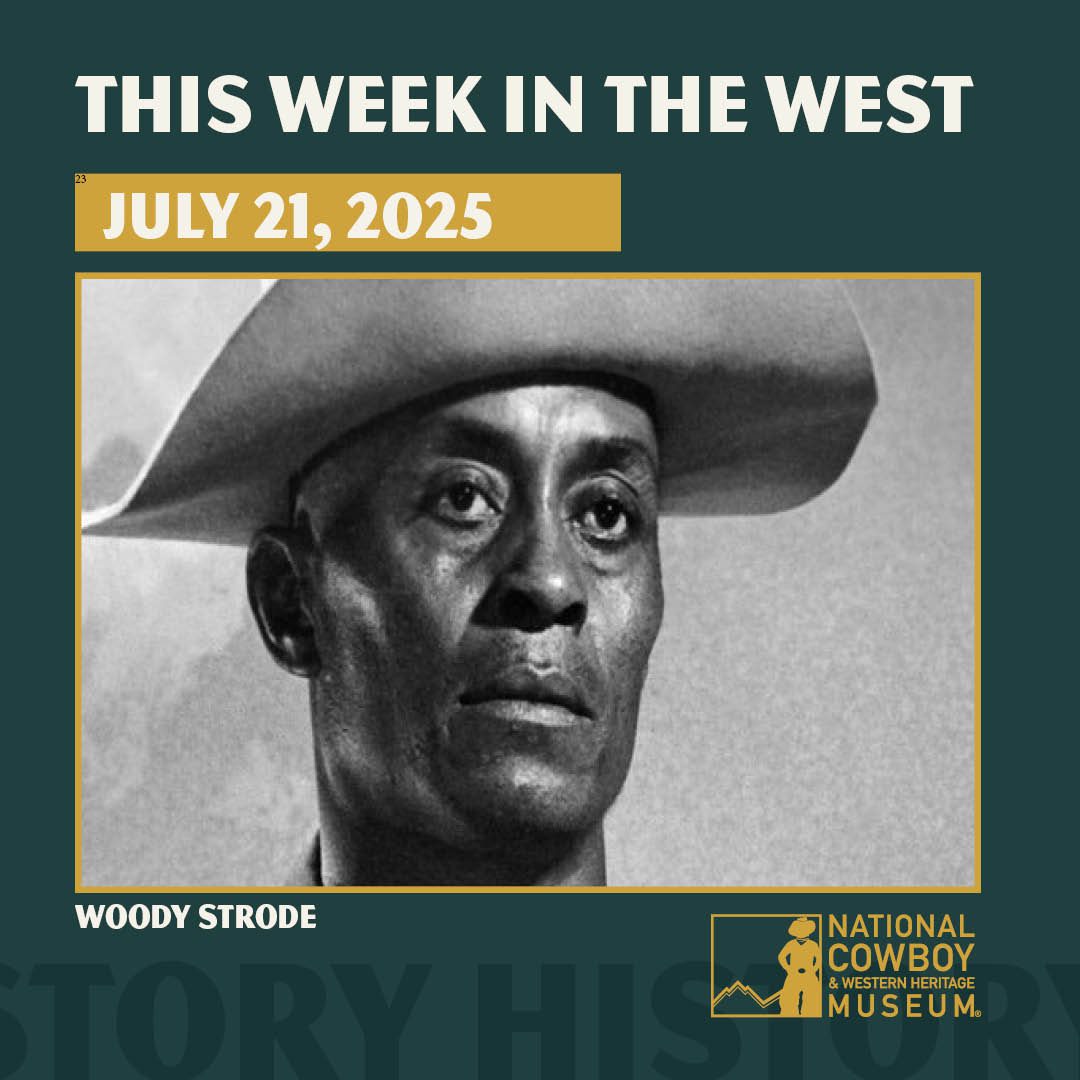
July 21: Woody Strode
Howdy folks, it’s the third week of July, 2025, and welcome to This Week in The West.
I’m Seth Spillman, broadcasting from the National Cowboy & Western Heritage Museum in Oklahoma City.
On this podcast, we share stories of the people and events that shaped the history, art and culture of the American West—and those still shaping it today.
When it came to teammates and compatriots, it would be hard to top Woody Strodes.
In college, he lined up next to Jackie Robinson. In the movies, he was shoulder-to-shoulder with John Wayne. In Ancient Rome, he dueled with Spartacus.
Sports and the movies took Strode just about everywhere, so we remember the member of our Hall of Great Western Performers this week, the anniversary of his birth, July 25, 1914.
Born Woodrow Wilson Woolwine Strode in Los Angeles, he traced his heritage back to African American, Cherokee and Cree ancestors. Throughout his life, Strode repeatedly broke down racial barriers.
He was one of the first African American athletes to play sports at a major college when he suited up for the football team at UCLA in the 1930s.
It was one of the most groundbreaking football teams in college history. Strode played alongside Kenny Washington and Jackie Robinson—yes, that Jackie Robinson. They were known as “the Gold Dust Gang,” three Black players on a powerhouse team that drew national attention in an era when college football was still largely segregated.
Strode also competed in track and field, finishing fourth in the shot put at the NCAA championships and nearly reaching Olympic-level decathlon marks. He even spent a few years as a professional wrestler.
He life continued to intersect with history, in 1936, Strode played semi-pro football for the Hollywood Bears and modeled for artist Hubert Stowitts for a nude portrait to be shown at an art show the 1936 Berlin Olympics—until Nazi authorities shut it down for featuring Black and Jewish athletes.
When the U.S. entered World War II, Strode joined the Army Air Corps, unloading bombs in Guam and playing football for the military.
In 1946, Woody Strode and Kenny Washington signed with the Los Angeles Rams, becoming among the first Black players in the modern NFL after a 13-year ban. Robinson would desegregate Major League Baseball the following year.
But Strode eventually retired from football and was drawn to another activity that was pulling in the spotlight in Southern California: Hollywood.
He’d tried it years earlier, but in the 1950s, Strode built on minor roles that called for imposing and exotic characters. His first major appearance came in Cecil B. DeMille’s The Ten Commandments in 1956, where he was hired as a background actor but ended up playing the King of Ethiopia. Roles in Tarzan films and B-movie adventures followed—sometimes playing African warriors, sometimes gladiators, and often both.
Then came Spartacus in 1960. Cast as the Ethiopian gladiator Draba, Strode faced Kirk Douglas in the arena. His character defeated Spartacus, but instead of killing him, Draba hurls a spear at a Roman commander and is immediately executed. It was a brief yet powerful scene. And it launched Woody into stardom.
That same year, legendary director John Ford cast Strode in Sergeant Rutledge, the first major Western to center on a Black hero. Strode played a Buffalo Soldier falsely accused of rape and murder. Ford insisted on casting him over more famous names, saying, “They’re not tough enough to do what I want Sergeant Rutledge to be.”
Strode would later say that when his character crossed the Pecos River in a heroic cavalry charge, “I carried the whole Black race across that river.”
Ford became a mentor and friend, giving Strode roles in The Man Who Shot Liberty Valance (1962) and Two Rode Together. Their bond ran deep—when Ford’s health declined, Strode stayed by his side for months, sleeping on the floor and caring for him until his death.
Yet even after rising to fame, Hollywood couldn’t always find space for Strode’s talent. He often took roles in European Westerns and action films, playing warriors, outlaws, revolutionaries and anything in between. He once said, “If the money was right, I’d play Mickey Mouse.”
He worked steadily into his seventies, appearing in films such as The Cotton Club, The Black Stallion Returns, and the 1995 Western The Quick and the Dead—released after his death and dedicated to his memory.
In 2021, he was posthumously inducted into our Hall of Great Western Performers here at The Cowboy.
Strode died from lung cancer on December 31, 1994, at age 80.
His legacy lives on in the most unlikely of places. One of the world’s most famous cowboys, Toy Story’s Sheriff Woody is named for Strode.
And with that, we’ll let the credits roll on another episode of This Week in The West.
Our show is produced by Chase Spivey and written by Mike Koehler.
Follow us and rate us on Apple Podcasts or wherever you hear us. That helps us reach more people.
We can follow us on social media and online at nationalcowboymuseum.org.
Got a question or a suggestion? Drop us an email at podcast@thecowboy.org
We leave you today with the words of film critic David Shipman in his obituary of Strode: “Woody Strode was tall of build, bald of pate, with a striking screen presence; had he been born white or later, he might have become a star. Sidney Poitier became the first black actor to achieve screen stardom, while Strode was playing supporting roles. Poitier was comfortable, while there was a quality of menace about Strode – the legacy, perhaps, of his years as a professional wrestler.”
Much obliged for listening, and remember, come Find Your West at the National Cowboy & Western Heritage Museum.