Back to all
Western Heritage Awards

Awarded in 2026
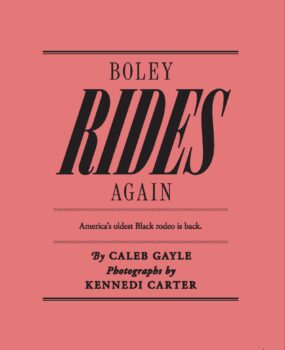
BOLEY RIDES AGAIN: Can the Rodeo Save a Historic Black Town?
Literary, Magazine Article
Author: Caleb Gayle
Magazine: The Atlantic
“BOLEY RIDES AGAIN: Can the Rodeo Save a Historic Black Town?” tells the sweeping and deeply human story of Boley, Oklahoma—once a thriving all-Black town on the Plains—and the people fighting to keep its heritage alive. Through immersive reporting and vivid historical reconstruction, the article follows Karen Ekuban, a determined promoter who attempts to revive the Boley Rodeo, the oldest Black rodeo in America, as a way to preserve the town’s past and imagine its future. Her efforts unfold against a backdrop of boarded-up buildings, dwindling population, and the fading memory of a time when Boley’s promise drew national attention and symbolized Black independence in the West.
Grounded in the broader history of Black migration, self-governance, and landownership in the territories of the American West, the piece traces Boley’s origins in the aftermath of the Civil War, when freed people of the Muscogee (Creek) Nation built a flourishing community anchored by land, autonomy, and shared aspiration. The article explores how Boley and similar Black towns formed a vibrant yet often overlooked chapter of Western settlement—one that challenged prevailing myths about who shaped the frontier and who belonged in its story.
Through narrative scenes set at the 120-year-old Boley Rodeo—its dust, thunder, pageantry, danger, and joy—the article captures the living tradition of Black cowboy culture. It highlights how the rodeo became a social and economic lifeline for Boley, a bridge between generations, and a testament to resilience in the face of rural decline, economic disinvestment, and cultural erasure. When thousands unexpectedly pour into the revitalized event, Ekuban’s team raises more than $270,000, offering a glimpse of what remembrance, community labor, and Western heritage can still make possible.
Ultimately, the story chronicles a counter-tradition within the mythology of the American West: the Black West. It examines how Black cowboys, ranching families, and all-Black towns not only participated in shaping Western identity but expanded it. The article argues that saving places like Boley is not merely an act of nostalgia but an urgent effort to honor and sustain one of the West’s most compelling—and endangered—legacies.
“BOLEY RIDES AGAIN: Can the Rodeo Save a Historic Black Town?” tells the sweeping and deeply human story of Boley, Oklahoma—once a thriving all-Black town on the Plains—and the people fighting to keep its heritage alive. Through immersive reporting and vivid historical reconstruction, the article follows Karen Ekuban, a determined promoter who attempts to revive the Boley Rodeo, the oldest Black rodeo in America, as a way to preserve the town’s past and imagine its future. Her efforts unfold against a backdrop of boarded-up buildings, dwindling population, and the fading memory of a time when Boley’s promise drew national attention and symbolized Black independence in the West.
Grounded in the broader history of Black migration, self-governance, and landownership in the territories of the American West, the piece traces Boley’s origins in the aftermath of the Civil War, when freed people of the Muscogee (Creek) Nation built a flourishing community anchored by land, autonomy, and shared aspiration. The article explores how Boley and similar Black towns formed a vibrant yet often overlooked chapter of Western settlement—one that challenged prevailing myths about who shaped the frontier and who belonged in its story.
Through narrative scenes set at the 120-year-old Boley Rodeo—its dust, thunder, pageantry, danger, and joy—the article captures the living tradition of Black cowboy culture. It highlights how the rodeo became a social and economic lifeline for Boley, a bridge between generations, and a testament to resilience in the face of rural decline, economic disinvestment, and cultural erasure. When thousands unexpectedly pour into the revitalized event, Ekuban’s team raises more than $270,000, offering a glimpse of what remembrance, community labor, and Western heritage can still make possible.
Ultimately, the story chronicles a counter-tradition within the mythology of the American West: the Black West. It examines how Black cowboys, ranching families, and all-Black towns not only participated in shaping Western identity but expanded it. The article argues that saving places like Boley is not merely an act of nostalgia but an urgent effort to honor and sustain one of the West’s most compelling—and endangered—legacies.