
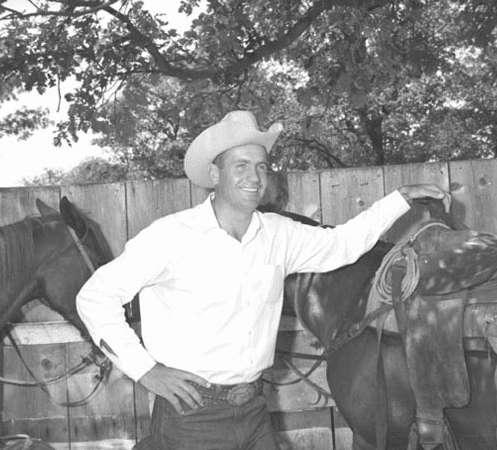
More than six decades after his induction into the National Rodeo Hall of Fame, Dean Oliver is still being recognized as one of the greatest competitors in rodeo history.
Oliver, the Hall of Fame’s oldest living member, recently received the Professional Bull Riders’ Ty Murray Top Hand Award. The award recognizes rodeo athletes whose courage, pride, respect and hard work have made a significant and lasting contribution to the sport.
For Oliver, the honor adds another chapter to a remarkable career that began nearly 80 years ago.
“It’s an honor to receive this award and be in with all the other legends of rodeo,” Oliver said. “It still feels good to have people talking about my accomplishments.”
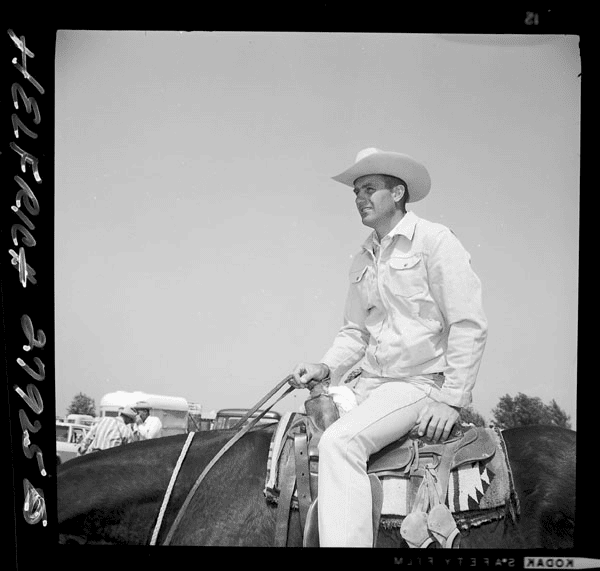
Born Nov. 17, 1929, in Dodge City, Kansas, Oliver grew up around Nampa, Idaho. His interest in rodeo began after watching a tie-down roper win $300 in only a few seconds at an Idaho rodeo. Believing he might be able to make a living the same way, Oliver began practicing on dairy calves and entered competition in 1948.
Success did not come without sacrifice. Oliver and his family sometimes went hungry so they could afford a horse and a single practice calf. After working all day, he practiced his roping at night—sometimes in the dark.
That determination eventually carried him to the top of professional rodeo. Between 1956 and 1969, Oliver won eight world tie-down roping championships, a record later equaled by Roy Cooper. Oliver might have captured a ninth championship had two catch ropes not broken during the 1966 National Finals Rodeo.
He also used his talents as a bulldogger to win three consecutive world all-around championships in 1963, 1964 and 1965. His combination of size, speed and smooth coordination made him one of the defining athletes of his era.
Oliver, however, said he was more focused on earning a living than collecting championships.
“Actually, the reason I went is because I was trying to win money to make a living,” he said. “I wasn’t thinking about the championships. They just happened.”
Life as a professional rodeo cowboy required almost constant travel. Oliver estimated that he spent much of his career covering between 70,000 and 80,000 miles each year.
“Sometimes I would go to two or three rodeos a day,” he recalled. “I remember one time I won seven rodeos in a row in the summertime. Seemed like it wasn’t hard for me to win.”
His family played an essential role in keeping him on the road, particularly his wife, who shared the driving and helped transport his horses. Oliver recalled one occasion when she drove alone from Omaha to New York City while pulling his horse trailer so a horse would be waiting when he arrived by plane.
Oliver’s success was built not only on relentless travel but also on the physical advantages he brought to the arena.
“I think the reason I won as much as I did was because of my size,” he said. “I’m big enough that I could throw a calf good.”
Yet beneath the championships and prize money was a genuine love of competing.
“I enjoyed the competition,” Oliver said. “When I would back in the box to go rope, that was fun—being able to do what I could do.”
Oliver was inducted into the National Rodeo Hall of Fame in 1963 while still in the midst of his championship career. He continued competing into his forties and was still roping and winning in 1979.
Now 97, Oliver can look back on a career that helped establish the standard for generations of tie-down ropers. His latest honor confirms that his influence remains as strong as ever.
“It isn’t an easy job to win calf roping championships,” Oliver said. “You got to get on that road. You got to get in that car and go.”
More than 60 years after entering the National Rodeo Hall of Fame, Dean Oliver remains exactly what the PBR’s award recognizes: a true top hand.
“God bless you all,” he said, “and God bless the sport of rodeo.”