



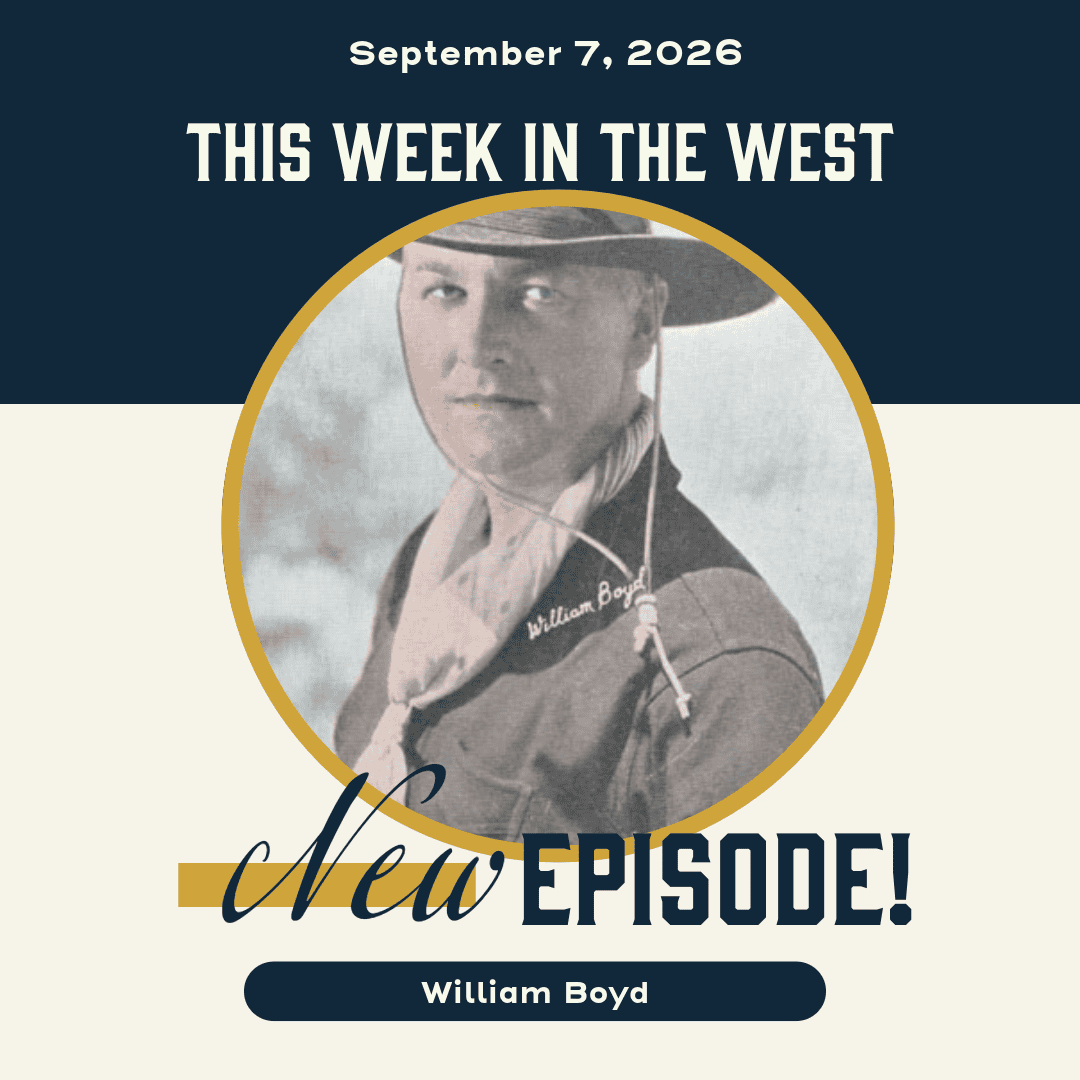
Howdy folks, it’s the second week of September 2026, and welcome to This Week in The West.
I’m Seth Spillman, broadcasting from the National Cowboy & Western Heritage Museum in Oklahoma City.
On this podcast, we share stories of the people and events that shaped the history, art and culture of the American West—and those still shaping it today.
For cowboys in the West, the word “brand” meant one thing for hundreds of years.
It was the mark you put on your cattle to let everyone know you owned them.
That was until the 20th century, when Hopalong Cassidy rode onto the scene.
Today, we remember William Boyd, the man who played Hopalong and helped transform a Western hero into one of America’s first multimedia brands. Boyd died this week, on September 12, 1972.
William Lawrence Boyd was born June 5, 1895, in Hendrysburg, Ohio. His family eventually settled in Tulsa, Oklahoma, where his father, Charles, worked as a laborer.
After his father’s death, Boyd headed West to California, taking any job he could find — picking oranges, surveying land and selling cars.
But he was tall, athletic and handsome and in the early days of Hollywood, that was enough to get him onto a set as an extra.
Boyd didn’t remain in the background for long.
Director Cecil B. DeMille gave him a breakout role in the 1925 film The Road to Yesterday. Bigger roles followed, including The Volga Boatman, The King of Kings and Skyscraper.
By the late 1920s, Boyd had become a genuine matinee idol and was reportedly earning $100,000 a year — an enormous salary at the time.
But his career nearly collapsed because of a newspaper photograph.
It was 1931, and another actor named William “Stage” Boyd was arrested on gambling and liquor charges. A newspaper needed a photo with the story and grabbed one labeled “William Boyd.” But it was the wrong one.
The newspaper corrected the mistake. But for our aspiring hero William Boyd, it was too late.
As he later put it: “The damage was already done.”
His contract with RKO ended, work became difficult to find, and the former matinee idol found himself nearly broke. For a time, he even began appearing professionally as “Bill Boyd” simply to separate himself from the other actor.
Then came 1935.
Boyd was offered a supporting role in a new Western called Hop-Along Cassidy, based on a character created by author Clarence E. Mulford. Boyd pushed to get the title role instead. Eventually, he did, and the job changed his life.
There was just one thing. The Hopalong Cassidy of Mulford’s stories had been a rougher character: a hard-drinking, redheaded cowboy.
Boyd’s portrayal turned the character on its head. His Hopalong dressed almost entirely in black, but he was unmistakably the good guy.
Hoppy, as he became known, didn’t smoke. He didn’t swear. He didn’t drink alcohol. He preferred sarsaparilla. And he generally allowed the bad guy to throw the first punch.
Audiences were smitten.
Beginning in 1935, Boyd appeared as Hopalong Cassidy in 66 feature films. Though considered “B pictures”, the Hopalong movies were often better produced than the typical low-budget Western of the era, with impressive outdoor photography and recognizable supporting actors. The series became popular enough that theaters that normally ignored Westerns began booking Hoppy’s adventures.
By the 1940s, however, the original film series was winding down.
Producer Harry Sherman, who had launched the series and produced most of its films, stopped making Hopalong Cassidy pictures. Boyd refused to let Hoppy disappear.
So he made a savvy business move decades ahead of its time.
Boyd ultimately spent a reported $350,000 acquiring the rights he needed to control the Hopalong Cassidy films and character. To raise the money, he sold or mortgaged almost everything he owned.
It looked like an enormous risk. But Boyd had noticed something new appearing in American living rooms: Television.
He began offering the old Hopalong Cassidy films to the new medium of television, where they quickly found an audience.
Viewers loved them and by 1949, NBC was airing the films nationally.
Soon, Boyd’s library of Hopalong Cassidy movies was reaching viewers across the country, and a character many in Hollywood considered finished suddenly had an enormous new audience.
Kids loved Hoppy and by 1950, Hopalong Cassidy was more than a character.
He was the face of a brand and that brand began showing up everywhere.
There were Hoppy watches, cups, dishes, trading cards, comic books, cowboy outfits and a radio program. The Western Performers Gallery here at The Cowboy boasts a Hopalong wallet, sweater and tie, badges and trading cards from Post Cereal boxes, as well as books and posters from Hopalong films.
Boyd became one of America’s first national television stars and became protective of his brand.
Boyd and Hopalong were inseparable. He frequently appeared in public dressed as Hoppy. He refused to license the character for products he considered dangerous or inappropriate for children. He even declined personal appearances when children would have been required to pay admission.
Boyd also donated some of his profits to children’s hospitals and homes
For millions of young Americans, Hopalong Cassidy wasn’t simply a cowboy on television. He was the ultimate good guy, on and off screen.
Boyd’s identification with Hoppy became so complete that it even limited his acting career. His old mentor Cecil B. DeMille reportedly considered Boyd for the role of Moses in his 1956 remake of The Ten Commandments.
Boyd declined, believing audiences would never look at him and see Moses—they would see Hopalong.
Boyd eventually retired and lived his later years largely away from the spotlight with his wife, actress Grace Bradley, whom he had married in 1937.
He died September 12, 1972.
William Boyd was inducted into the Hall of Great Western Performers here at the National Cowboy & Western Heritage Museum in 1995.
And his legacy isn’t just as an actor. Boyd was also a marketer and merchandiser who glimpsed a future built on television, licensing, image rights and a whole different meaning of the word “brand.”
And with that, we’ve hopped right along through another episode of “This Week in the West.”
Our show is produced by Chase Spivey and written by Mike Koehler.
Follow us and rate us on Apple Podcasts or wherever you hear us. That helps us reach more people.
Come visit us in Oklahoma City! You can now buy tickets online at thecowboy.org/tickets
Got a question or a suggestion? Drop us an email at podcast@thecowboy.org
We leave you today with the words of William Boyd himself: “I’ve tried to make Hoppy a plain and simple man in manners and dress. Hoppy isn’t a flashy character. He isn’t illiterate. Nor is he smart-alecky. He doesn’t use big words or bad words. After all, I felt that Hoppy might be looked up to and that children might try to pattern their lives after the man. If Hoppy said ‘ain’t’ and ‘reckon’ and that-away’, all the kids might start saying the same things.”
Much obliged for listening, and remember, come Find Your West at the National Cowboy & Western Heritage Museum.