




Howdy folks, it’s the second week of October 2026, and welcome to This Week in The West.
I’m Seth Spillman, broadcasting from the National Cowboy & Western Heritage Museum in Oklahoma City.
On this podcast, we share stories of the people and events that shaped the history, art and culture of the American West—and those still shaping it today.
The American West had produced its share of presidents:
Ronald Reagan, Richard Nixon and Herbert Hoover from California; the Bushes from Texas; and then there was the man raised at the cattle-drive trailhead in Abilene, Kansas.
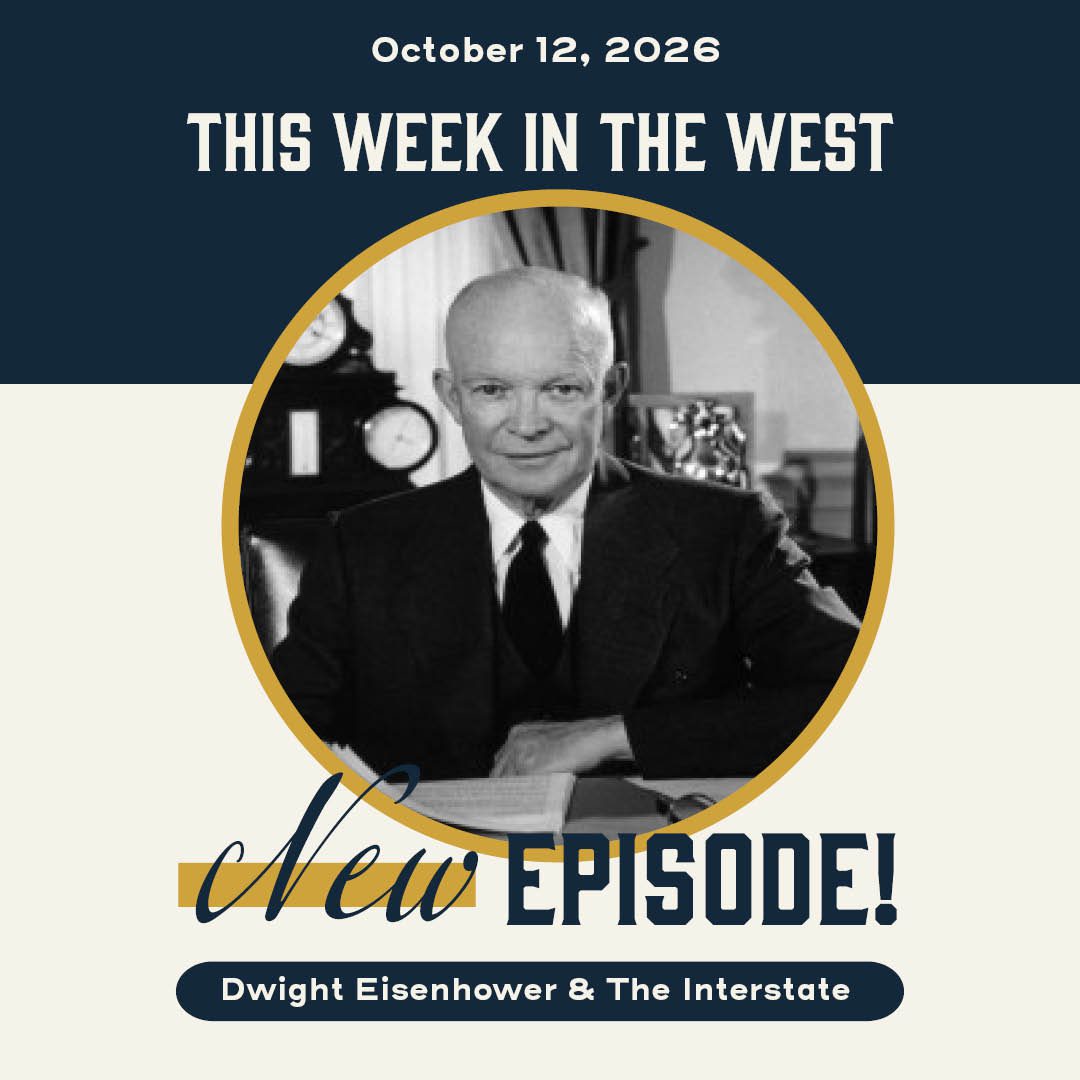
Today we remember Dwight David Eisenhower, born this week, October 14, 1890, and his lasting impact on keeping the Nation free and keeping the West connected with the rest of the country.
Born in Denison, Texas, Eisenhower grew up in Abilene after his family moved there in 1892. Abilene was a destination for drovers bringing herds along the Chisholm Trail.
The great cattle-town years were over by the time Eisenhower arrived. His boyhood belonged to a quieter Abilene, but his ambitions lay in the military. His career almost took a different direction. The Naval Academy was his first choice, but he was too old to qualify. Instead, he entered West Point in 1911 and graduated in 1915.
His first assignment brought him back to Texas, to Fort Sam Houston. In 1916, he married Mamie Doud.
During World War I, Eisenhower trained soldiers in the United States. He did not lead troops into battle in France. His early career involved logistics, drills and less-than-glamorous assignments. One such deployment came in 1919, when Eisenhower was part of a convoy of trucks tasked with crossing the country.
His expedition included 81 motorized Army vehicles and covered 3,251 miles from Washington, D.C., to San Francisco. Eisenhower accompanied the convoy as an observer.
But in 1919, there was no easy nationwide route. The roads that did exist were sometimes just old wagon-wheel ruts. They’d turn to mud when it rained, and the trucks would get stuck. Bridges weren’t up to the standards needed for automobiles to cross. Eisenhower’s cross-country trip took two months.
Eisenhower wouldn’t forget it.
While serving in Panama during the 1920s, Eisenhower found a mentor in General Fox Conner, who encouraged him to study history, military science and philosophy. Eisenhower later graduated first in a class of 245 officers at the Army’s Command and General Staff School at Fort Leavenworth.
Everything he was learning began to fit together into a full set of leadership skills, especially as the country was thrust into another World War.
Eisenhower led Allied operations in North Africa before being tasked with the greatest assignment in military history: directing the Allies’ invasion of Normandy.
His job required more than military planning. He had to hold together a coalition of nations and commanders, each with its own priorities and strong personalities. Supplies, ships, aircraft, troops and timing had to serve a common purpose.
On June 6, 1944, in the largest operation ever undertaken, the Allies landed in Normandy.
Before the invasion, Eisenhower had prepared a brief message in case it failed. He praised the troops and accepted responsibility for the decision to attack. Its final sentence read: “If any blame or fault attaches to the attempt it is mine alone.”
The message was never needed. But it showed Eisenhower, nicknamed “Ike,” understood that command included accountability.
After the war, Eisenhower served as Army chief of staff, president of Columbia University and NATO’s first Supreme Allied Commander Europe. In 1952, he won the presidency. He took office the following January and served two terms.
His administration faced the Cold War, the threat of nuclear conflict and the struggle over civil rights. An armistice ended organized fighting in Korea in July 1953. In 1957, he sent federal troops to Little Rock, Arkansas, to enforce school desegregation and protect nine Black students.
When he left office in 1961, the former general warned Americans about the growing influence of the military-industrial complex.
But his most visible legacy in the States was the answer to his two-month struggle to move across the country as a young man.
That 1919 trip had exposed the difference between a road drawn on a map and a road capable of carrying heavy traffic. During World War II, Eisenhower saw Germany’s autobahns and recognized the advantages of a modern highway network. His experiences at home and abroad strengthened his conviction that America needed better roads.
He did not invent the interstate highway idea. Federal planning had begun before his presidency, and Congress had authorized a national interstate system in 1944. Eisenhower’s decisive contribution was helping secure the commitment and financing to build it.
On June 29, 1956, he signed the Federal-Aid Highway Act. The legislation accelerated interstate construction, with the federal government generally paying 90 percent of the cost.
For the West, the implications were enormous.
Long distances had always shaped Western life. The interstate system made those distances easier and more predictable to cross. It may have dimmed the quaint nostalgia for roadside attractions like those on Route 66, but it improved connections between producers and markets and helped travelers reach places that once required a much harder journey.
The family road trip gained a new rhythm: entrance ramp, highway miles, exit sign. Mountains and deserts remained, but the roads crossing them changed the experience of traveling through the region. The roads that connected distant places could also leave familiar places behind.
That tension belongs in the story of the modern West. New routes create opportunity, but they also change where people gather, work and spend their money.
Eisenhower’s highways continued a long history of connections across the region: trails, cattle drives, railroads and highways.
After his presidency, Eisenhower settled with his wife, Mamie, at their farm near the Gettysburg battlefield in Pennsylvania. There he was again a full man of West: retirement gave him more time to raise Angus cattle, paint, enjoy friends and spend winters in California.
In 1964, he returned to Normandy to help film a documentary marking the twentieth anniversary of D-Day, revisiting the shores where his leadership had helped change the course of history.
Eisenhower died on March 28, 1969, at age 78. Following funeral ceremonies in Washington and a journey home by train, he was buried on April 2 at his presidential library in Abilene, Kansas. At his request, he wore his World War II uniform and rested in a standard Army casket—a final expression of his enduring identity as a soldier.
And with that, we’ve pulled into another exit on an episode of “This Week in the West.”
Our show is produced by Chase Spivey and written by Mike Koehler.
Follow us and rate us on Apple Podcasts or wherever you hear us. That helps us reach more people.
Come visit us in Oklahoma City! You can now buy tickets online at thecowboy.org-slash-tickets
Got a question or a suggestion? Drop us an email at podcast@thecowboy.org:
We leave you today with the words of Eisenhower himself: “…We have had a group of the ablest and most loyal men I know in America, and people who realize this one great truth: in the operation of any great human organism, constructive plans and programs must be developed in what we call the great middle road. I always liken, in my own mind, the people marching forward into tomorrow as occupying a great road. Most of them instinctively grow to like the broad highway stretching before them, and they understand here is where human progress is achieved.”