


Howdy folks, it’s the first full week of October 2026, and welcome to This Week in The West.
I’m Seth Spillman, broadcasting from the National Cowboy & Western Heritage Museum in Oklahoma City.
On this podcast, we share stories of the people and events that shaped the history, art and culture of the American West—and those still shaping it today.
You can just imagine everyone holding their breath.
It was a summer day here at The Cowboy, and it was time to move End of the Trail, James Earle Fraser’s massive 17-foot-tall sculpture.
Sure, it was only a few yards from one spot at our museum to another. But it was a piece of art that had nearly turned to dust decades earlier, so this was a delicate operation on a vulnerable object.
A crowd gathered to watch. The sculpture was wrapped in a steel cage and attached to a crane.
And then, it was just dangling there.
More than 7000 pounds of plaster, 65 feet above the ground, the definition of fragile.
Pause the story right there. As they say in the movies, “You might be wondering how we got into this predicament.”
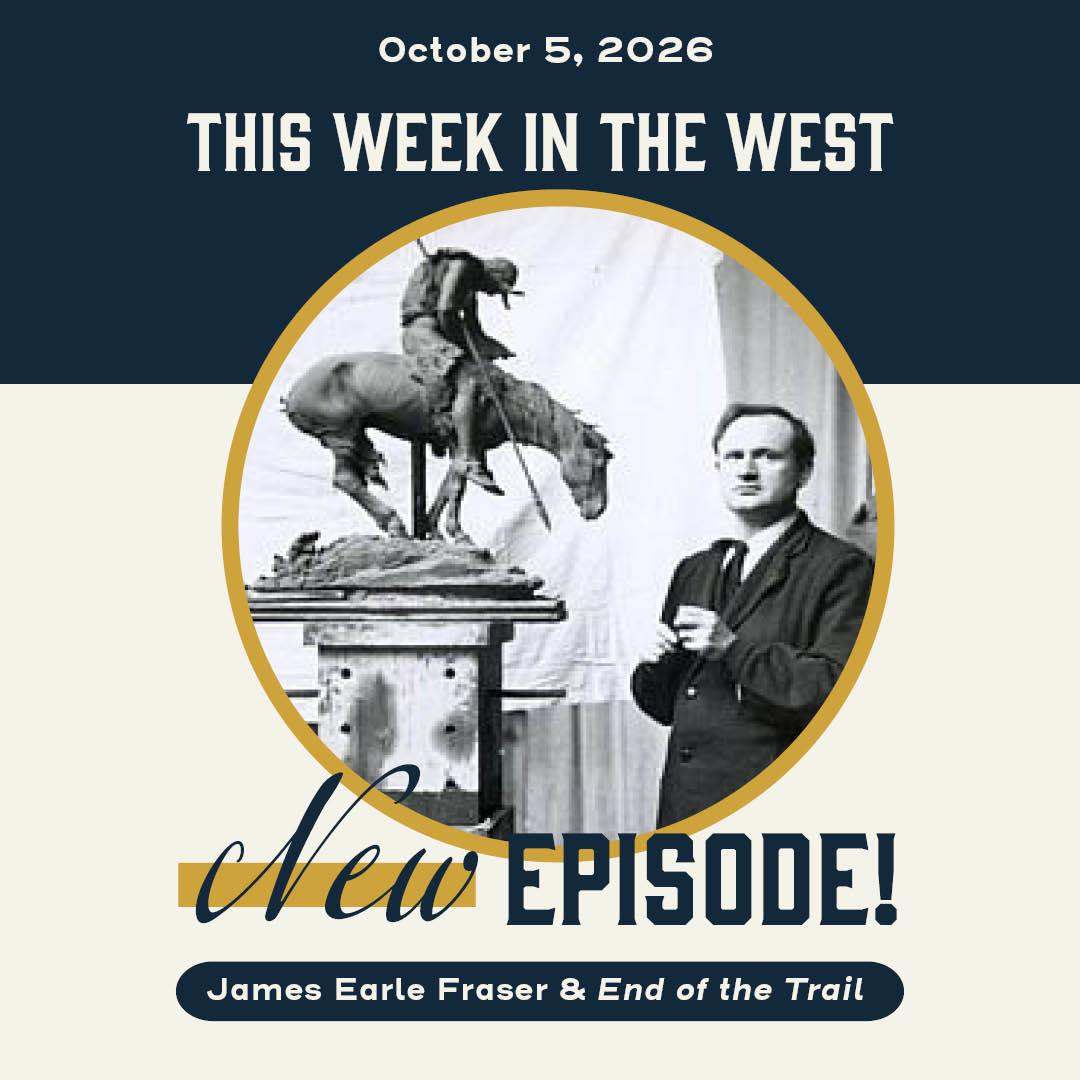
That’s the tale we tell today: Fraser, his career as an artist, and the iconic work that is a centerpiece of our collection of Western works here at The Cowboy. This episode comes on the anniversary week of Fraser’s death, October 11, 1953.
Fraser was born in Minnesota in 1876 and spent much of his childhood near Mitchell, in what became South Dakota. His father worked for railroads expanding across the West. As a boy, Fraser saw a region changing rapidly, including the displacement of Native people.
When he was young, Fraser carved pieces of limestone he found near home. He later studied at the Art Institute of Chicago and traveled to Paris to continue his training. He worked with Augustus Saint-Gaudens, one of the leading American sculptors of the day.
It wasn’t very long before the idea of End of the Trail took root in his mind.
After seeing depictions of Native Americans at Chicago’s 1893 World’s Columbian Exposition, he made an early version of End of the Trail in 1894. He kept revisiting the composition, working toward the much larger sculpture visitors know today.
Fraser wanted to express how westward expansion affected Native peoples. He imagined a rider pushed to the edge of the continent. That was the meaning he gave the title: End of the Trail.
In 1915, the monumental plaster version of End of the Trail had its first home: The Panama-Pacific International Exposition in San Francisco. It won a gold medal and attracted enormous attention. Images circulated far beyond the fairgrounds. Before long, people across the country recognized its silhouette.
Fraser went on to do other work, including designing the Buffalo nickel and figures at the United States Supreme Court. His wife, Laura Gardin Fraser, was an accomplished sculptor and medalist in her own right.
But the celebrated plaster sculpture nearly disappeared.
After the San Francisco Exposition closed, Fraser hoped to see End of the Trail cast in bronze. But World War I made bronze scarce, so those plans were scrapped. The sculpture, along with other works from the Exposition were discarded in a pit.
The Tulare County Forestry Board purchased and rescued the statue in 1919, transporting it to Mooney Grove Park in Visalia, California. Fraser was unaware of the statue’s location until 1922.
But the outdoor park setting didn’t do the sculpture any favors. It stood for decades, exposed to sun, rain and changing seasons. Its plaster surface was painted over several times, but that did little to stop cracks from developing.
Our museum had first been interested in acquiring a sculpture of the Oklahoma Land Run by Fraser’s wife, but after her death, the couple’s entire studio collection became available.
It had initially been willed to Syracuse University, soon after the college approached the museum to see if any interest remained in having the Frasers’ work.
Indeed it did. The Museum secured the Frasers’ studio, casts, molds and other pieces in 1968. But End of the Trail was still in Visalia. The Cowboy put up $25,000 and promised a bronze casting to replace the original, and a deal was struck.
Then came the challenge of getting the plaster masterpiece from California to Oklahoma City.
The trip was rough. The sculpture was divided into pieces and packed into crates. A few days into the journey, the trucking company told the Museum, according to Bobby Weaver’s book on our history, quote, “transport jolting was causing the statue to disintegrate.” Museum curators got three tons of sawdust from a sawmill to pack around the statue for the rest of the trip, and they put small broken pieces into a bucket.
Once in Oklahoma, the original plaster sculpture underwent restoration by Leonard McMurray, who reconstructed its face, chest and torso.
But then came the question of where to put it. There was only one spot in the existing museum with ceilings high enough, so it was decided an entirely new building would be built for End of the Trail and the Fraser collection. In December 1970, it was dedicated.
In 1994, renovations at The Cowboy created a new home for the sculpture, front-and-center in our lobby, pride of place on a museum undergoing a renaissance.
On June 21, 1994, more than a thousand spectators jostled for a spot to watch the sculpture’s move. It was put inside its steel cage, lifted by a crane and swung toward the new entrance area. It was set down on a forklift, which eased it into place. According to Weaver’s book, it was a tight opening with only a few inches to spare.
That move was just one chapter in the long story of End of the Trail, which has become a worldwide icon. It appeared on postcards, prints, belt buckles and countless other objects.
We see it every day, but there’s something about the moments of awe we witness when a new guest walks through our doors and gets their first glimpse at the plaster giant.
As with any great piece of art under our roof, its meaning is left to the mind and heart of the viewer.
Native artist Jeffrey Gibson has described his own changing response to End of the Trail. As a child, he saw an image of defeat and wondered whether others viewed Native people that way. Later, after seeing the image used at powwows to honor veterans and prisoners of war, he came to see another possibility: a warrior resting before rising again.
And with that, we’ve transported and unpacked another episode of “This Week in the West.”
Our show is produced by Chase Spivey and written by Mike Koehler.
Follow us and rate us on Apple Podcasts or wherever you hear us. That helps us reach more people.
Come visit us in Oklahoma City! You can now buy tickets online at thecowboy.org-slash-tickets
Got a question or a suggestion? Drop us an email at podcast@thecowboy.org
We leave you today with the words of James Earle Fraser, reflecting on his other signature work, the Buffalo Nickel: “When I was asked to do a nickel, I felt I wanted to do something totally Am”erican—a coin that could not be mistaken for any other country’s coin. It occurred to me that the buffalo, as part of our western background, was 100 percent American, and that our North American Indian fitted into the picture perfectly.”
Much obliged for listening, and remember, come Find Your West at the National Cowboy & Western Heritage Museum.