

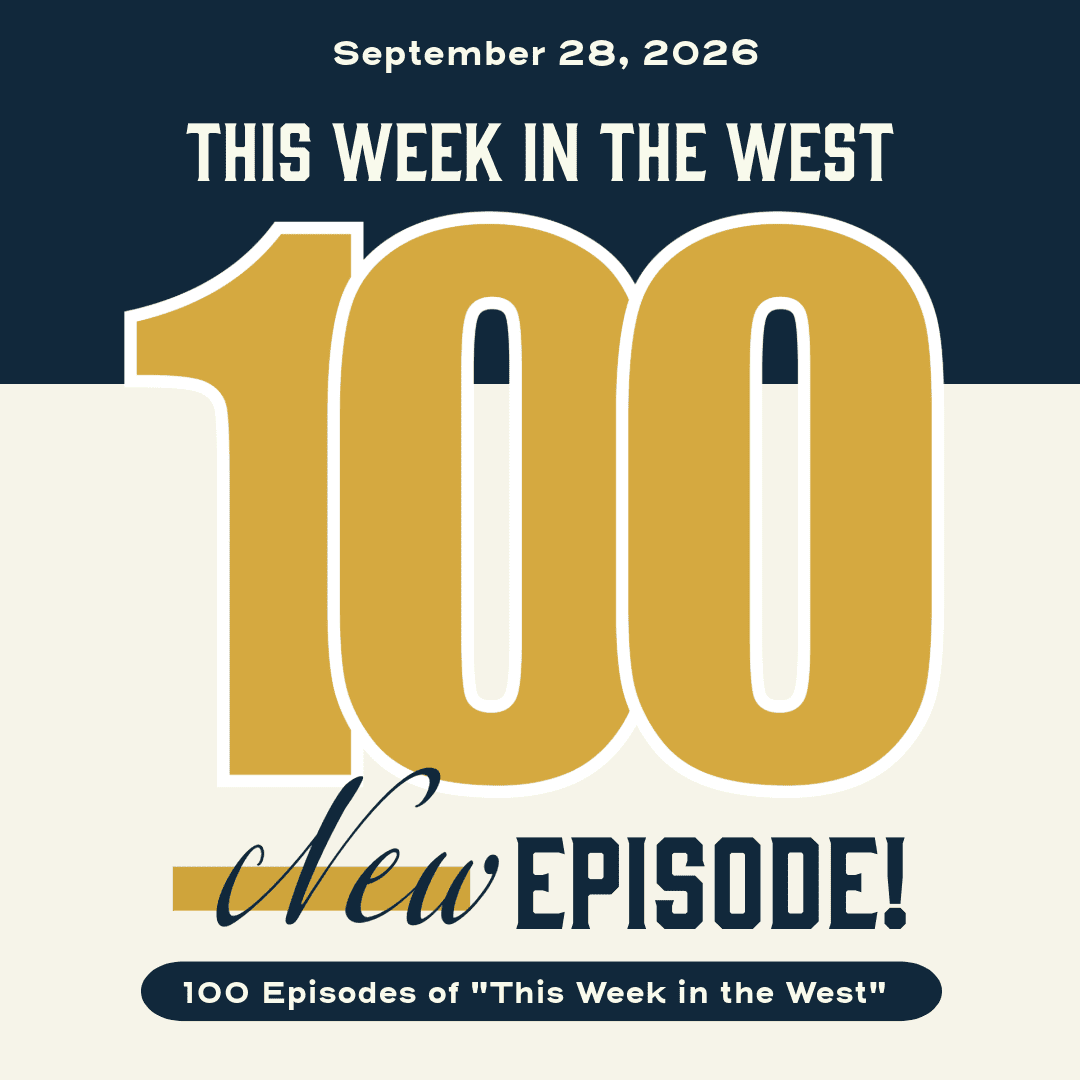
Howdy folks, it’s the 28th of September 2026, and welcome to the 100th episode of This Week in The West.
I’m Seth Spillman, broadcasting from the National Cowboy & Western Heritage Museum in Oklahoma City.
Like any great journey into the American West, when we set out to make this podcast, we knew where we were going, but we didn’t know all the discoveries that lay ahead.
The goal on our horizon? Crack open more than 70 years of our Museum’s history and celebrate the subject matter we preserve and share. Like we say every week: We share stories of the people and events that shaped the history, art and culture of the American West—and those still shaping it today.
So what have we learned?
Well, the first lesson came pretty quick, on our very first episode: Oklahoma’s favorite son, Will Rogers, has said a lot of interesting and quotable remarks. But not everything attributed to Will in the history books and on the Internet was truly said by him, as confirmed by our friends at the Will Rogers Memorial Museum. That was duly noted and helped us to dive even deeper into trusted sources, many of them right here in our Dickinson Research Center.
Another lesson was much more visceral: Life in the West, especially in the 18th, 19th and early 20th centuries, was tough. Just surviving was a challenge worth celebrating.
Author Mari Sandoz was a child when she permanently lost vision in one eye to snow blindness after spending a day digging her family’s cattle out of a snowdrift.
Naturalist John Muir was working in a factory when he pierced his right cornea. His left eye then sank into “sympathetic” blindness.
Cotton Rosser, a burgeoning rodeo star, broke both of his legs in a horrible post hole auger accident. And no one ever wants to hear the phrase “horrible post hole auger accident.”
But what’s amazing about these tales is what happened next. Mari Sandoz became an acclaimed Western author, telling the stories of her family’s roots in the Great Plains and later earning induction into our Hall of Great Westerners.
Muir left factory life and headed West, becoming one of the nation’s most influential advocates for preserving its natural beauty and helping build the conservation movement that shaped America’s national parks.
And Rosser left rodeo competition behind but transformed the sport forever as a promoter, producer and member of our National Rodeo Hall of Fame.
Now, of course, we could spend the whole rest of this episode recounting all the rodeo cowboys and cowgirls who overcame the hardships of injuries – Tad Lucas’ crushed arm, Jim Shoulders’ concussions and Casey Tibbs, who was told by doctors to stay in bed in the hospital for six weeks, but escaped after nine days.
Rodeo, especially in its early years, is a whole different world, but one we can’t get enough of here at The Cowboy.
We shared the stories of Hollywood stars – like Roy Rogers and Gene Autry – and the lesser-known performers like stuntman Yakima Canutt and Broncho Billy Anderson, who was part of “The Great Train Robbery,” the landmark 1903 film that helped establish the Western as a movie genre.
We told the story of another Hollywood cowboy, Audie Murphy, who gained fame as a decorated hero of World War II before returning to his Texas roots to become a bona fide Western star.
Murphy had a hard time adjusting to civilian and celebrity life and died tragically in a plane crash. He wasn’t the only one of our stories that ended too abruptly. We also shared stories about Western art legend Frederic Remington, who passed at age 48 and the death of bull rider Lane Frost, who died at 25.
But that’s our job as a Museum, to be a good steward of the stories, good and bad, tragic and triumphant. We’re privileged to be able to walk our halls and see Remington masterpieces and mementos of Frost’s epic battles in the rodeo arena.
All that’s housed here at The Cowboy – the National Rodeo Hall of Fame, PBR’s Heroes & Legends, the Hall of Great Western Performers, the Hall of Great Westerners – gives us fertile ground from which to grow this podcast.
From the stories we’ve uncovered, we have seen how the American West touches the world, capturing the attention of German Duke Paul Wilhelm of Württemberg, sparking the love story of Texas Jack Omohundro and Italian ballerina Giuseppina Morlacchi and drawing in immigrant artists like Albert Bierstadt, Karl Bodmer and Olaf Wieghorst, who came to America knowing just three words of English and died a master of Western Art.
We’ve been able to shine a light on the stories of Native peoples, dispelling myths surrounding Sacagawea, celebrating the rodeo heroics of Jackson Sundown, inspiration for our Museum logo, and remembering the struggles and perseverance of last week’s podcast subject, Chief Joseph.
And we’ve even discovered the compelling histories of the objects of the American West, like Arbuckle’s coffee, barbed wire and the winding roads of Route 66.
Over these 100 episodes, we’ve also attempted to pack as much Western wisdom as we can into the five or six minutes you give us every Monday. Luckily, writers like Louis L’Amour and poets like Badger Clark have carried some of the load for us, making those words sound just right so far, and hopefully, far into the future.
As Badger Clark wrote in “The Cowboy’s Prayer:”
“Just keep an eye on all that’s done and said
And right me, sometimes, when I turn aside,
And guide me on the long, dim trail ahead
That stretches upward toward the Great Divide.”
In 1955, the dream that became the National Cowboy & Western Heritage Museum was born.
In the years since, we’ve become known as “The Cowboy” to our friends, which now includes you, the thousands of listeners who tune into this podcast.
Thanks for being a part of this ride through the sometimes rocky, occasionally ridiculous, but always compelling world of the Western frontier. We couldn’t have done it without you.
And with that, we’ve reached the century mark on episodes of “This Week in The West.”
Our show is produced by Chase Spivey and written by Mike Koehler.
Follow us and rate us on Apple Podcasts or wherever you hear us. That helps us reach more people.
Come visit us in Oklahoma City! You can buy tickets online at thecowboy.org/tickets
Got a question or a suggestion? Drop us an email at podcast@thecowboy.org
We leave you today with the words of the great Western writer and Pulitzer Prize winner Wallace Stegner: “One cannot be pessimistic about the West. This is the native home of hope. When it fully learns that cooperation, not rugged individualism, is the quality that most characterizes and preserves it, then it will have achieved itself and outlived its origins. Then it has a chance to create a society to match its scenery.”
Much obliged for listening, and remember, come Find Your West at the National Cowboy & Western Heritage Museum.