





Howdy folks, it’s the third week of September 2026, and welcome to This Week in The West.
I’m Seth Spillman, broadcasting from the National Cowboy & Western Heritage Museum in Oklahoma City.
On this podcast, we share stories of the people and events that shaped the history, art and culture of the American West—and those still shaping it today.
In the summer of 1877, hundreds of men, women and children began an extraordinary journey across the American West.
Ahead of them lay mountains, rivers, hostile territory and, they hoped, safety in Canada. Behind them came the United States Army.
Over the next several months, the Nez Perce tribe would travel more than a thousand miles, fighting a series of battles against pursuing soldiers while attempting to protect their families and their way of life.
And when that journey finally ended, just a short distance from the Canadian border, one man would emerge as the public face of their struggle.
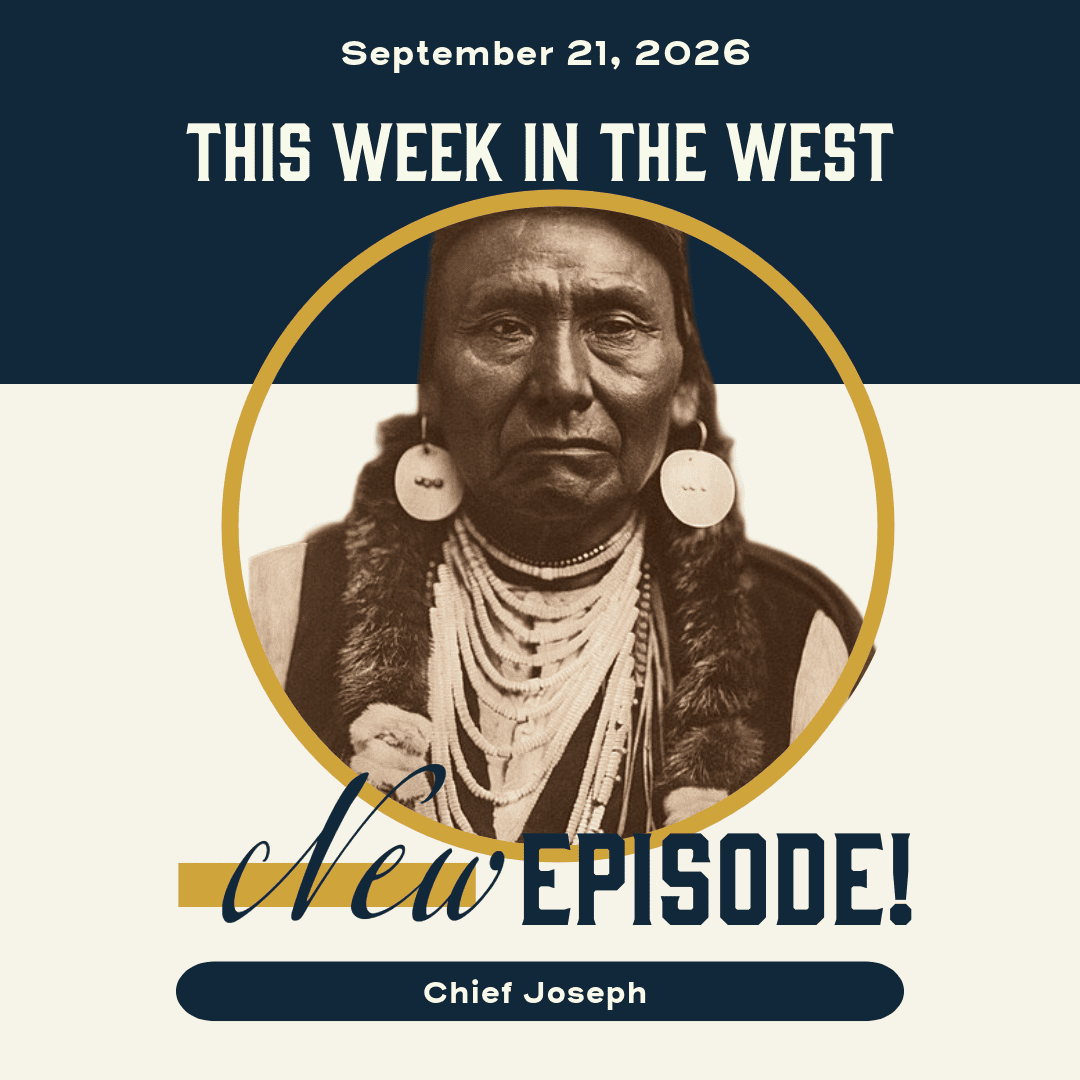
His name was Chief Joseph.
We remember him this week on the anniversary of his death on September 21, 1904.
He was born in 1840 in the Wallowa Valley of northeastern Oregon, where his people had lived for generations.
His Nez Perce name is often translated as “Thunder Rolling Down the Mountain.”
Joseph took his name from his father, a leader of the Wallowa band who had been baptized by Christian missionaries and given the name Joseph. His son therefore became known as Young Joseph.
In 1855, Joseph’s father was among the Nez Perce leaders who signed a treaty establishing a reservation that included millions of acres across what is now Oregon, Washington and Idaho — including their beloved Wallowa Valley.
Then everything changed – gold had been discovered.
Miners and settlers poured into the region, and in 1863, the federal government proposed a dramatically smaller reservation centered in Idaho.
Joseph’s father refused to sign a treaty creating the new reservation.
The result divided the Nez Perce between those who accepted the new plan and those, including the Wallowa band, who insisted they had never surrendered their homeland.
Before he died in 1871, the elder Joseph reportedly reminded his son never to forget that.
Young Joseph inherited leadership of the band and spent the next several years attempting to keep both his land and the peace.
Joseph was primarily a political leader for his tribe, not yet the warrior he is often portrayed as. He repeatedly argued against violence and tried to negotiate a peaceful solution with the government.
By 1877, however, the United States had decided the remaining non-treaty Nez Perce would have to move onto the Idaho reservation.
General Oliver O. Howard gave them 30 days.
Joseph reluctantly agreed.
He later explained that rather than begin a war, he was willing to give up his country — even his father’s grave.
But before the relocation could be completed, several young Nez Perce men attacked white settlers in retaliation for earlier violence.
Like it or not, war had begun.
Joseph and several other Nez Perce leaders concluded that their people had to leave.
What followed became one of the most remarkable episodes in the history of the American West.
Around 800 Nez Perce — most of them women, children and elderly people — began moving through Idaho and across the Bitterroot Mountains into Montana.
They were accompanied by thousands of horses.
Leaders such as Looking Glass, White Bird and Joseph’s brother Ollokot directed the fight against the U.S. Army. At the same time, Joseph acted as a camp leader, helping organize the movement of families, supplies and animals while trying to keep his people together.
Again and again, the Nez Perce managed to elude or defeat the soldiers pursuing them.
At White Bird Canyon, Nez Perce warriors routed an attacking Army force. They crossed the rugged Lolo Trail through terrain that proved difficult for soldiers chasing them.
In August 1877, came the Battle of the Big Hole in Montana.
Army troops surprised a Nez Perce camp in the early morning and fired into the lodges.
Dozens of Nez Perce were killed, many of them women and children.
The Nez Perce changed their plans: They would flee to Canada. So they continued east, crossed through what is now Yellowstone National Park and turned north.
Sitting Bull and other Lakota had already crossed the border following the Great Sioux War. Perhaps the Nez Perce could find refuge there, too.
By late September, they were exhausted, and winter was quickly approaching.
Still, Canada was astonishingly close. The Nez Perce reached the Bear Paw Mountains of Montana, only about 40 miles from the border.
Then Colonel Nelson Miles and his troops caught them. For five brutal days, the Nez Perce endured fighting, cold and hunger.
Looking Glass was killed. Joseph’s brother Ollokot was dead. Hundreds remained trapped, surrounded by troops.
Finally, on October 5, 1877, Joseph surrendered.
The words attributed to him became some of the most famous in the history of the American West: “My heart is sick and sad. From where the sun now stands, I will fight no more forever.”
Debate continues over the exact wording. Joseph did not speak English, so an interpreter relayed his words before they were recorded.
He surrendered believing the Nez Perce would be allowed to return to Idaho. That promise was not kept.
Instead, Joseph and hundreds of his followers were transported first to Kansas and eventually to Indian Territory in present-day Oklahoma.
Joseph continued pleading with federal officials.
He traveled to Washington, D.C., met President Rutherford B. Hayes and became nationally famous. Newspapers portrayed him as a brilliant military commander, even calling him the “Red Napoleon.”
In 1885, Joseph and some of his followers were finally permitted to return to the Pacific Northwest, but not to the Wallowa Valley.
Joseph was sent instead to the Colville Reservation in Washington, more than a hundred miles from his homeland.
For the rest of his life, he continued asking for the right to return. He even returned to the Wallowa Valley in 1900 and appealed directly to the settlers now occupying the land.
Nothing changed.
On September 21, 1904, Chief Joseph died near Nespelem, Washington.
And with that, we’re finished with the journey of another episode of “This Week in the West.”
Our show is produced by Chase Spivey and written by Mike Koehler.
Follow us and rate us on Apple Podcasts or wherever you hear us. That helps us reach more people.
Come visit us in Oklahoma City! You can now buy tickets online at thecowboy.org/tickets
Got a question or a suggestion? Drop us an email at podcast@thecowboy.org
We leave you today with the words of Chief Joseph from his book An Indian’s View of Indian Affairs: “You might as well expect the rivers to run backward as that any man who was born a free man should be contented when penned up and denied liberty to go where he pleases.”
Much obliged for listening, and remember, come Find Your West at the National Cowboy & Western Heritage Museum.