


Howdy folks, it’s the first week of November 2026, and welcome to This Week in The West.
I’m Seth Spillman, broadcasting from the National Cowboy & Western Heritage Museum in Oklahoma City.
On this podcast, we share stories of the people and events that shaped the history, art and culture of the American
West—and those still shaping it today.
Walk into one of our galleries, and you’ll spot a coin in a display case. About the size of a quarter, it’s a 19th-century English half-penny with a noticeable dent.
Now imagine the skill it took to spot it flying through the air and knock it down with a bullet.
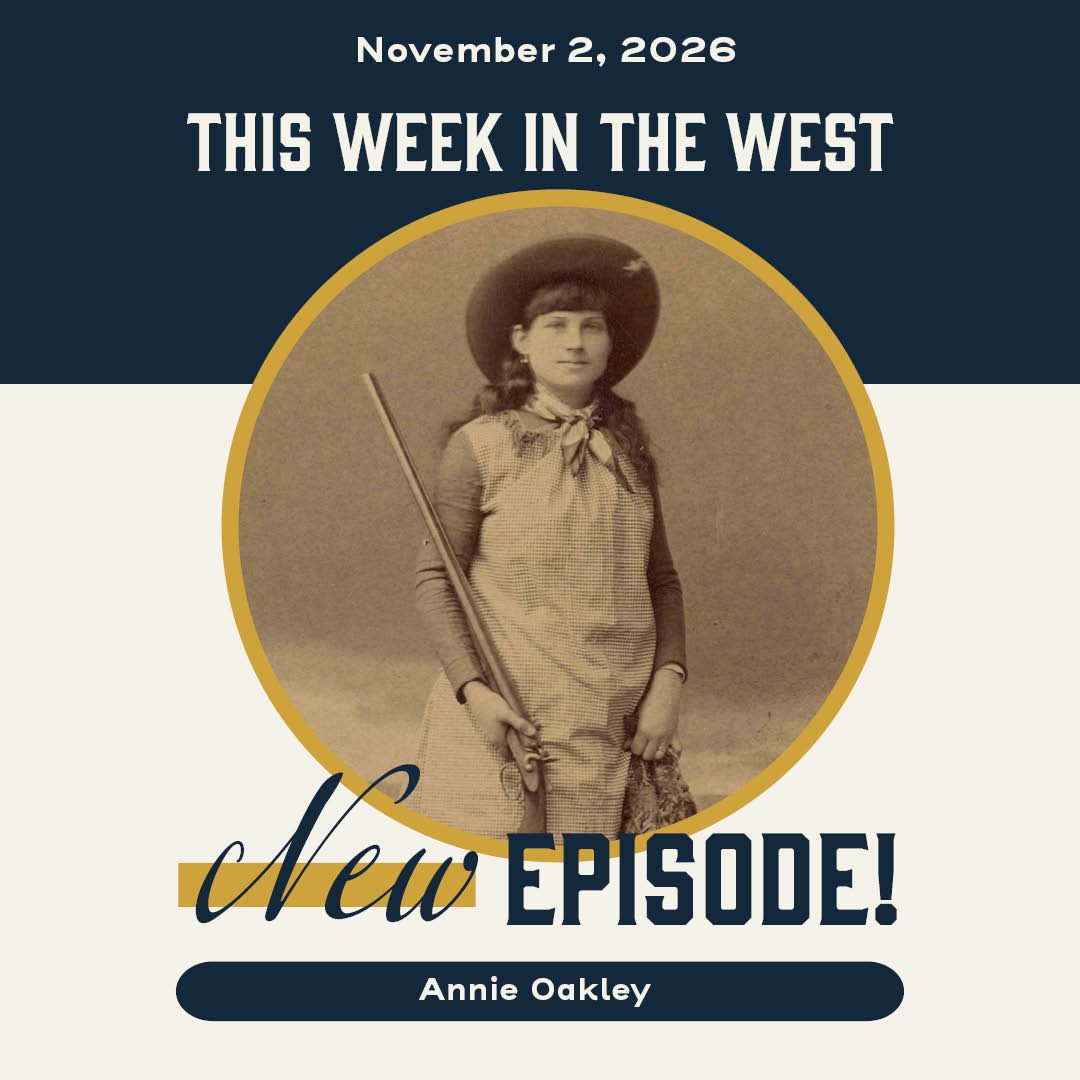
Annie Oakley’s sharpshooting skill had to be seen to be believed. Count us among the believers today as we remember Oakley, the namesake of our Annie Oakley Society here at The Cowboy, on the week of her death, November 3, 1926.
Coins aren’t the only items that Oakley shot that are in our collection. There are some broken glass bulbs, displayed right next to a couple of her rifles.
She made a lot of impossible shots. Listing them all just adds to her legend.
She could hit targets behind her while looking into a mirror.
She could split playing cards edge-on.
She could shoot a cigarette from her husband’s mouth.
And night after night, before audiences across America and Europe, she demonstrated that one of the greatest marksMEN of the American West wasn’t a man at all.
Her story began in rural Ohio.
She was born Phoebe Ann Moses on August 13, 1860, in Darke County, Ohio.
Her father died when Oakley was still a young girl, and the family struggled financially. At various points, she lived away from her mother and worked to help support herself. She later described a particularly unhappy period living with a family she called “the wolves.”
From a young age, she learned to shoot. But at first, it wasn’t sport or entertainment. It was survival. Her family needed any game she could bag in the woods around her home. The birds and animals Annie shot could feed the family or be sold. Her hunting became an important source of income and, according to later accounts, helped her mother pay family debts.
Then, as the story goes, came a shooting match that changed her life.
Frank Butler was a professional exhibition shooter traveling through Ohio. According to the familiar version of the tale, a local hotelkeeper arranged a shooting contest between Butler and a young local woman who supposedly knew her way around a gun.
Butler was probably not worried. The contest involved shooting live birds released from traps.
Butler hit 24 out of 25.
Annie hit all 25.
Frank Butler had just been beaten by the woman he would eventually marry.
Their relationship became one of the most important partnerships in entertainment history. Butler was an accomplished marksman himself, but something remarkable happened as the couple performed together.
It became increasingly obvious that Oakley was the star.
So Butler did something unusual for a late-nineteenth-century husband. He stepped aside.
Rather than competing with his wife’s fame, he supported it. He became Oakley’s partner, assistant, manager and promoter.
Around this time, Phoebe Ann Moses changed her name and became known professionally as Annie Oakley.
In 1885, she joined America’s biggest Western spectacle: Buffalo Bill’s Wild West.
The Wild West wasn’t quite a circus, and it wasn’t quite a theatrical production. It was a giant outdoor spectacle filled with horseback riding, shooting demonstrations and staged scenes inspired by frontier life.
Audiences could see cowboys, Native American performers, trick riders and marksmen demonstrating their skills.
Into that arena stepped Annie Oakley. She became one of Buffalo Bill’s greatest stars.
She did it all: She shot while standing normally, she shot looking backward, she shot using a mirror. And then Butler would step up a few yards away, place a cigarette in his mouth, and Oakley would fire. The cigarette flew out of his mouth, and the crowd would roar its approval.
Oakley’s performance required timing, coordination, concentration and almost unbelievable precision. She was just five feet tall, but in the middle of the Wild West show, she was larger than life.
Audiences loved her and so did many of her fellow performers.
One of Annie Oakley’s most fascinating friendships was with Sitting Bull.
The Hunkpapa Lakota leader became famous throughout the United States after the Battle of the Little Bighorn. He later spent a period traveling with Buffalo Bill’s Wild West.
According to Oakley’s recollections, Sitting Bull admired her shooting and formed a close bond with her. He reportedly called her “Little Sure Shot.” The nickname followed her for the rest of her life.
Buffalo Bill’s Wild West eventually crossed the Atlantic as Oakley performed before enormous European audiences and royalty.
During the company’s appearances in Britain, she performed as part of the celebrations surrounding Queen Victoria’s Golden Jubilee in 1887.
The Wild West went on to tour elsewhere in Europe, presenting a dramatic — and certainly romanticized — vision of the American frontier to audiences who had never seen it for themselves.
Oakley became an international celebrity and leaned into the contrast between the rough-and-tumble Wild West follies and the conservative femininity expected of a Victorian woman.
She often performed in dresses and skirts she designed or chose herself. Her clothing could be decorative, but it remained relatively modest. She was a tiny, polite woman who could walk into a traditionally male arena and beat almost anyone.
She encouraged women to learn to shoot and argued that women could handle firearms safely and skillfully. Oakley said marksmanship could give women confidence and self-protection.
She even offered her services during wartime.
Oakley proposed training troops in marksmanship during the Spanish-American War and World War I and at one point offered to help organize women for military service. The government didn’t take her up on those offers.
But Annie continued demonstrating her shooting abilities well into later life.
In 1922, Annie and Frank were involved in a serious automobile accident, and she suffered significant injuries.
After recovering, Annie returned to shooting exhibitions, but her health was in serious decline.
Annie Oakley died in Ohio on November 3, 1926. She was 66. Frank Butler, her husband, partner and greatest supporter, died only a few weeks later.
Hollywood, Broadway and popular culture would continue reshaping her story. The musical “Annie Get Your Gun” helped introduce a fictionalized Annie Oakley to new generations.
And with that, we’ve hit the target on another episode of “This Week in the West.”
Our show is produced by Chase Spivey and written by Mike Koehler.
Follow us and rate us on Apple Podcasts or wherever you hear us. That helps us reach more people.
Come visit us in Oklahoma City! You can now buy tickets online at thecowboy. org/tickets
Got a question or a suggestion? Drop us an email at podcast@thecowboy.org
We leave you today with the words of Annie Oakley herself: “Aim at a high mark, and you will hit it. No, not the first time, nor the second and maybe not the third. But keep on aiming and keep on shooting for only practice will make you perfect. Finally, you’ll hit the Bull’s Eye of Success.”
Much obliged for listening, and remember, come Find Your West at the National Cowboy & Western Heritage Museum.