



Howdy folks, it’s the last week of October 2026, and welcome to This Week in The West.
I’m Seth Spillman, broadcasting from the National Cowboy & Western Heritage Museum in Oklahoma City.
On this podcast, we share stories of the people and events that shaped the history, art and culture of the American West—and those still shaping it today.
It was over quickly, nearly as fast as it took me just to read that introduction.
Just about 30 seconds, around 3 o’clock, in the dusty streets of the Arizona Territory.
But that half-a-minute is burned into Western and popular culture history.
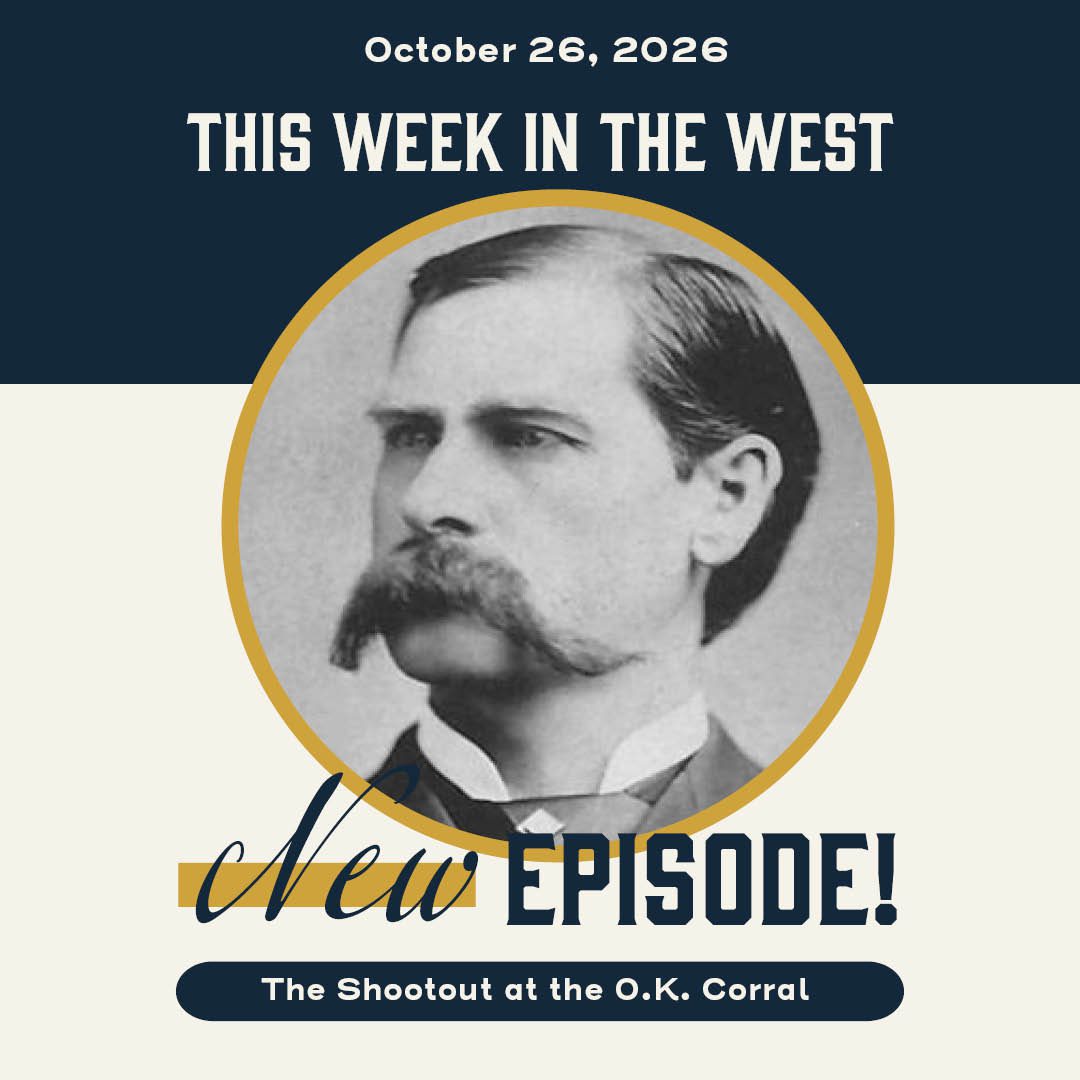
October 26, 1881: The Gun Fight at the OK Corral.
Let’s break it down like the crime scene it was:
Four men were walking through the heart of Tombstone, Arizona. Waiting for them were five others, the gang they’d been feuding with for months.
There were threats. There were accusations. There were guns. And then someone fired.
Within moments, three of them were dead, three more were wounded, and an otherwise ordinary vacant lot in an Arizona mining town had been transformed into one of the most famous places in the history of the American West.
Now, a little clarification of the legend.
For one thing, the gunfight didn’t actually take place inside the O.K. Corral. It happened in a narrow vacant lot near its rear entrance, just off Fremont Street.
And the men who fought that day were not the iconic flawless heroes and dastardly villains we’ve seen in the movies.
The real story was far more complicated.
Tombstone was booming thanks to a flood of prospectors, businessmen, gamblers, saloonkeepers, miners and fortune seekers looking to get rich mining silver.
Bands of men known locally as “Cowboys” came through the town, moving cattle, sometimes legitimately, sometimes guiding stolen herds into Mexico.
In Tombstone, the word “cowboy” could mean something very different than it does today. They had shady reputations, and trouble often followed them wherever they went.
The law in Tombstone was enforced by Virgil Earp. His brothers Wyatt and Morgan also had experience as peace officers, but operated in the gray area of frontier law enforcement, business, gambling and politics. Joining them in Tombstone was their close friend John Henry “Doc” Holliday, a former dentist, a gambler and a gunfighter suffering from tuberculosis.
On the other side were members of the Clanton and McLaury families, including brothers Ike and Billy Clanton and brothers Tom and Frank McLaury.
The Earps and the Cowboys distrusted each other, and by October 1881, that distrust was becoming dangerous.
Tombstone’s political divisions helped deepen the feud. The Earps were associated with one faction of the community while the Clantons and their allies were connected with another.
This was not simply lawmen versus outlaws. It was personal. It was economic. It was political.
And ultimately, it was violent.
Things reached a breaking point on October 25.
Ike Clanton came into Tombstone and spent much of the night drinking. According to accounts, he repeatedly threatened the Earps and Doc Holliday.
By the next morning, tensions were at a boiling point.
Virgil Earp eventually confronted Ike for illegally carrying a weapon inside the town limits. Ike was disarmed, taken before a judge and fined.
Tom McLaury also had a violent encounter with Wyatt.
The momentum toward a bigger conflict kept growing as the Earps and Holiday heard that a group of armed Cowboys had gathered near the O.K. Corral.
Virgil Earp decided something had to be done. He was joined by Wyatt, Morgan and Doc Holliday.
The four began walking toward Fremont Street. It’s probably pretty easy to pictures. It’s been the go-to dramatic shot in many Western movies.
It wasn’t in slow-motion though. In reality, it was probably faster and much more uncertain. Virgil’s plan was to just disarm the men. Cochise County Sheriff Johnny Behan met the Earps along the way and attempted to intervene.
But the Earps continued.
When they reached the lot near the O.K. Corral, they found Frank McLaury, Tom McLaury, Billy Clanton, Ike Clanton and Billy Claiborne.
Virgil reportedly ordered the men to surrender their weapons.
And then everything happened at once.
Exactly who fired the first shot has been argued about for more than a century.
What is certain is that the confrontation exploded into gunfire at extremely close range.
Doc Holliday carried a shotgun as well as a handgun.
Wyatt, Virgil and Morgan Earp opened fire.
Billy Clanton and Frank McLaury returned fire.
Ike Clanton, who was apparently unarmed, escaped the fighting. So did Billy Claiborne.
In perhaps thirty seconds, dozens of shots were exchanged.
Then it was over.
Billy Clanton lay dying.
Tom McLaury was dead.
Frank McLaury was dead.
Virgil Earp had been shot in the leg.
Morgan Earp had been wounded.
Doc Holliday had been grazed.
Wyatt Earp emerged without a wound.
But three dead men did not end the story.
Ike Clanton filed murder charges against the Earps and Holliday.
For weeks, testimony was heard about what had happened in the vacant lot. Were the Earps legitimate law officers attempting to disarm threatening men or had they used their badges to settle a personal feud?
Ultimately, Judge Wells Spicer ruled that there was not sufficient cause to send the Earps and Holliday to trial, concluding that their actions were justified under the circumstances.
But violence and death would continue to haunt the men.
In December, Virgil Earp was ambushed and badly wounded. On March 18, 1882, Morgan Earp was shot and killed while playing billiards.
Wyatt Earp’s response became another Western legend: the so-called Earp Vendetta Ride, during which Wyatt and his companions pursued men they believed responsible for the attacks.
Holliday would die six years later at age 36.
The legacy of the event grew thanks to newspaper stories, dime novels, biographies, television programs and movies, which turned the confrontation into something larger than the thirty-second burst of violence it had actually been.
The Gunfight at the O.K. Corral lasted less than a minute.
But nearly a century and a half later, we’re still arguing over what happened.
And with that, we’ve had a showdown with another episode of “This Week in the West.”
Our show is produced by Chase Spivey and written by Mike Koehler.
Follow us and rate us on Apple Podcasts or wherever you hear us. That helps us reach more people.
Come visit us in Oklahoma City! You can now buy tickets online at thecowboy.org/tickets
Got a question or a suggestion? Drop us an email at podcast@thecowboy.org
We leave you today with the words of Jeff Guinn, author of “The Last Gunfight: The Real Story of the Shootout at the O.K. Corral-And How It Changed the American West”
“As Americans embraced Wild West mythology by ignoring inconvenient facts and exaggerating or inventing more palatable ones, they also altered the meaning of a traditionally negative term.
In Wyatt’s real West, anyone referred to as a cowboy was most likely a criminal.
But in movies the word was used first to describe hardworking ranch hands and then, generically, those who rode horses, toted six-guns, and, when necessary (and it always became necessary) fought to uphold justice at the risk of their own lives. Cowboys were heroes, and their enemies were outlaws. So far as his growing legion of fans was concerned, Wyatt Earp was a cowboy in the new, best sense of the word.”
Much obliged for listening, and remember, come Find Your West at the National Cowboy & Western Heritage Museum.