



Howdy folks, it’s the third week of October 2026, and welcome to This Week in The West.
I’m Seth Spillman, broadcasting from the National Cowboy & Western Heritage Museum in Oklahoma City.
On this podcast, we share stories of the people and events that shaped the history, art and culture of the American West—and those still shaping it today.
Raymond Ritter should have just paid the brothers the money he owed them.
Instead, Ritter ushered in the first appearance of an Old West legend.
As the story goes, Ritter needed some help grading a section of track for the Atchison, Topeka and Santa Fe Railroad. He hired a couple of teenagers, Ed and Bartholomew, to do the work. But Ritter skipped out without paying their wages.
Bartholomew wouldn’t let the snub go. For a year, he tried to find out where Ritter was. As it turned out, on April 15, 1873, Ritter would be on a train rolling into Dodge City, Kansas, with a pocketful of money. When the train pulled into the station, Bartholomew stormed into the car and pulled Ritter out to the platform. In front of a growing crowd, he demanded that Ritter fork over what the brothers were due.
The crowd cheered! Dodge City just had to know who this kid was.
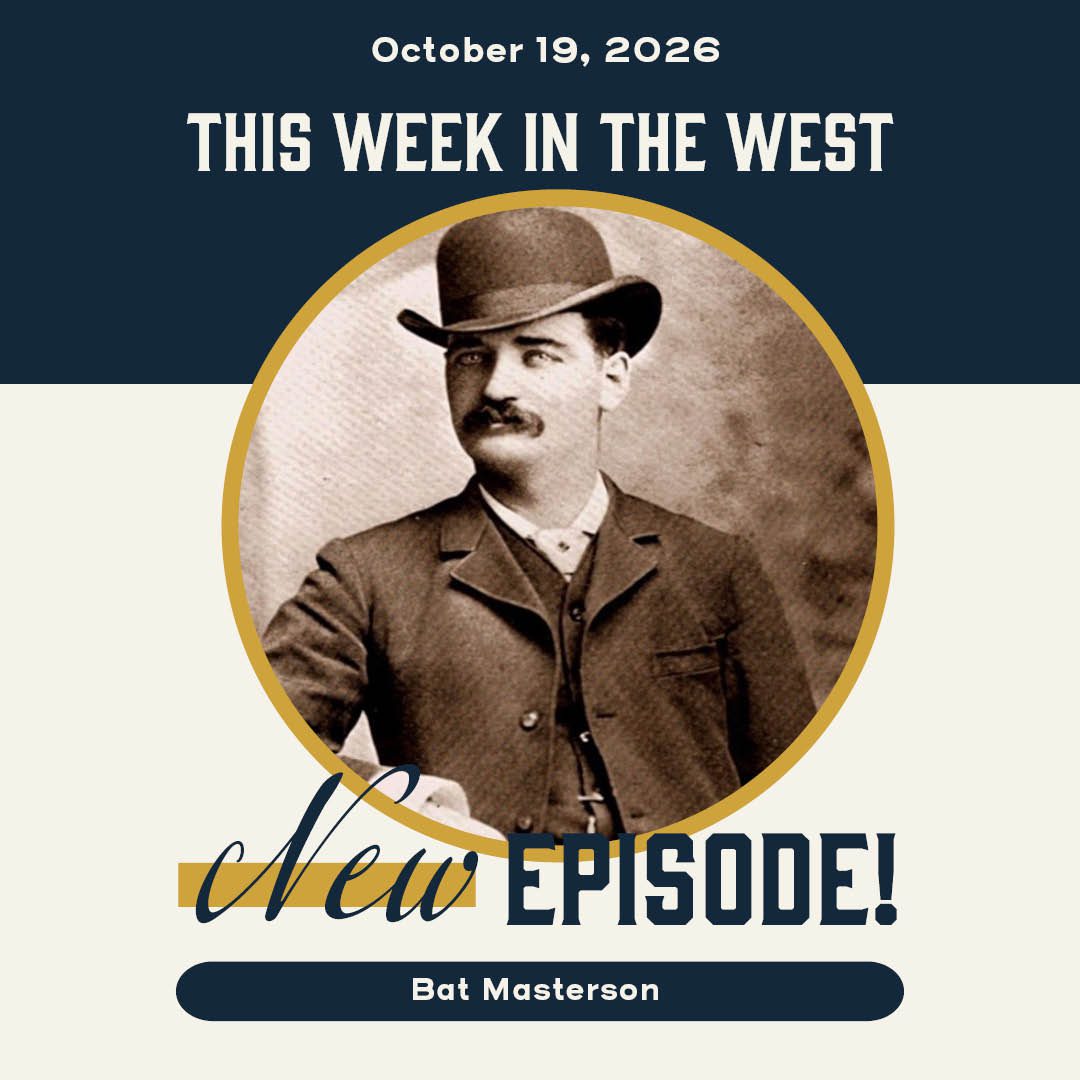
They soon did, and it was the first, but not the last time that Dodge City would connect with Bartholomew “Bat” Masterson, who we remember this week, the anniversary of his death: October 25, 1921.
After the incident, Masterson continued to weave his way into the story of the American West. He was part of a five-day siege against several hundred Native American warriors at the Battle of Adobe Walls. From there, he became a US Army scout.
He spent more time in Texas and Kansas, but all roads seemed to lead to Dodge City. He settled down there, met Wyatt Earp, and was eventually elected County sheriff in 1877.
While sheriff, Masterson arrested a gang of train robbers, avenged the death of his brother Ed, joined Earp and Bill Tilghman in a posse that captured another murderer in 1878 and fought in a “railroad war” when two companies rounded up gunmen to decide who had the right to lay down track in Colorado.
Masterson crossed paths with Buffalo Bill Cody while rescuing another gunfighter from Nebraska a couple of years later, then spent time in Tombstone with Earp.
Earp returned the favor in 1883 when the pair engaged in what was called “The Dodge City War,” a conflict that drew some of the West’s legendary gunmen over what amounted to a squabble over whether the mayor could close the Long Branch Saloon.
The group called itself “The Dodge City Peace Commission,” and it was determined to reopen the Saloon.
“It was decided that if a fight were all that would satisfy the mayor of Dodge, a fight he would have,” Masterson said at the time.
Ultimately, the fear of what Masterson would do was enough to solve the problem without bloodshed. The saloon would be opened. But his reputation was settled. He was now quote “one of the most dangerous (men) the West has ever produced,” according to a newspaper in Kansas City.
Masterson still had more chapters to write (literally) in his life.
Wounded several times in various gunfights and forced to use a cane, he eventually left Dodge City for Denver and other pursuits. He first tried to survive by gambling and working with con men. It was during this time that Masterson became more deeply interested in boxing. He’d made many bets and got to know the heavyweight contenders of the late 1890s.
Masterson moved to New York City in 1902 and reinvented his life around his interest in sports, specifically boxing. He was hired by the New York Morning Telegraph to write a column, which he would pen until the end of his life.
He took advantage of his writing to craft more work about the West and further and build up the mythology around the larger-than-life gunfighters. Masterson wrote about Earp and Tilghman, Doc Holliday, and Buffalo Bill.
While a newspaperman, Masterson struck up a friendship with another towering figure of the era, President Theodore Roosevelt. The president even managed to appoint Masterson as a deputy U.S. Marshal, though with a warning to the old gunslinger to stay on the straight and narrow.
“You must be careful not to gamble or do anything while you are a public officer who might afford opportunity to your enemies and my critics to say that your appointment was improper,” Roosevelt wrote. Despite the warning, after Roosevelt left office, there was an investigation into Masterson’s appointment, and he was fired.
He continued writing his column and attending prize fights.
On Oct. 25, 1921, Masterson was at his desk at the Morning Telegraph, penning his column, when he suffered a massive heart attack and fell dead. Bat Masterson was 67.
At his funeral, friend and fellow writer Damon Runyon offered this eulogy: “He was a 100 percent, 22-karat real man. Bat was a good hater and a wonderful friend. He was always stretching out his hand to some down-and-outer. He had a great sense of humor and a marvelous fund of reminiscence and was one of the most entertaining companions we have ever known. There are only too few men in the world like Bat Masterson, and his death is a genuine loss.”
And with that, we’ve finished our at-bat on another episode of “This Week in the West.”
Our show is produced by Chase Spivey and written by Mike Koehler.
Follow us and rate us on Apple Podcasts or wherever you hear us. That helps us reach more people.
Come visit us in Oklahoma City! You can now buy tickets online at thecowboy.org/tickets
Got a question or a suggestion? Drop us an email at podcast@thecowboy.org
We leave you today with the words of Bat Masterson: “There are many in this old world of ours who hold that things break about even for all of us. I have observed, for example, that we all get the same amount of ice. The rich get it in the summertime, and the poor get it in the winter.”
Much obliged for listening, and remember, come Find Your West at the National Cowboy & Western Heritage Museum.