

Howdy folks, it’s the fourth week of November 2026, and welcome to This Week in The West.
I’m Seth Spillman, broadcasting from the National Cowboy & Western Heritage Museum in Oklahoma City.
On this podcast, we share stories of the people and events that shaped the history, art and culture of the American West—and those still shaping it today.
It was 1900, and Carrie Nation was tired of being subtle.
She’d been protesting outside saloons in Medicine Lodge, Kansas, with other members of the local Woman’s Christian Temperance Union chapter she had organized a few years before. The women wanted authorities to enforce Kansas’ constitutional ban on liquor sales.
So far, they’d been singing hymns outside the saloons, but neither bartenders nor their patrons seemed especially moved.
Frustrated with the results, Nation looked for a different method of protest.
She found one.
In June 1900, inside Dobson’s Saloon in Kiowa, Kansas, Carrie Nation began hurling rocks and bricks at bottles, mirrors and barroom fixtures. The woman who would become America’s most famous saloon smasher had arrived. We remember her this week, the week of her birth, November 25, 1846.
So what spurred Nation to start smashing?
It wasn’t just frustration. Nation believed she had received a command from God.
She later wrote that after praying on the night of June 5, 1900, she awoke the next morning with words speaking in her heart: “Go to Kiowa. I’ll stand by you.”
Carrie recalled, “I was impressed with a great inspiration; the interpretation was very plain. It was this: Take something in your hands and throw at these places in Kiowa and smash them.”
Nation set out for Kiowa on June 6 and stayed overnight with a friend. Early the next morning, she entered Dobson’s Saloon carrying what she called her “smashers”—rocks and bricks wrapped in paper. She wrecked bottles and mirrors there, then moved on to two more saloons and did the same.
Soon afterward, a tornado swept through southeastern Kansas. Nation reportedly took it as another sign that God approved of her actions.
Nation was born into a well-to-do Kentucky family. After financial setbacks, the family moved to Missouri and later to the Kansas City area during the Civil War. Nation helped nurse wounded soldiers. After the war, she met and married Charles Gloyd, a physician and former Union soldier.
Gloyd, however, had a severe drinking problem. Nation left him within months and returned to her family while pregnant. He died from alcoholism in 1869, leaving her with an infant daughter.
Gloyd’s death helped forge Nation’s fierce hatred of alcohol. It eventually led to what she called “the smashings,” but she didn’t stop with rocks.
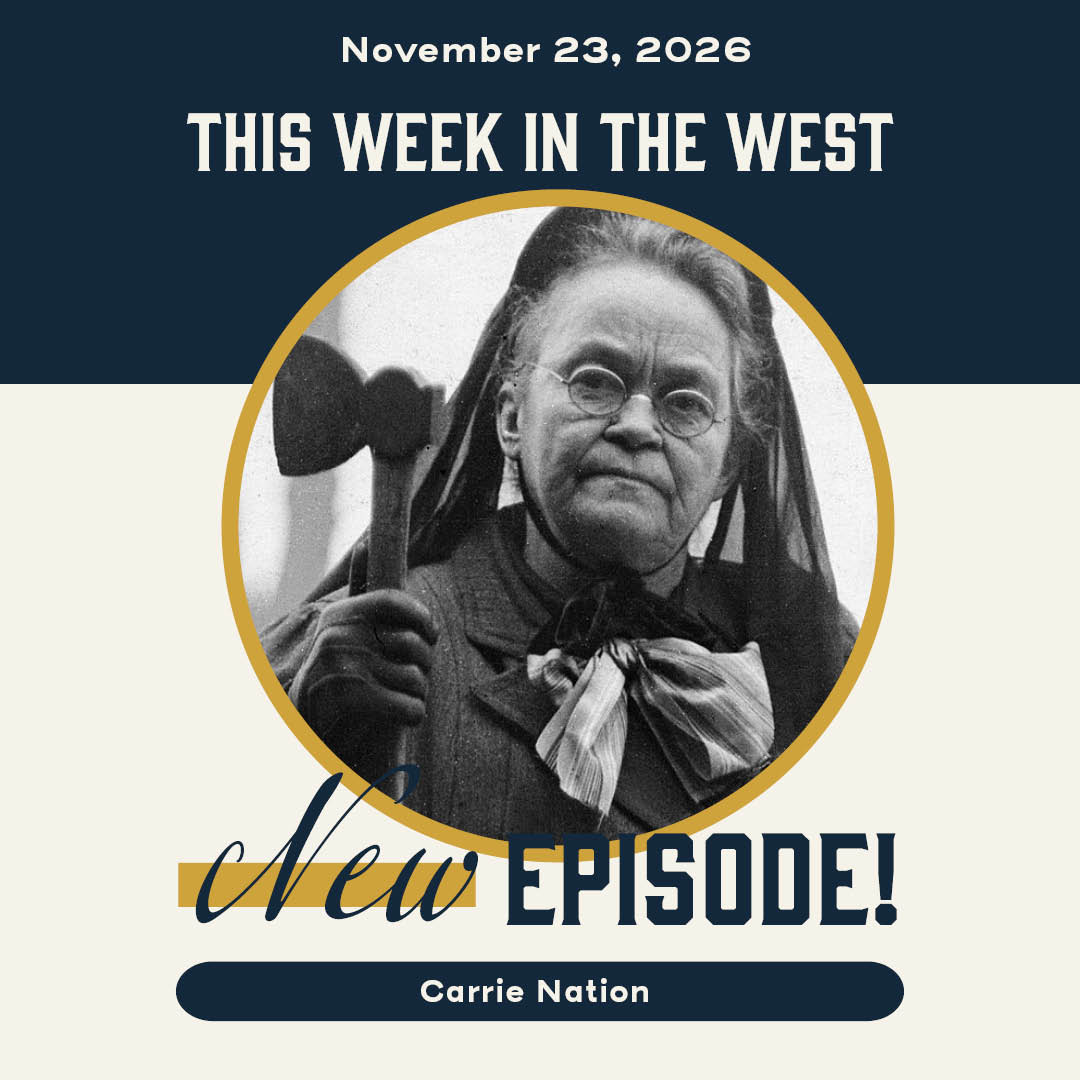
In Wichita, she escalated from bricks to an iron rod and a cane. On January 21, 1901, she first wielded the weapon that would make her famous: a hatchet.
And she put it to work.
Hatchet in hand, Nation and her hymn-singing supporters swept through illegal saloons across Kansas. She attacked fixtures, liquor bottles and the bars themselves. Newspaper coverage transformed her into a national celebrity. Her crusade soon carried her into Missouri, Nebraska and beyond, where she lectured, entered saloons and confronted bartenders and public officials.
Her methods also brought consequences. Nation was beaten, fined and repeatedly jailed. In fact, she was arrested more than 30 times between 1900 and 1910.
And alcohol was not Nation’s only cause. She opposed tobacco and supported women’s suffrage, arguing that women needed the vote to protect their homes and families.
According to a report in a Nebraska newspaper, the Blue Valley Blade: “She seems to have a very poor opinion of the stronger sex. Mrs. Nation contends that men are to blame for all the evil in the land and that things will not go right until women are allowed to vote.”
To support herself—and pay court costs, fines and travel expenses—Nation sold small hatchet-shaped stick pins, including ones that read “Death to Rum.” She also published a newsletter, “The Smasher’s Mail,” and a newspaper called “The Hatchet.” In 1903, she legally changed the spelling of her first name to C-A-R-R-Y, turning her name into a slogan: Carry A. Nation.
Saloon owners answered with a slogan of their own. Signs in bars across the country declared: “All Nations Welcome—Except Carrie.”
Nation embarked on a speaking tour through Britain and Ireland in 1908. It wasn’t exactly a triumph. In London, one audience pelted her with rotten eggs and water, forcing her from the
stage under police protection. Nation returned to the United States in 1909 and settled in Eureka Springs, Arkansas. There she bought a property called Hatchet Hall and hoped to establish a school promoting prohibition.
On January 13, 1911, Nation collapsed during a speech in Eureka Springs. Her final public words reportedly were, “I have done what I could.” She was taken to a hospital in Leavenworth, Kansas, where she died on June 9, 1911, at age 64.
But the temperance movement didn’t die with Nation. It actually gained political strength through organizations including the Woman’s Christian Temperance Union and the Anti-Saloon League.
In December 1917, only 6 years after her passing, Congress proposed the Eighteenth Amendment. The states ratified it in January 1919, banning the manufacture, sale and transportation of intoxicating liquor nationwide.
National Prohibition took effect in 1920 and lasted until the Twenty-first Amendment repealed it in 1933.
And with that, we’ll put away the hatchet on another episode of “This Week in the West.”
Our show is produced by Chase Spivey and written by Mike Koehler.
Follow us and rate us on Apple Podcasts or wherever you hear us. That helps us reach more people.
Come visit us in Oklahoma City! You can buy tickets online at thecowboy.org slash tickets.
Got a question or a suggestion? Drop us an email at podcast@thecowboy.org.
We leave you today with the words of Carrie Nation: “The success of life, the formation of character, is in proportion to the courage one has to say to one’s own self: ‘Thou shalt not.’”
Much obliged for listening, and remember, come Find Your West at the National Cowboy & Western Heritage Museum.