




Welcome to the blog about our podcast “This Week in the West.” We’ll share the show’s scripts on our blog each week. If you want to listen, click above, subscribe on your favorite podcast app or check back here every Monday.
If you have questions, ideas or feedback about the podcast, you can reach out to podcast@nationalcowboymuseum.org
July 14: Jim Bridger
Howdy folks, it’s the third week of July 2025 and welcome to This Week in The West.
I’m Seth Spillman, broadcasting from the National Cowboy & Western Heritage Museum in Oklahoma City.
On this podcast, we share stories of the people and events that shaped the history, art and culture of the American West—and those still shaping it today.
In 1824, a young trapper dipped his hand into a vast body of water nestled between mountain ranges and tasted something unexpected — salt. He thought he’d reached the Pacific Ocean.
What Jim Bridger had found was the Great Salt Lake, and he was likely the first American of European descent to lay eyes on it.
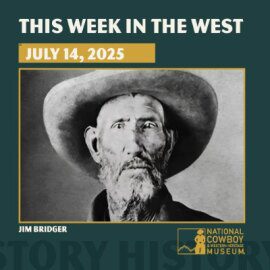
That bold mistake is just one of many remarkable moments in the life of Bridger, one of the most iconic mountain men in Western history, who died this week, July 17, 1881.
Bridger was born in Virginia in 1804 but moved to St. Louis with his family as a boy. Orphaned by the age of 13, he was apprenticed to a blacksmith, but the dirty work around the forge soon lost his interest compared to the lure of the wild frontier.
At just 18, he signed on with a fur trapping expedition in 1822, joining a rough-and-ready group that included legendary mountain men Jedediah Smith and Hugh Glass.
Bridger traveled deep into the unexplored portion of North America, navigating the Rocky Mountains, the Missouri River and the vast Great Basin. He helped chart routes through dangerous territory thanks to his ability to quickly learn about the Native people his expedition encountered.
He learned the languages and customs of Native tribes like the Crow, Blackfeet and Shoshone. He married into Indigenous families, formed alliances and built trust.
Bridger is not without some dubious claims as well. He was known for embellishing stories about the areas he explored. A website about Yellowstone National Park calls him a “spinner of tall tales” about the area.
Bridger often made the region seem more magical than real, hardly helping skeptics believe it existed. One colorful yarn involved a petrified forest where, he claimed, even the birds were turned to stone—and still sang “petrified songs.”
Another favorite story of Bridger’s took place near what is now called Yellowstone’s Obsidian Cliff. He told of stalking a bull elk, firing shot after shot without the animal flinching. Creeping closer, Bridger raised his rifle like a club to finish the job—only to strike what he described as a “mountain of clear glass.” The invisible wall, he said, was a natural lens that made the elk appear close when it was actually miles away.
Mountain Men like Bridger became mythic figures in the West, just like the cowboys who would follow them. According to author Stephen Brennan, the Golden Age of the Mountain Men only lasted for a generation, generally from 1810 when post-Lewis-and-Clark expeditions were launched into the Louisiana Purchase in search of natural resources and valuable beaver pelts through 1840, when the animal’s numbers had fallen.
One of the first things Bridger did after the discovery of the Great Salt Lake was to go with other men to search its tributaries for beaver.
When those adventurous days waned, Bridge settled down.
In 1843, he co-founded Fort Bridger in what’s now southwestern Wyoming. It became a lifeline for thousands of pioneers making the perilous trip west on the Oregon, California, and Mormon Trails.
Fort Bridger offered supplies, repairs and safe passage advice to weary travelers. Notoriously, Bridger is said to have given bad advice – that a pass in the Sierras was easy to navigate – to the doomed Donner Party.
Tensions with Brigham Young and the Mormon settlers eventually forced Bridger off his land. He pivoted again — this time working as a scout for the U.S. Army during the Utah War and throughout the Indian Wars of the 1850s and ’60s.
He identified Bridger Pass, an efficient route through the Rockies that would later be used for the Overland Trail and help shape the path of the transcontinental railroad.
By the late 1860s, arthritis and blindness forced Bridger into retirement. He lived his final years on a farm near present-day Kansas City, Missouri, and died in 1881, at the age of 77.
Bridger was inducted into our Hall of Great Westerners here at The Cowboy in 1976.
And with that, we’ll blaze our trail back to camp on another episode of This Week in The West.
Our show is produced by Chase Spivey and written by Mike Koehler.
Follow us and rate us on Apple Podcasts or wherever you hear us. That helps us reach more people.
You can follow us on social media and online at nationalcowboymuseum.org.
Got a question or a suggestion? Drop us an email at podcast@nationalcowboymuseum.org.
We leave you today with the words of General Grenville Dodge at the dedication of a memorial in honor of Bridger. “Unquestionably, Bridger’s claim to remembrance rests upon the extraordinary part he bore in the explorations in the West. As a guide, he was without equal, and this is the testimony of everyone who ever employed him. The whole West was mapped out in his mind, and such was his instinctive sense of locality and direction that it was said that he could smell his way where he could not see it.”
Much obliged for listening, and remember, come Find Your West at the National Cowboy & Western Heritage Museum.