



Welcome to the blog about our podcast “This Week in the West.” We’ll share the show’s scripts on our blog each week. If you want to listen, click above, subscribe on your favorite podcast app or check back here every Monday.
If you have questions, ideas or feedback about the podcast, you can reach out to podcast@thecowboy.org
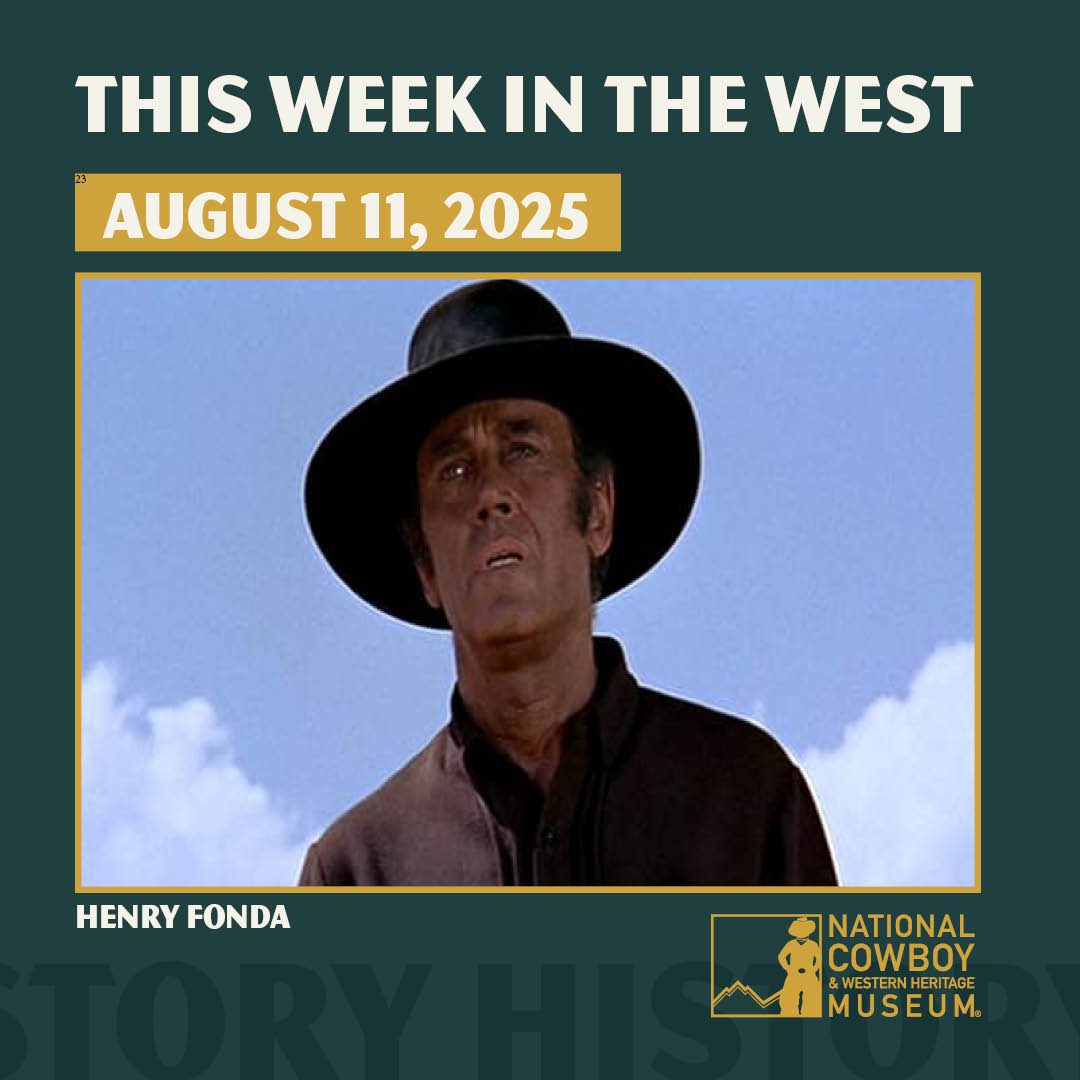
August 11: Henry Fonda
Howdy folks, it’s the second week of August 2025 and welcome to This Week in The West.
I’m Seth Spillman, broadcasting from the National Cowboy & Western Heritage Museum in Oklahoma City.
On this podcast, we share stories of the people and events that shaped the history, art and culture of the American West—and those still shaping it today.
Henry Fonda was known as one of Hollywood’s good guys. He played a young Abraham Lincoln, charming in his early days in Illinois. He was the voice of reason in 12 Angry Men’s tense jury room. And in many classic Westerns, he played by-the-book lawmen, including Wyatt Earp.
But his greatest performance may have been when he put on the black cowboy hat and turned villain, forever cementing himself in Western lore.
So we remember Fonda this, a member of our Hall of Great Western Performers, on the anniversary of his death, August 12, 1982.
Fonda was born in May 1905 in Grand Island, Nebraska, and raised in Omaha.
He was shy, tall and quiet, and he seemed unsuited for the stage until a family friend, Dodie Brando — yes, Marlon’s mother—pushed him toward acting at the Omaha Community Playhouse.
By the time he was 20, Fonda had found a calling in theater. That led him to the East Coast, to summer stock with the University Players, where he met lifelong friend Jimmy Stewart. The two actors shared everything, from cramped apartments to stage roles, to eventually achieving stardom.
Fonda came to Hollywood in 1935 and found quick success. His early roles had him playing everything from Abraham Lincoln in John Ford’s Young Mr. Lincoln to Frank James in Jesse James.
But it wasn’t long before he started carving out his corner of the Western genre. One of the earliest—and most unforgettable—was The Ox-Bow Incident in 1943.
The film was a psychological and moral tale about the intersection of mob justice and personal responsibility. Fonda played Gil Carter, a man caught in the middle of a lynch mob and forced to confront the dangers of its thirst for retribution.
It was a performance that revealed what would become Fonda’s movie persona: a slow-burning moral clarity and a willingness to stand alone.
Fonda’s work in The Ox-Bow Incident was all the more potent because of his own experience.
At just 14 years old, he and his father had witnessed a lynching in Omaha during the 1919 race riots. That memory haunted him—and informed his work.
After serving in the Navy during World War II, Fonda returned to the West in My Darling Clementine in 1946, playing none other than Wyatt Earp. Directed by Ford, the film was less about gunfights and more about the quiet burden of leadership. Fonda’s Earp was thoughtful, principled and almost reluctant to use force.
He teamed up with Ford again for Fort Apache in 1948, playing a taciturn Army colonel clashing with John Wayne’s more seasoned frontier soldier.
Fonda’s collaborations with Ford weren’t always smooth, the actor recalled, saying, “He had instinctively a beautiful eye for the camera. But he was also an egomaniac.”
One of the most underappreciated Westerns of his career was released in 1957 with The Tin Star, in which he played a weary bounty hunter mentoring a greenhorn sheriff, played by Anthony Perkins. His character was grizzled, patient and laced with world-weary wisdom.
He had a starring role in the NBC series The Deputy, where he played a circuit-riding U.S. Marshal.
But it was in 1968 that Fonda shocked movie fans with a chilling and unforgettable role in Sergio Leone’s spaghetti Western masterpiece Once Upon a Time in the West.
Fonda became the cold-blooded killer Frank, with an intense, blue-eyed stare and a villainous outfit of all black.
The movie’s most infamous scene set the tone for Fonda’s diabolical performance. After his gang massacres a family, a child runs out of the house and faces down Frank. With the hint of a smirk on his face, the villain draws his gun and fires. Leone reportedly wanted Fonda because nobody would believe Henry Fonda could be a villain. That’s exactly what made it work.
Wrote Fonda biographer Scott Eyman. “Leone explained (in the massacre scene) that the camera would swing around Fonda’s head and into a close-up that captured his cold blue eyes. ‘Now I understand,’ Fonda told Leone. The face that had embodied tortured conscience for more than 30 years was now going to indicate a rigid sociopath.”
Fonda returned to the West once more with Firecreek (1968) and The Cheyenne Social Club (1970), the latter reuniting him with Jimmy Stewart in a light-hearted take on aging cowboys.
Though he’d shift focus to dramas, television, and stage work in the 1970s, Fonda’s shadow across the Western genre never faded. His final bow came in On Golden Pond (1981), where he played an emotionally brittle father opposite Katharine Hepburn and his daughter, Jane Fonda. The film won him his first and only Academy Award for Best Actor.
Henry Fonda passed away in August 1982. He was posthumously inducted into our Hall of Great Western Performers in 2005.
And with that, we’ve played our last scene on another episode of “This Week in The West.”
Our show is produced by Chase Spivey and written by Mike Koehler
Follow us and rate us on Apple Podcasts or wherever you hear us. That helps us reach more people.
We can follow us on social media and online at nationalcowboymuseum.org.
Got a question or a suggestion? Drop us an email at podcast@thecowboy.org
We leave you today with the words of Henry Fonda: “If there is something in my eyes, a kind of honesty in the face, then I guess you could say that’s the man I’d like to be, the man I want to be.”
Much obliged for listening, and remember, come Find Your West at the National Cowboy & Western Heritage Museum.