


Welcome to the blog about our podcast “This Week in the West.” We’ll share the show’s scripts on our blog each week. If you want to listen, click above, subscribe on your favorite podcast app or check back here every Monday.
If you have questions, ideas or feedback about the podcast, you can reach out to podcast@nationalcowboymuseum.org
Howdy folks, it’s the fourth week of August 2025,, and welcome to This Week in The West.
I’m Seth Spillman, broadcasting from the National Cowboy & Western Heritage Museum in Oklahoma City.
On this podcast, we share stories of the people and events that shaped the history, art and culture of the American West—and those still shaping it today.
They called him Eight Bears.
They called him Man-Afraid-Of-His-Name.
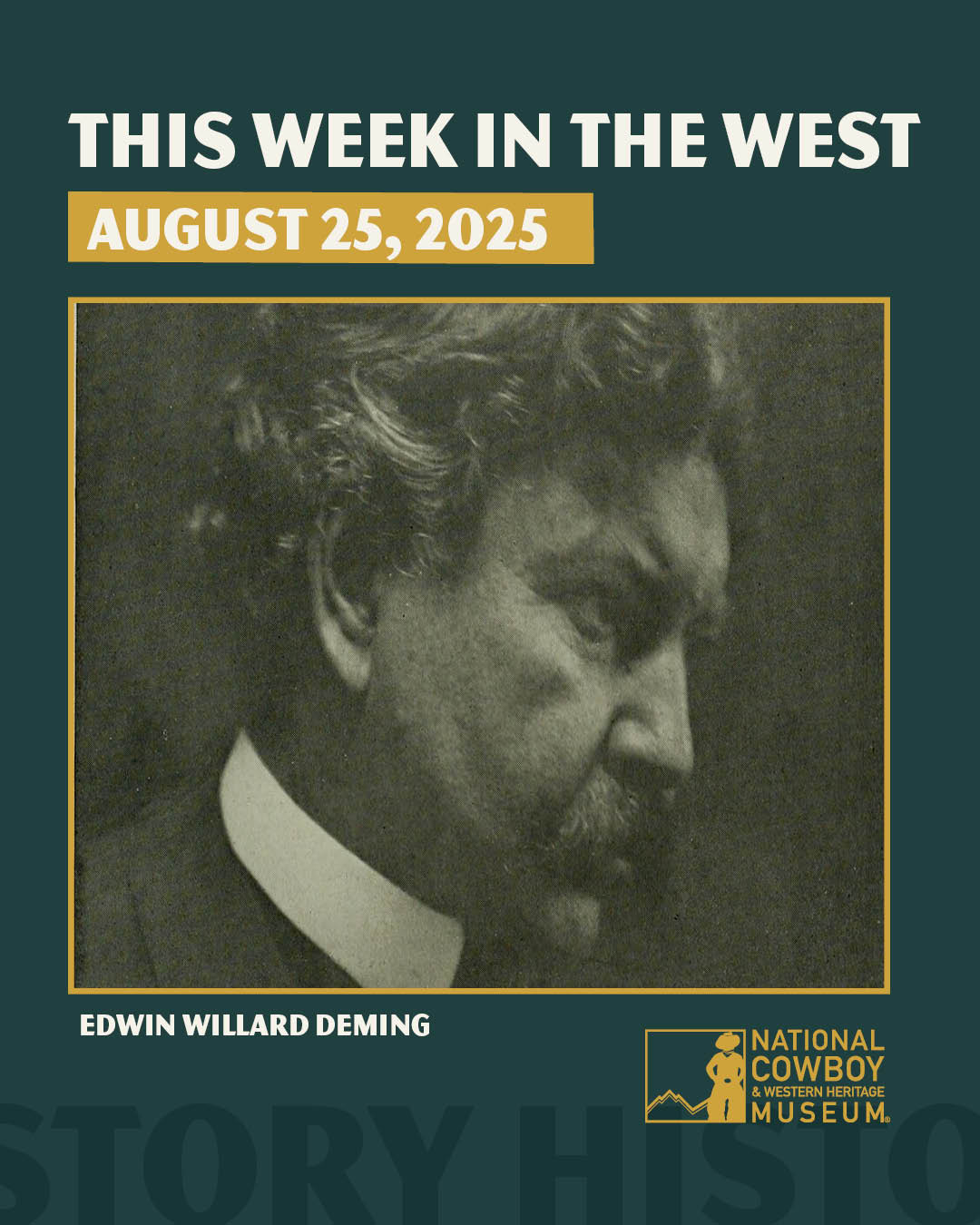
He was artist Edwin Willard Deming, and we remember him this week on the 165th Anniversary of his birth, August 26, 1860.
It was the summer of 1898, and Deming stood before a Blackfoot tribal council in Montana. He was no stranger there. He’d sketched their dances, joined their hunts and shared their campfires for years. But this day was different. In recognition of his respect, his presence and his realistic portraits, the Blackfoot honored him with something more enduring than any medal: a name.
They called him Eight Bears.
To the Blackfoot, the bear symbolized power, and giving that name to a white artist from Illinois was no small thing. And for Deming, who’d once wandered into Indian Territory armed with just a sketchbook, it was the greatest honor of his life.
Deming was born in Ashland, Ohio, but soon his family moved west to Illinois, and it was there through meeting people from the Winnebago tribe, that Deming became fascinated with native people. With an early talent for art, they quickly became the subject of his sketches.
In his teens, Deming made his first solo trip to Indian Territory in present-day Oklahoma. There, he filled page after page with studies of Native life, laying the foundation for a career that would combine observation, artistry and cultural respect.
He enrolled at the Art Students League in New York and by 1884, he’d raised enough money to cross the Atlantic and study at Paris’s famed Académie Julian.
Upon returning home in 1885, Deming’s career took an unusual turn. He painted massive cycloramas — panoramic battlefield scenes painted on cylindrical canvases, designed to immerse the viewer. It was demanding work, but it taught him the power of scale, drama, and storytelling — tools he would later use in his murals and museum pieces.
In the summer of 1887, Deming traveled west to paint the Apaches and Pueblos of the American Southwest. By 1890, he was with the Crow at the Little Bighorn and later the Sioux. He often traveled with fellow artist DeCost Smith, photographing dances, sketching tools and dwellings, and recording tribal customs before they vanished as pioneer settlements expanded.
Deming lived alongside Native families, participated in their ceremonies and earned their trust. It was in these surroundings that Deming learned more about tribal life, which encouraged him to keep his painting realistic, avoiding some of the dramatic (and stereotypical) portrayals of other artists and writers.
In 1892, Deming married and settled down in New York City, the rest of his life developed a steady rhythm: travel in the summer, sketch and study in the field, then return to his studio to turn those notes into finished works.
Deming also became an accomplished sculptor, and during World War I, he even served as a camouflage expert for the U.S. Army, training the Fortieth Engineers in marksmanship and disguise. He rose to the rank of captain.
Perhaps his most lasting legacy came in the form of murals — sweeping, romantic depictions of Native American life — commissioned by major institutions.
Between 1914 and 1916, Deming completed a monumental series of murals for the American Museum of Natural History’s Plains Indian Hall in New York. Visitors to the museum would soon witness sweeping scenes populated by figures from tribes like the Blackfoot, Crow, and Sioux.
His work also found its way into the Brooklyn Museum, the Museum of the American Indian, and the Black Hawk Museum in Wisconsin. One of his murals was even adapted for use on a U.S. postage stamp.
Deming died October 15, 1942, leaving behind a large body of work, including paintings here at The Cowboy.
And with that, we’ve put our name on another episode of “This Week in The West.”
Our show is produced by Chase Spivey and written by Mike Koehler.
Follow us and rate us on Apple podcasts or wherever you hear us. That helps us reach more people.
We can follow us on social media and online at nationalcowboymuseum.org.
Got a question or a suggestion? Drop us an email at podcast@nationalcowboymuseum.org
We leave you today with the words of Henry Fairfield Osburn of the American Museum of Natural History: “Only through sympathy and insight can the artist portray more than a superficial aspect of his subject. Deming gives us far more than a model; he penetrates the deep reserve of Indian stoicism and finds there an underlying reverence and awe in the presence of the great founder of nature, and flashes of the underlying human spirit of sentiment and tenderness.”
Much obliged for listening, and remember, come Find Your West at the National Cowboy & Western Heritage Museum.