

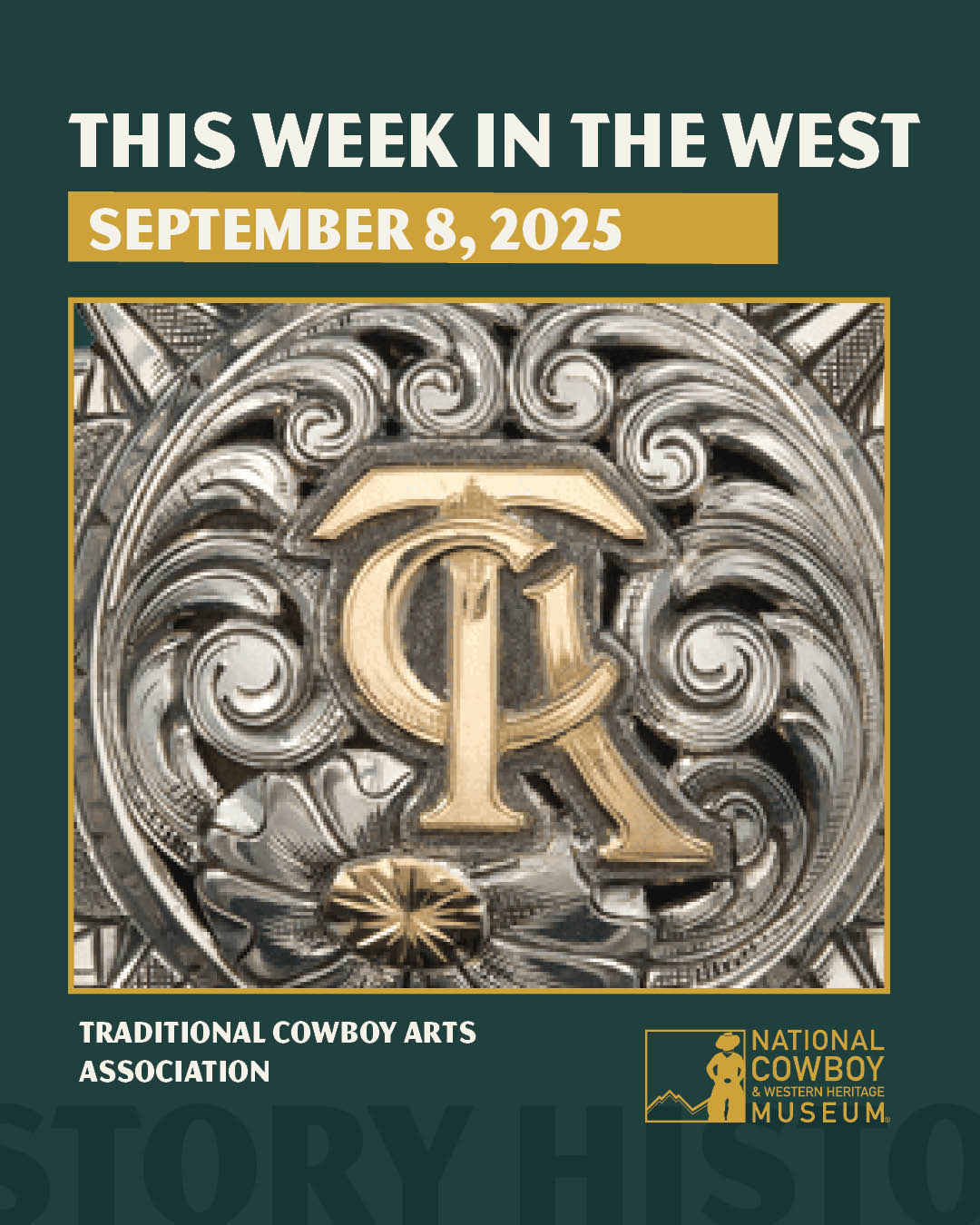
Welcome to the blog about our podcast “This Week in the West.” We’ll share the show’s scripts on our blog each week. If you want to listen, click above, subscribe on your favorite podcast app or check back here every Monday.
If you have questions, ideas or feedback about the podcast, you can reach out to podcast@nationalcowboymuseum.org
Howdy folks, it’s the second week of September 2025 and welcome to This Week in The West.
I’m Seth Spillman, broadcasting from the National Cowboy & Western Heritage Museum in Oklahoma City.
On this podcast, we share stories of the people and events that shaped the history, art and culture of the American West—and those still shaping it today.
It had all the trappings of a good ol’ Western origin story – handshake deals, coin flips and just a couple of guys sitting around the table thinking up big ideas.
The idea that came out of that origin story? The Traditional Cowboy Arts Association, which brings together craftsmen from around North America to showcase their individual disciplines as an art exhibition, is honored to host it here every year at The Cowboy.
So, on today’s episode, we remember those early days of the TCAA, including its first-ever show, held this week, September 11, 1999.
It all started in 1998, in the high desert town of Elko, Nevada. The National Cowboy Poetry Gathering was in full swing—one of those annual events where poets, musicians, ranchers and artists all came together to celebrate the cowboy way of life.
Inside the Red Lion Inn, several of the West’s most talented craftsmen were displaying their wares. Saddles, spurs, rawhide reins, and silver conchos lined the tables.
Among those present were rawhide braider Mike Beaver and Idaho saddlemaker Cary Schwarz.
The men had built reputations for excellence, but both felt a nagging sense that their art, though respected, wasn’t fully recognized and elevated in the larger world of Western culture.
They asked themselves: Could there be more? More freedom to create? More opportunity for recognition? More reward for months of finely detailed work and years of painstaking dedication.
The idea? Perhaps what they needed was a group, something like the Cowboy Artists of America —a gathering of painters and sculptors who had found success by mounting annual group shows.
Why not craftsmen? Why not saddle makers, silversmiths, rawhide braiders and bit and spur makers?
As it turned out, this wasn’t the first time such an idea had bubbled up in someone’s mind.
Years earlier, cowboy artist Joe Beeler had launched a show in Flagstaff, Arizona, titled “Trappings of the West.” He hoped that craftsmen might rally together, just as painters and sculptors had. However, beyond casual conversation, nothing substantial ever developed. What was missing was a catalyst.
That catalyst arrived in the form of a banker.
When Beaver and Schwarz returned home from Elko, the idea still buzzed in their minds. Beaver reached out to Beeler, who encouraged him. Beaver called Schwarz again, who mentioned a friend in his hometown of Salmon, Idaho, who had the business sense that could move them from talk to action.
That friend was Don Bellamy, manager of the local Bank of America branch. Bellamy had experience with corporate start-ups, a love for Western art and a willingness to listen.
In a log cabin on Bellamy’s ranch, he met with Beaver and Schwarz to see what they could create. They studied the bylaws of the Cowboy Artists of America, hammered out a structure and started to sketch out what a new organization might look like.
A larger meeting was held in Boise, Idaho, bringing together skilled artisans in all the traditional cowboy disciplines. Common ground emerged. Three concerns rose above all others: the aging of master artisans whose knowledge might soon be lost, the need to promote craftsmanship as a fine art rather than mere utility, and the desire to educate younger generations so that the traditions wouldn’t fade.
For the first time, these concerns had a roomful of serious people ready to act.
Momentum built through the summer of 1998. Beaver opened up the clubhouse of his Hayden Lake golf and country club for another meeting. A short list of master craftsmen was invited, including silversmiths like Mark Drain and Scott Hardy, bit and spur makers like Ernie Marsh, saddle makers like Dale Harwood, and rawhide braiders of national reputation. A group was taking shape.
But where could such an association showcase its work? Who would give them a stage large enough to prove the worth of cowboy craftsmanship?
The answer came from right here in Oklahoma City.
In July 1998, Bellamy and others met with Dr. Bobby Weaver, then the assistant director at The Cowboy. Weaver listened carefully to the pitch for a group exhibition. When the question of money came up, his answer set the tone for a long partnership: “Let’s find the money and do this right.”
The Museum was nearing completion of a 140,000-square-foot expansion in a little over a year. A new show could be a part of celebrating that addition.
It was settled. The Cowboy would host the group’s first exhibition on September 11, 1999.
But what exactly was this group going to be called?
Over a meal in Oklahoma City, two proposals were put forward: the Cowboy Working Arts Association and the Traditional Cowboy Arts Association. When the votes came in, it was a tie.
The solution was as old-fashioned as a poker game in a saloon: a coin toss. Don Bellamy flipped the coin, saddlemaker Chuck Stormes called it, the Museum’s Cowboy Curator Don Reeves witnessed it and the name Traditional Cowboy Arts Association was born.
In January of 1999, a marathon meeting was held at a Denny’s restaurant in Elko, Nevada, during the Cowboy Poetry Gathering. Nine active members sat around the table, joined by museum staff and advisors.
They pored over the Cowboy Artists’ bylaws, shaped their own rules and laid the groundwork for a first exhibition. The sense of excitement was palpable.
That fall, the first TCAA Exhibition & Sale opened at the National Cowboy Museum. Thirty outstanding works of Western craftsmanship filled the Eldridge Gallery, a display of saddles, spurs, silver and rawhide that combined utility with art.
Guests walked past a looming statue of Abraham Lincoln into a room that looked less like a tack shop and more like a fine art gallery.
The message was clear: this was art of the highest order.
The craftsmanship of the West had found its rightful stage.
From that successful debut, the TCAA grew into much more than an exhibition. Its mission expanded to include mentorship programs, professional workshops, scholarships, and educational outreach. All these efforts were designed to pass knowledge from the masters to the next generation. What began as a conversation in a Nevada hotel evolved into a living, breathing community of artists dedicated to preserving cowboy traditions.
Last year, the TCAA celebrated its 25th exhibition here at The Cowboy. All current members of the organization, along with some emeritus members, collaborated on a single project: the California Rose Saddle.
Today, the Traditional Cowboy Arts Association is recognized as a standard-bearer for excellence in saddlemaking, bit and spur making, rawhide braiding, and silversmithing.
This year’s show begins on September 12, with the sale weekend taking place on September 26-27.
The TCAA reminds us that the West is not just abstract history; often, it’s something tangible. We can see those living traditions, hammered, stitched, braided and engraved into objects that carry both beauty and purpose.
And with that, we’ve carved out another episode of “This Week in The West.”
Our show is produced by Chase Spivey and written by Mike Koehler.
Follow us and rate us on Apple Podcasts or wherever you hear us. That helps us reach more people.
We can follow us on social media and online at nationalcowboymuseum.org.
Got a question or a suggestion? Drop us an email at podcast@nationalcowboymuseum.org
We leave you today with the words of Western historian and author Don Hedgpeth in the book “Cowboy Renaissance” about the history of the TCAA: “The boys of the TCAA know what counts to cowboys. They are cut from the same cloth. I suppose it is possible for someone to learn how to build a saddle, a loose-jawed bit or a set of Santa Ynez reins without ever having been on a horse. But I wouldn’t want to own them.:
Much obliged for listening, and remember, come Find Your West at the National Cowboy & Western Heritage Museum.