





Welcome to the blog about our podcast “This Week in the West.” We’ll share the show’s scripts on our blog each week. If you want to listen, click above, subscribe on your favorite podcast app or check back here every Monday.
If you have questions, ideas or feedback about the podcast, you can reach out to podcast@thecowboy.org
Howdy folks, it’s the fifth week of September 2025, and welcome to This Week in The West.
I’m Seth Spillman, broadcasting from the National Cowboy & Western Heritage Museum in Oklahoma City.
On this podcast, we share stories of the people and events that shaped the history, art and culture of the American West—and those still shaping it today.
He was one of Hollywood’s greatest and most successful cowboys.
He made a fortune in business and changed the landscape of Major League Baseball.
But Gene Autry’s most lasting legacy comes every Christmas when his words come warbling out of the radio: “You know Dasher and Dancer, Prancer and Vixen, Comet and Cupid, Donner and Blitzen, but do you recall, the most famous reindeer of all.”
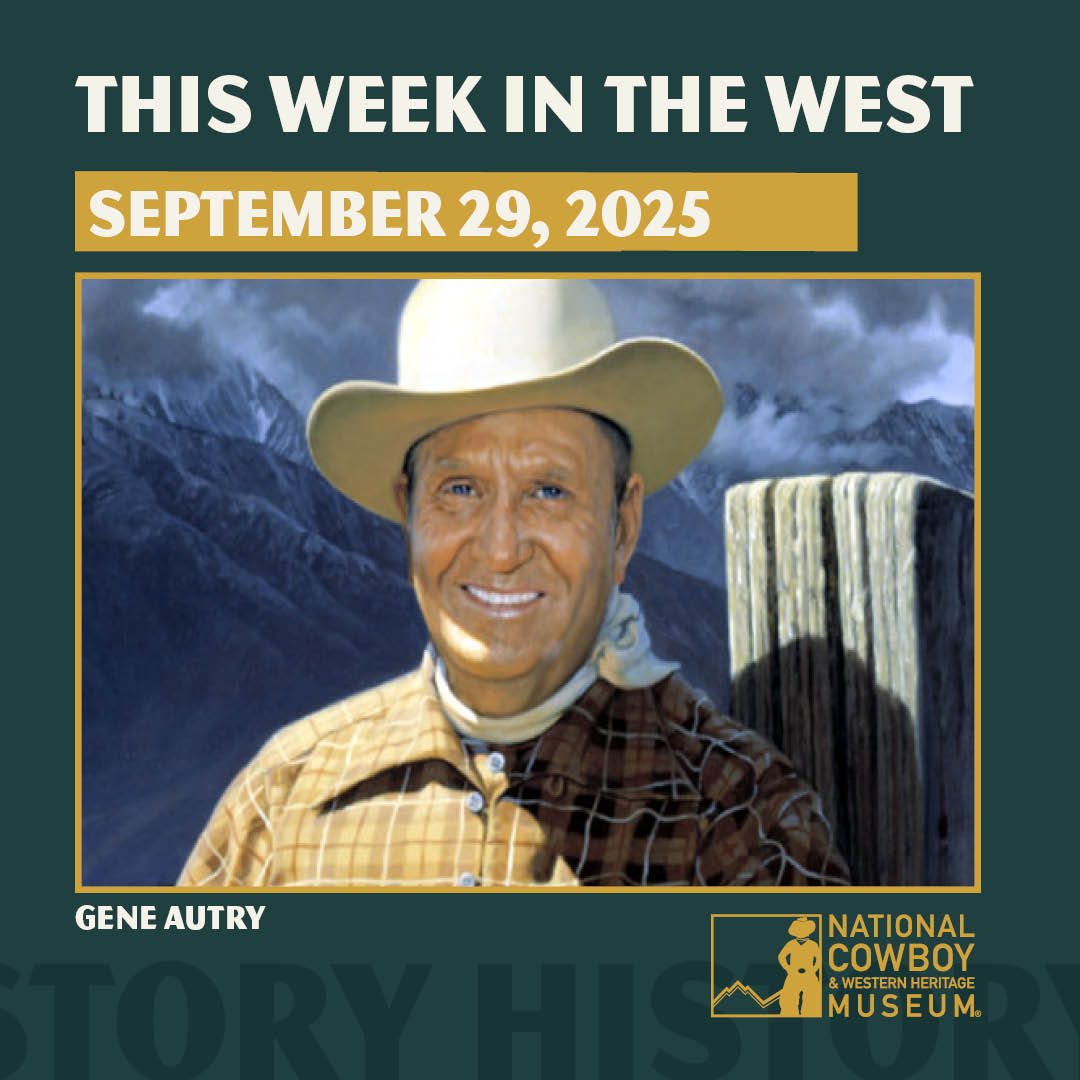
Today, we remember the Singing Cowboy on the week of his birth, September 29, 1907.
Gene Autry was born in Tioga, Texas, but his family soon moved north to Oklahoma, where young Gene grew up working cattle on his father’s ranch.
After finishing high school, he found steady work as a telegraph operator for the St. Louis–San Francisco Railway in Chelsea, Oklahoma. Late at night, in the lonely quiet of the telegraph office, Gene kept himself company with a guitar.
He strummed cowboy songs, gospel hymns, and the popular tunes of the day. According to legend, one night, who would overhear the telegraph troubadour, but none other than Will Rogers.
Oklahoma’s favorite son encouraged the lad to take his singing talent seriously. It was all the nudge that Autry needed.
By 1928, he was singing on Tulsa’s KVOO radio as “Oklahoma’s Yodeling Cowboy.” A year later, he signed with Columbia Records, and his first hit came in 1932 with That Silver-Haired Daddy of Mine. That song sold hundreds of thousands of copies during the depths of the Great Depression. He worked in Chicago on the WLS-AM radio show National Barn Dance for four years, where he met singer-songwriter Smiley Burnette.
Radio success brought film offers. In 1934, Autry and his sidekick Smiley were cast in In Old Santa Fe. Audiences loved him, and just a year later, Gene starred in the 12-part serial The Phantom Empire, a wild mix of cowboys, science fiction, and musical numbers.
What set Autry apart was simple: he played himself. He was a cowboy who could ride hard, fight fair and carry a tune. His horse, Champion, became nearly as famous as Autry himself.
Between 1934 and 1953, Autry appeared in 93 films. He wasn’t just a cowboy—he was a brand. His films carried Western music nationwide, cementing him as one of country music’s most influential pioneers.
By the late 1930s, Autry was Republic Pictures’ biggest star. His blend of action, humor, and song filled theaters coast to coast. Kids carried Gene Autry cap guns, read his comic books, and listened to his radio adventures.
His theme song, Back in the Saddle Again, became a smash hit.
When World War II broke out, Autry didn’t stay in Hollywood. He enlisted in the U.S. Army Air Corps in 1942. Already a licensed pilot, he trained for military service and became a flight officer. He flew supply missions over the Himalayas, a dangerous route known as “The Hump,” delivering critical resources to Allied troops in China.
During his service, Republic Pictures worried about losing its star. They promoted Roy Rogers as “King of the Cowboys” in Gene’s absence.
In the postwar years, Autry’s fame only grew. He signed with Columbia Pictures, formed his own Flying A Productions company, and co-starred in films and television shows with a new sidekick, Pat Buttram (you might remember him, and his voice, as Mr. Haney on Green Acres).
His Gene Autry Show ran on CBS from 1950 to 1956, and Melody Ranch remained a radio favorite for 16 years.
Meanwhile, Gene was recording music at a furious pace. Over his career, he made 640 recordings and sold more than 100 million records.
And that’s where Christmas comes into the picture,
Autry wrote Here Comes Santa Claus after serving as Grand Marshal of the Hollywood Christmas Parade, inspired by hearing children chant the phrase as Santa rode by.
He recorded Rudolph the Red-Nosed Reindeer in 1949, and it became the first No. 1 hit of the 1950s.
Add in Frosty the Snowman and Up on the Housetop, and Gene Autry secured his place as the cowboy who defined Christmas.
In 1953, Autry bought Monogram Ranch in California and renamed it Melody Ranch. It became a hub for film and television production, hosting classics like Gunsmoke.
When a devastating fire destroyed much of the ranch in 1962, Autry shifted his dream toward building a museum. That vision became the Autry Museum of the American West in Los Angeles.
Gene also loved rodeo. He ran one of the largest rodeo stock companies in America, providing animals for major events across the West. For his contributions, he was inducted into the ProRodeo Hall of Fame in 1979.
Autry was also a successful businessman. He invested in hotels, real estate, radio and television stations. In 1961, he became the founding owner of the Los Angeles Angels baseball franchise.
The Angels never won a World Series during his lifetime, but when they finally did in 2002, players carried Gene’s cowboy hat onto the field in tribute, and his song Back in the Saddle Again played over the loudspeakers.
By the time of his passing in 1998, Gene Autry had done it all. He remains the only person with stars in all five categories on the Hollywood Walk of Fame—film, television, music, radio and live performance.
He was inducted into the Country Music Hall of Fame, the Nashville Songwriters Hall of Fame, and our own Hall of Great Western Performers.
On November 16, 1941, the southern Oklahoma town of Berwyn renamed itself “Gene Autry.”
And with that, we’re finished with our reindeer games for another episode of “This Week in the West.”
Our show is produced by Chase Spivey and written by Mike Koehler
Follow us and rate us on Apple Podcasts or wherever you hear us. That helps us reach more people.
You can follow us on social media and online at nationalcowboymuseum.org.
Got a question or a suggestion? Drop us an email at podcast@thecowboy.org
We leave you today with the words of music legend Johnny Cash: “Reflecting upon the great people I have known, as an All-American image of goodness, justice, good over bad, nothing or no one comes closer than Gene Autry.”
Much obliged for listening, and remember, come Find Your West at the National Cowboy & Western Heritage Museum.