

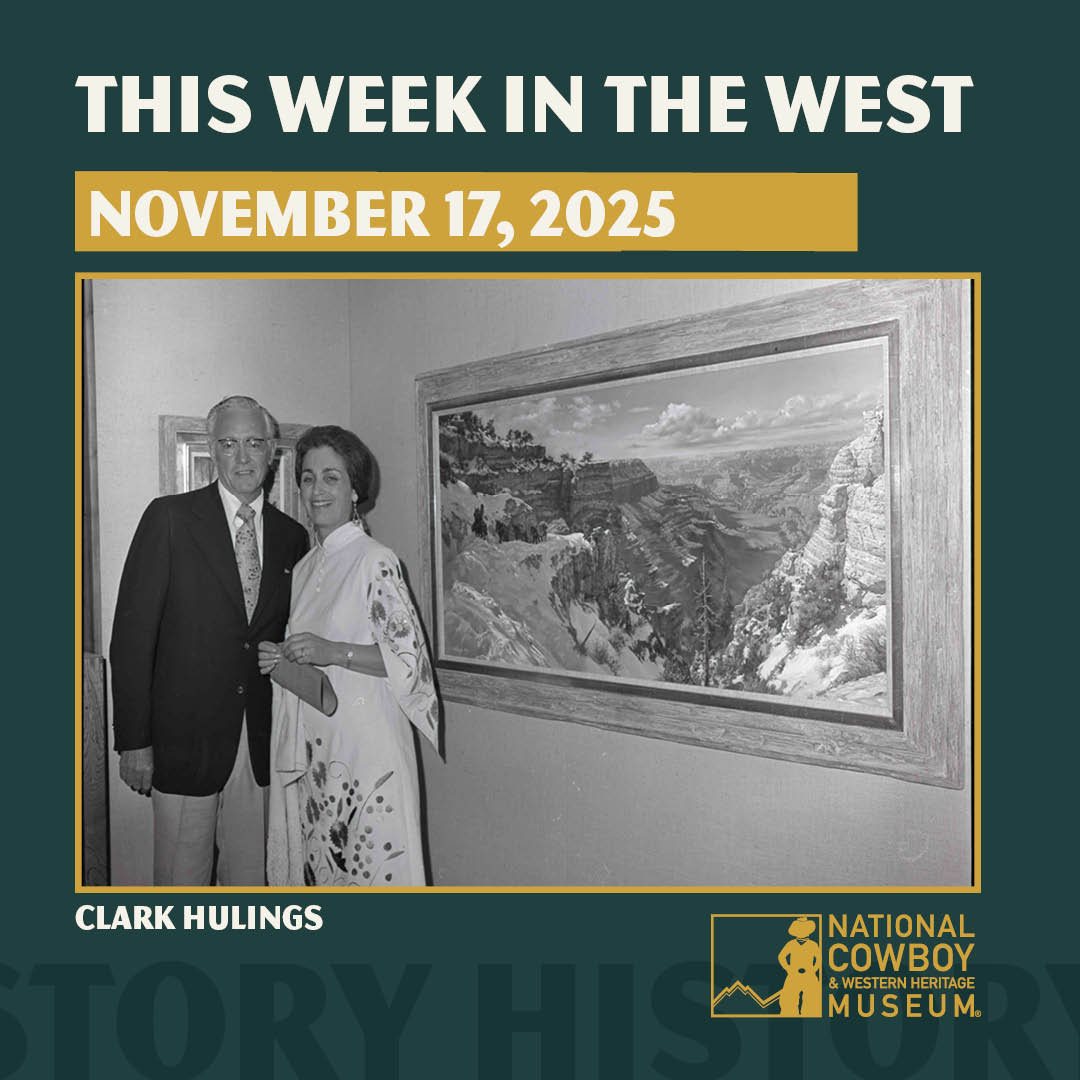
Howdy folks, it’s the third week of November 2025, and welcome to This Week in The West.
I’m Seth Spillman, broadcasting from the National Cowboy & Western Heritage Museum in Oklahoma City.
On this podcast, we share stories of the people and events that shaped the history, art and culture of the American West—and those still shaping it today.
Every June here at the Cowboy, we are surrounded by the stunning creations of the best Western artists in the country.
We are the hosts of the annual Prix de West Invitational Art Exhibition & Sale, an event that has showcased leading works of Western art for more than 50 years. The pinnacle of each year’s show is the naming of the Purchase Award Winner, the piece selected to join the Museum’s permanent collection.
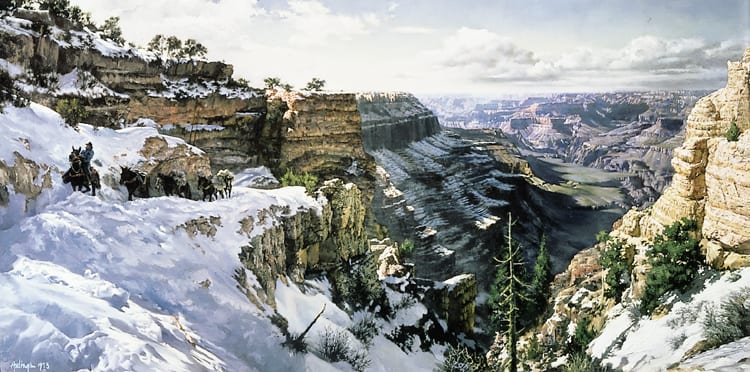
That tradition began in 1973, honoring a painting of sweeping, snowy slopes called “Grand Canyon, Kaibab Trail” by artist Clark Hulings, who was born this week, November 20, 1922.
Clark was born in Florida, but his family moved frequently and lived abroad until he was 6.
When they finally settled in New Jersey, Clark was already showing signs of artistic talent. By his teens, his family had enrolled him in art classes, and his father would take him on weekend trips to New York City. While there, Clark would spend hours being inspired by great works of art.
Clark told Art of the West Magazine in a 2007 interview. “The story is that I used to go to New York with my father every Saturday to visit my aunt,” “He would drop me off at the Metropolitan Museum of Art, and I would study the paintings there. I was about 13 at the time. My favorites then are still my favorites today.”
Clark struggled with serious illness as a young man. The tuberculosis that would take his mother’s life left him sickly. After earning a degree in Physics, he was invited to join the Manhattan Project during World War II, but his health kept him from participating in the secret program.
While Clark never made it to Los Alamos, New Mexico, to help with the bomb, his family did send him to Santa Fe, hoping the climate would improve his health. The relocation did more than that. The landscapes of the Southwest inspired Clark to dive deeply into his passion for painting. Selling portraits helped to pay the bills, and he earned his first show at the New Mexico Museum of Art in 1945.
Yet Clark remained restless and hungry to develop his craft. He lived in Denver, then Baton Rouge, and later returned to New York City, where he built a successful career as an illustrator. He later spent several years in Europe, studying painting techniques and deepening his skills.
When he returned to the U.S., Clark gradually transitioned from commercial illustration to fine art. A final move from New York to Santa Fe, where he would live for the rest of his life, cemented his standing in the art world.
He was enthralled by his Southwest surroundings, both its natural landscapes and the hustle and bustle of local markets.
Clark said. “If I were to claim a talent, I think it’s basically recognizing what to paint,” “To be able to drive across the countryside and know what to paint is almost intuitive.”
Clark’s intuition served him well when he sat down to create “Grand Canyon, Kaibab Trail” in the early 1970s. A podcast might not be the best medium to talk about the visual art of painting, so we’ll post a link to the painting in our show notes and on social media.
The canvas shows a man on horseback followed by four pack mules navigating a narrow, snow-covered trail. The trail is barely more than a notch carved into the cliff face. Beneath them spreads the vastness of the Grand Canyon, rendered in sweeping color and extraordinary detail.
That is the work Clark brought to Oklahoma City in 1973, the first year of what was then called the National Academy of Western Art exhibition. Museum Director Dean Krakel established the Academy to expand the idea of what counted as ‘Western art’ — moving beyond the strictly cowboy-themed works that had dominated earlier shows.
Western artist Robert Lougheed (LOW-HEED) helped recruit artists from across the country. The result? On the weekend of June 8th and 9th, 1973, 92 works by 34 artists were presented to a crowd of more than 500 art enthusiasts.
After winning the Purchase Award, Clark called it one of the high points of his career.
He never entered the Prix de West again, saying he could never surpass that first success. In 1976, the Museum hosted a major one-man show of his work.
Clark returned to Santa Fe and continued to paint well into his 80s.
He died in 2011. Clark Hulings was 88.
And with that, we’ve put a frame around another episode of “This Week in the West.”
Our show is produced by Chase Spivey and written by Mike Koehler.
Follow us and rate us on Apple Podcasts or wherever you hear us. That helps us reach more people.
You can follow us on social media and online at nationalcowboymuseum.org.
Got a question or a suggestion? Drop us an email at podcast@thecowboy.org
We leave you today with the words of Clark Hulings: “I don’t think I ever have bad painting days, but that isn’t the same question as ‘Do you ever paint bad paintings?’ Sometimes what I’m trying to achieve isn’t working out, and I handle that by working my way out of it; I don’t just give up.”
Much obliged for listening, and remember, come Find Your West at the National Cowboy & Western Heritage Museum.