




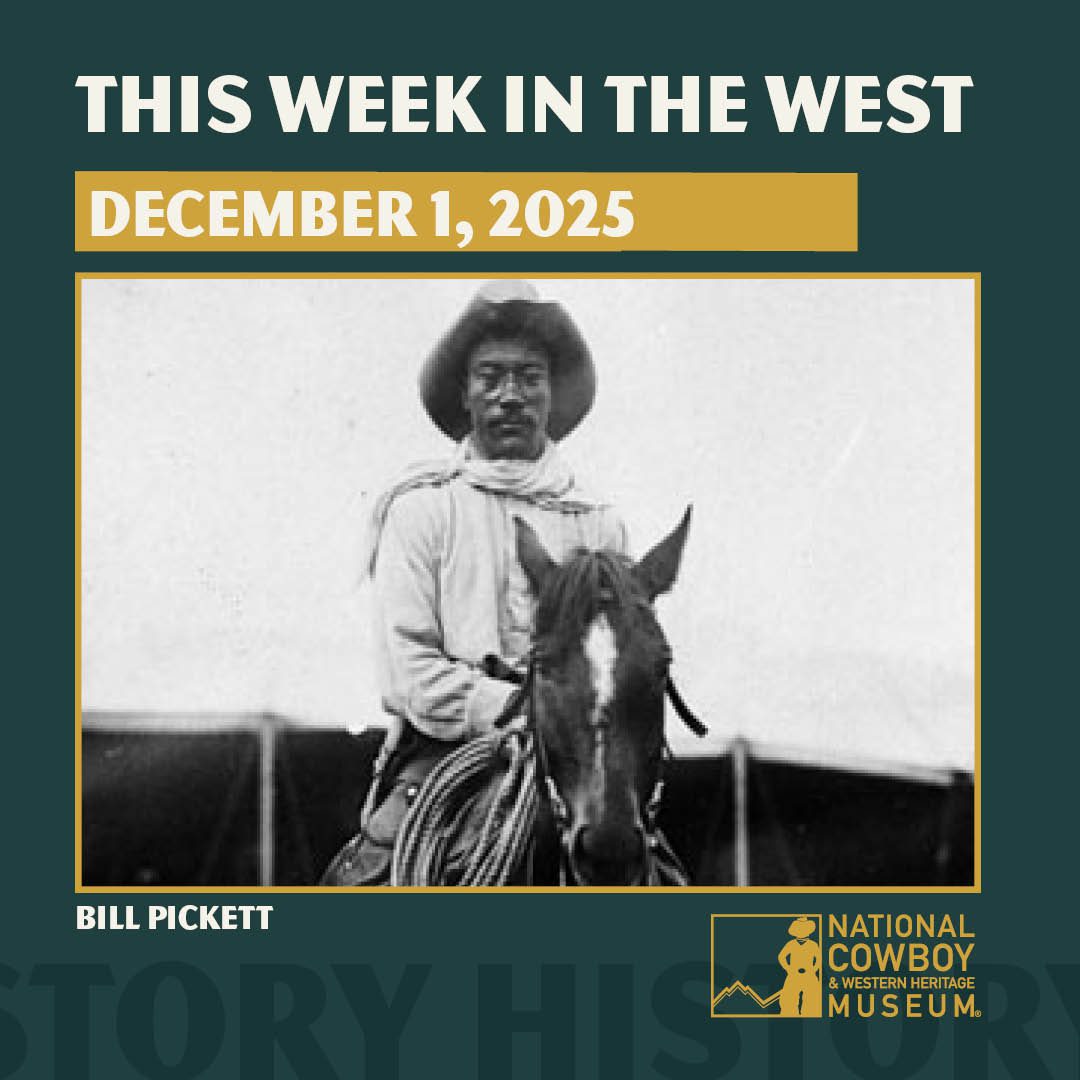
DEC. 1: 1870 –Bill Pickett birth
Howdy folks, it’s the first week of December 2025, and welcome to This Week in The West.
I’m Seth Spillman, broadcasting from the National Cowboy & Western Heritage Museum in Oklahoma City. On this podcast, we share stories of the people and events that shaped the history, art and culture of the American West—and those still shaping it today.
It seems like mythology, but it’s worth saying this first.
Bill Pickett pulled down steers with his teeth.
There were witnesses to this in the wild early days of the rodeo, and they could barely contain themselves when they described the exploits of Bill Pickett, born this week, Dec. 5, 1870.
Let’s start there with the recollections of Dr. J. Gordon Bryan, a Texas doctor who saw Bill perform in a rodeo in the early 1900s. In a biography of Pickett, Dr. Bryan recalled: “’Tis a happy moment indeed, when someone comes forward to substantiate a factual, but wild-sounding statement which has slipped out in an enthusiastic declaration. Right now I am thinking about (Bill) Pickett, who threw and dragged the big steer with his teeth … at a county fair in Florence, Texas.”
Pickett was born in Texas to formerly enslaved parents, one of 13 children who became arguably the world’s most famous Black cowboy, reputed inventor of bulldogging, and a Hall of Fame rodeo performer.
Post-Civil War Texas was a challenging environment for any black family, let alone the Picketts. They eked out a living by farming and providing labor on other ranches. That work involved all the children, including young Bill, who picked up the skills of riding, roping, and handling livestock.
After the fifth grade, he left school and began working full-time as a ranch hand. He had a way with cattle but noticed that ranch dogs, especially bulldogs, had a particular way of controlling the steers they were tasked with herding.
A bulldog would run up on a stray steer while grazing or stuck in the brush, biting its lip and forcing it to submit. After the bite, the steer would go anywhere the dog wanted it to go.
This inspired Pickett’s technique. He adapted this method for human use, perfecting the art of riding hard toward a steer, leaping from a horse, biting the steer’s lip, and wrestling it to the ground. He tried it out at different rodeos.
The innovation was radical, and it immediately garnered attention. Pickett’s ability to bulldog a steer became a major draw at rodeos and Wild West shows across the country.
While the lip-biting part of his technique was eventually abandoned in modern steer wrestling due to safety concerns, Pickett’s method of wrestling the steer to the ground remained the foundation of the event.
As his fame spread, Bill joined one of the most famous rodeo outfits of the time, the Miller Brothers’ 101 Ranch Wild West Show, based in Oklahoma.
The 101 Ranch was known for its massive shows, which featured cowboys, Native Americans, and performers from various backgrounds showcasing their skills in front of packed crowds.
Bill was a standout performer. Not only was he a rare Black cowboy in a largely segregated society, but his bulldogging act was unlike anything the audience had ever seen.
In the early 1900s, he performed in traveling Wild West shows alongside legendary figures such as Buffalo Bill Cody, Tom Mix, and Will Rogers, further cementing his status as a top-tier cowboy and rodeo star. The shows took him around the world performing.
Zack Miller of the 101 Ranch said “Bill Pickett was the greatest sweat-and-dirt cowhand that ever lived – bar none. When they turned Bill Pickett out, they broke the mold.”
In 1907, the program of the 101 Ranch Wild West Show described Bill’s act as “‘The Dusky Demon of Texas’ who jumps from the back of a horse going at full speed to that of a steer and then, grappling with the latter, throws it to the ground without using his hands in the operation.”
Despite his fame, Bill was not immune to the racial prejudices of the early 20th Century. Often, he would identify himself as a Mexican or Native American in order to perform in certain parts of the country. Some cities, upon learning that he was black, banned him.
In the 1920s, like many other Wild West show performers, Bill gave Hollywood a try. He became the first black cowboy movie star, filming a pair of films in Oklahoma, Crimson Skull in 1921 and The Bulldogger in 1923, which were shown to African-American audiences.
He retired from rodeo and movies soon after but continued to work as a cowhand.
On April 1, 1932, Bill was working on the 101 Ranch when he was kicked in the head by a horse. He died the next day. Bill Pickett was 61.
And with that, we’ve bulldogged another episode of “This Week in the West.”
Our show is produced by Chase Spivey and written by Mike Koehler.
Follow us and rate us on Apple Podcasts or wherever you hear us. That helps us reach more people.
You can follow us on social media and online at nationalcowboymuseum.org.
Got a question or a suggestion? Drop us an email at podcast@thecowboy.org
We leave you today with words from the poem “Old Bill is Dead,” written by Zack Miller following Bill’s death: “Like many men in the old-time West, on any job he did his best. He left a blank that’s hard to fill, for there’ll never be another Bill. Both White and Black will mourn the day that the ‘Biggest Boss’ took Bill away.”
Much obliged for listening, and remember, come Find Your West at the National Cowboy & Western Heritage Museum.d Your West at the National Cowboy & Western Heritage Museum.