





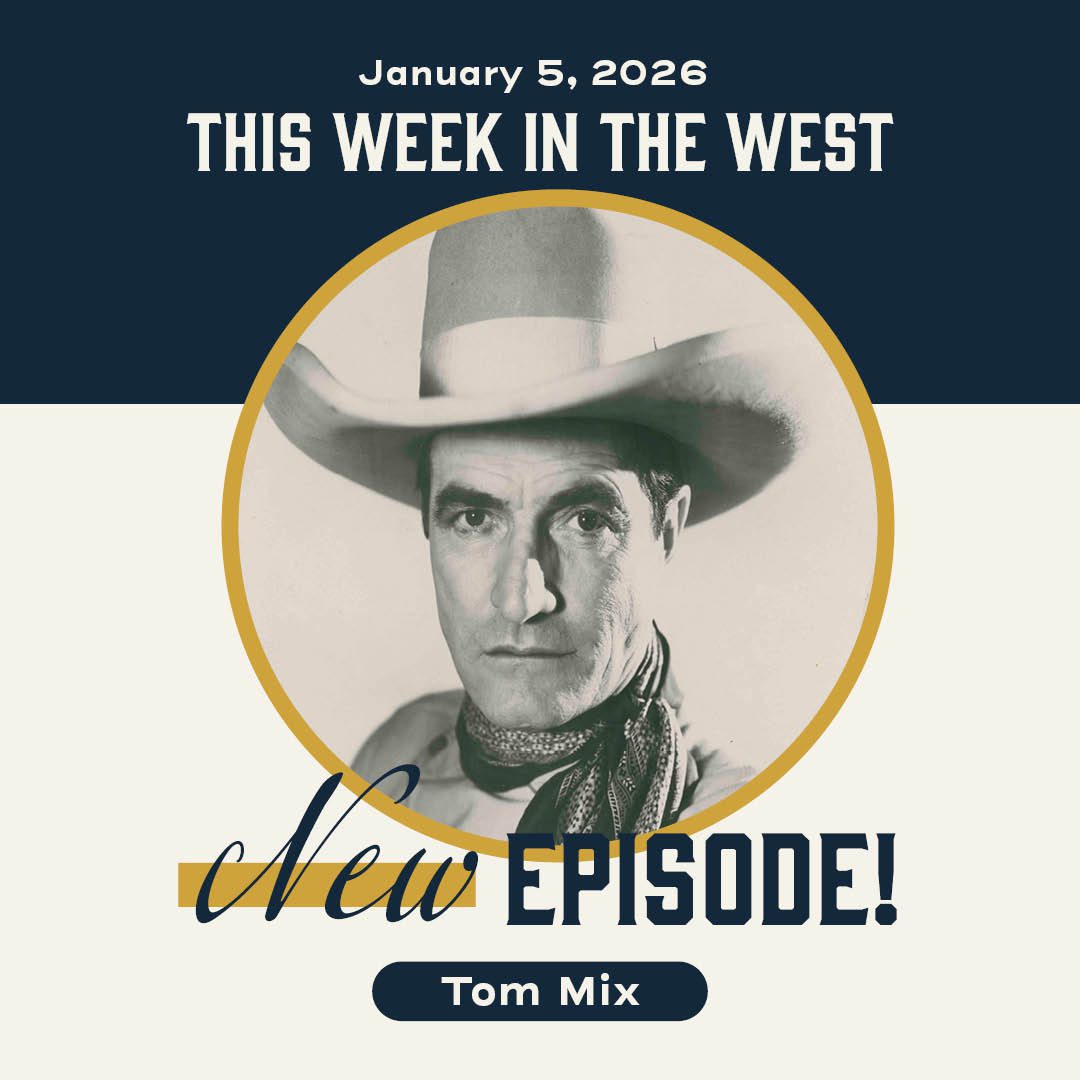
Howdy folks, it’s the first week of January 2026, and welcome to This Week in The West.
I’m Seth Spillman, broadcasting from the National Cowboy & Western Heritage Museum in Oklahoma City.
On this podcast, we share stories of the people and events that shaped the history, art and culture of the American West—and those still shaping it today.
It’s said that Tom Mix was larger than life.
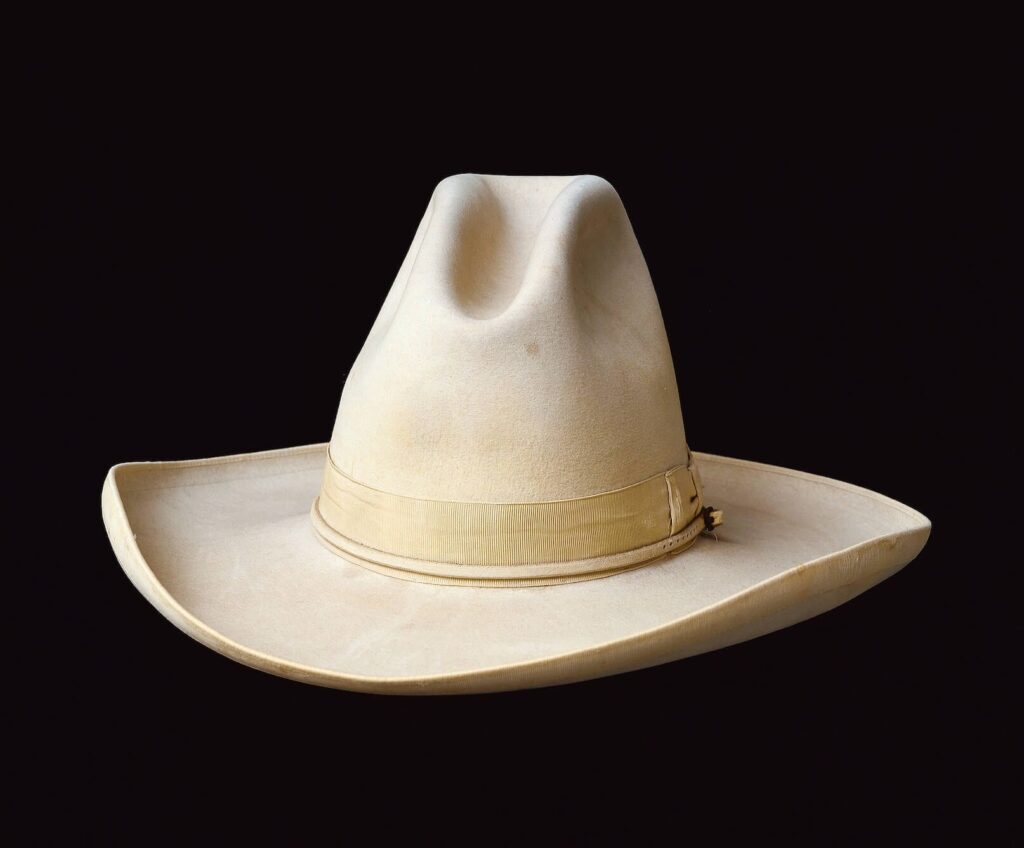
That’s true of his story, his Hollywood career and, honestly, his cowboy hat.
Mix wore a huge white ten-gallon Stetson, 7 inches high and 14 inches wide. At the height of his fame, Stetson was custom-making them for the movie star, the bigger the better. We even have one of the towering hats in our collection, created for the star in 1925.
Let’s tell the story of one of the first cowboy matinee idols on the week of his birth, January 6, 1880.
Thomas Hezikiah Mix was born in Mix Run, Pennsylvania, a rugged little settlement tucked into the state’s northern woods. His father, a stablemaster, taught him to ride, and he worked on nearby ranches as a young man.
Mix enlisted in the U.S. Army during the Spanish–American War in 1898. His unit never deployed, and in 1902, when he overstayed a furlough to marry Grace Allin, he was listed as AWOL. The marriage ended within the year, and Mix drifted west.
By the early 1900s, he found himself in Oklahoma: bartending in Guthrie, drumming in the Territorial Cavalry Band, working at the Dewey Portland Cement Plant and picking up ranch work wherever he could.
His life changed when he met the Miller brothers of the legendary 101 Ranch. They hired him as a ranch hand and later as a performer in the 101 Ranch Wild West Show. Mix quickly stood out. He was a superb rider, an accomplished shot and charismatic. He won national roping and riding contests and began to sense that show business might be his calling.
In 1909, he married Olive Stokes, who was part Cherokee and an accomplished cowgirl herself. They would have a daughter, Ruth, in 1912, and Olive would later document her life with Tom in a memoir.
Then the movies arrived.
The Selig Polyscope Company came to Oklahoma to shoot a short documentary called Ranch Life in the Great Southwest. Mix appeared in it as himself, demonstrating his horsemanship and cattle-handling skills. Audiences loved it.
The camera had captured cowboys not as mythic figures but as real working hands. Mix stole the show.
Selig signed Mix and put him to work. Between 1909 and 1917, Mix made more than 230 films for the company, most of them one-reelers, many shot in Oklahoma or New Mexico. They were simple, fun, action-packed stories, and Mix, always doing his own stunts, was riveting. Audiences loved him.
When Selig faced financial hardship during World War I, Mix sought new opportunities. He found them with William Fox of the Fox Film Corporation. Fox admired Mix’s athleticism, loved that he did his own stunts, and offered him $350 a week. The broader distribution of Fox films catapulted Mix from a regional star to a worldwide celebrity.
At Fox, Mix helped transform the Western from 15-minute quickies into full-length adventure films. The studio soon raised his salary to $17,500 a week. In 2026 dollars, that’s about $15 million a year.
Mix quickly put his riches to use: He built Mixville, a 12-acre Western town on the studio lot, complete with saloon, jail, frontier storefronts and even a faux mountain range for dramatic chase scenes.
Mix’s movies laid out some of the basic vocabulary of Westerns in the 20th Century. Good guys wore white hats, bad men were in black, the daring horseback rescues, moral clarity and a guy’s best friend was his horse.
Mix had Tony the Wonder Horse, who became a star in his own right, performing tricks and stunts that dazzled audiences.
Mix lived lavishly and worked relentlessly, but cracks began to form. He divorced Olive, then married an actress, and his travel and her spending strained their marriage.
Even at the height of his film fame, Mix returned periodically to Wild West shows because he loved the live connection with audiences.
But soon silent films gave way to sound, and Mix found himself out of step with Hollywood’s new direction.
In 1928, Fox chose not to renew his contract.
By 1929, everything seemed to happen at once: a tax dispute, the collapse of the stock market and the loss of both his fortune and his Arizona ranch.
Looking to make a living, Mix hit the road again. He toured with the Sells-Floto Circus from 1929 to 1931, making back some of his fortune while performing trick riding and roping acts. In 1932, he married his fifth and final wife.
Universal briefly lured him back into films, but a string of injuries and fickle film fans convinced him to return to the circus world full-time.
In 1935, he made one last outstanding Hollywood contribution: the 15-episode Mascot Pictures serial The Miracle Rider, earning $40,000 for the four-week shoot. The serial was a smash hit, and its dramatic chase scenes filmed among the sandstone boulders of Chatsworth, California, are among the best of early Westerns.
But the twilight of his career was anything but a Hollywood ending.
He had earned more than six million dollars during his film career — over $130 million in today’s money — but just as quickly spent or lost most of it.
On October 12, 1940, while driving through Arizona after visiting a friend, Mix approached a washed-out detour at high speed. His car overturned, killing him instantly. He was 60 years old.
Thousands attended his funeral at the Little Church of the Flowers in Glendale. At the site of his death, a simple stone marker reads: “In memory of Tom Mix, whose spirit left his body on this spot and whose portrayals in life helped fix memories of the Old West in the minds of living men.”
Mix made nearly 300 films, though tragically many were lost in the 1937 Fox vault fire.
In 1958, he was inducted into the Hall of Great Western Performers here at The Cowboy.
And with that, we’ve doffed our hats to another episode of “This Week in the West.”
Our show is produced by Chase Spivey and written by Mike Koehler.
Follow us and rate us on Apple Podcasts or wherever you hear us. That helps us reach more people.
Come visit us in Oklahoma City! You can now buy tickets online at nationalcowboymuseum.org-slash-tickets
Got a question or a suggestion? Drop us an email at podcast@nationalcowboymuseum.org
We leave you today with the words of author Paul Mix (no relation) in his biography of the movie star: “Tom Mix has always been considered more or less a man of mystery… It is extremely difficult to distinguish between Tom’s legendary acts of heroism and true-life adventures. The legend of Tom Mix will probably never die.”
Much obliged for listening, and remember, come Find Your West at the National Cowboy & Western Heritage Museum.odcast@nationalcowboymuseum.org
We leave you today with the words of Shanna Bush about her mother, Wanda: “(A friend) said Wanda was ‘quietly famous’ and I always thought that summed her up. Granddad raised her that way. He said, ‘We were who we were, just be yourself. We’re not above anyone else or below anyone else. All you have to do is be Wanda.’”
Much obliged for listening, and remember, come Find Your West at the National Cowboy & Western Heritage Museum.