
Howdy folks, it’s the third week of January 2026, and welcome to This Week in The West.
I’m Seth Spillman, broadcasting from the National Cowboy & Western Heritage Museum in Oklahoma City.
On this podcast, we share stories of the people and events that shaped the history, art and culture of the American West—and those still shaping it today.
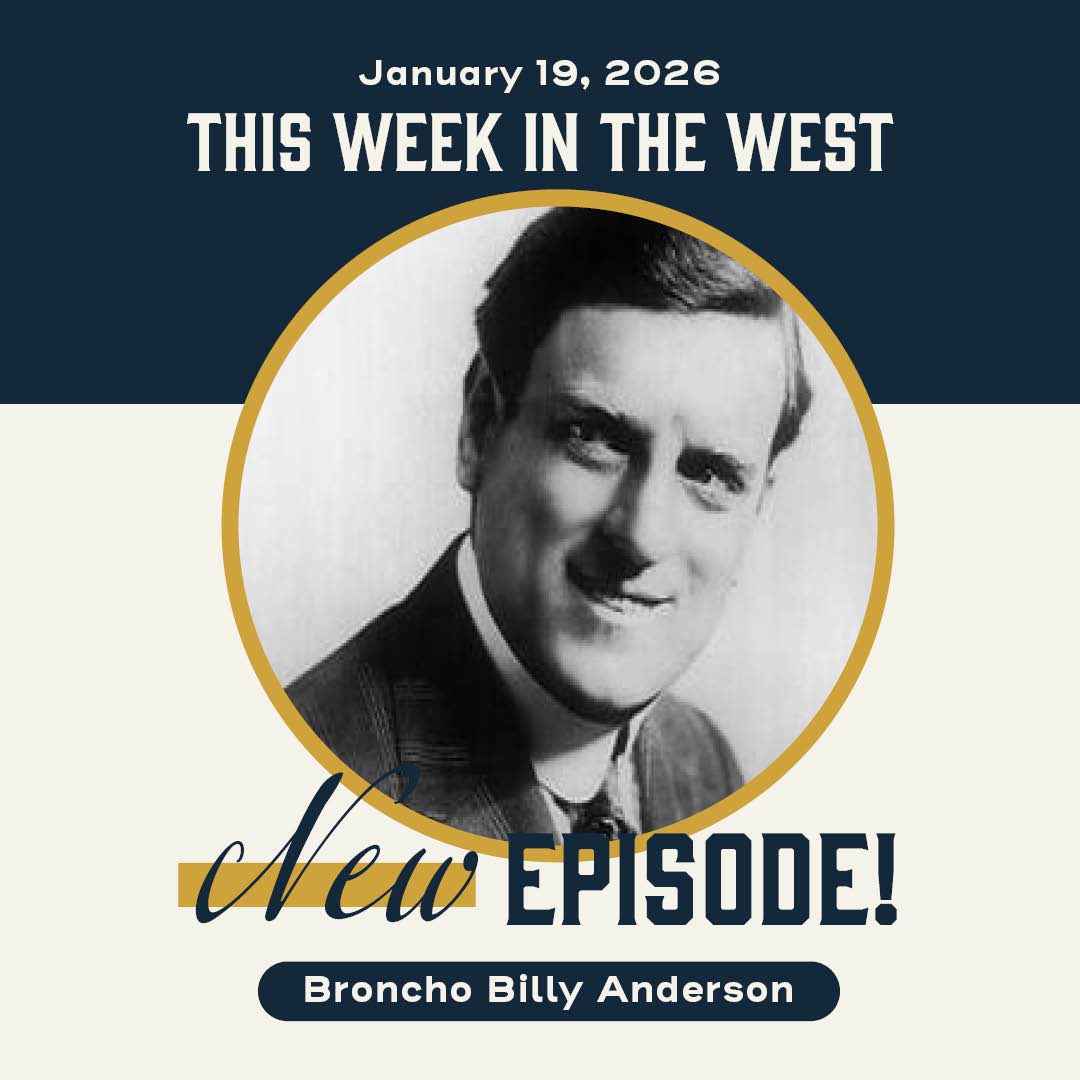
Long before Hollywood had sound, superheroes, or even a clear idea of what a movie could be, one man helped invent the cowboy — and the language of film itself. It was November 1903 in New Jersey, and Gilbert Aronson was juggling three different roles in a bold new motion picture. He scowled as an outlaw, danced, and then died as an unlucky passenger gunned down in a groundbreaking Western film.
Shot by Thomas Edison’s studio, the film became an instant sensation, packing early vaudeville theaters and launching Anderson, who would soon take the name “Broncho Billy Anderson,” into national fame as one of the very first cowboy stars.
More than that, he would help define what a cowboy hero looked like — and how stories would be told on screen.
We remember Broncho Billy Anderson today during the week of his death, January 20, 1971.
Born Maxwell Henry Aronson on March 21, 1880, in Little Rock, Arkansas, Anderson grew up in a family of Jewish immigrants from Prussia and Russia.
As a kid, he enjoyed performing. He’d recite poems at school events and perform in every play he could.
By the time he was eighteen, the pull of the stage was too strong to ignore. Aronson left Arkansas for New York, where his early acting jobs were humble —and sometimes downright comical. In one case, he was fired from a minstrel show after accidentally joining the chorus, despite being hired strictly as a silent “dummy” who wasn’t supposed to make a sound.
In 1903, Aronson crossed paths with Edwin S. Porter, a filmmaker working for Thomas Edison. Porter was experimenting with a radical new idea: cutting shots together to tell a story. That’s when Aronson ended up playing several small roles in a revolutionary Western, The Great Train Robbery.
Anderson went on to make more movies, and in 1907, he partnered with producer George K. Spoor to form a new studio: Essanay Studios, a phonetic spelling of their initials, S & A.
Essanay would grow into one of the major studios of the silent era, home to stars like Francis X. Bushman, Gloria Swanson, and, eventually, Charlie Chaplin.
But the studio’s most lasting contribution to film history came from the man in the saddle – Anderson himself.
At first, Essanay’s Westerns struggled. Something was missing. As Anderson later recalled, “We needed a central character — someone the audience could pull for.” So, he created one.
In 1908, Anderson adapted a Western story, titled it Broncho Billy and the Baby, and cast himself in the lead. What he gave audiences was something new—a cowboy with a real personality.
Broncho Billy was flawed, brave, stubborn, and sentimental. Anderson leaned into close-ups to show emotion, a technique that was still uncommon at the time, and audiences responded right away. The film was a hit.
Before long, theaters across the country were begging for more Broncho Billy stories. Anderson began turning out Western shorts at a pace that seems impossible today — nearly one every two weeks — eventually making 148 Broncho Billy films and hundreds more as a writer, director, and producer.
By 1911, his face was everywhere. One newspaper remarked that it was “as familiar to the people of this country as that of President Taft.”
The studio aggressively promoted its new cowboy hero, often blurring the line between character and actor. Newspapers ran with wild stories, claiming Anderson had survived thousands of gunfights, been shot more than two thousand times, and was wanted by sheriffs across the West.
In truth, his films weren’t shot on the sweeping plains of Wyoming or the deserts of Arizona. Instead, Anderson made movie magic with modest landscapes — first in New Jersey, then in Colorado, and eventually in the small town of Niles, California.
And in the process, he helped shape the language of film itself, using long shots, medium shots, close-ups, and re-establishing shots in ways that would soon become industry standards.
By 1916, the relentless pace of production had worn him out. Anderson sold his interest in Essanay and walked away from the screen.
He tried producing plays on Broadway, then returned briefly to film production, helping launch Stan Laurel’s early career, including early screen pairings that would later lead to Laurel and Hardy.
For decades, this pioneer of the Western genre lived quietly, largely forgotten by the industry he had helped shape. Then, in 1958, an Associated Press reporter rediscovered him and made the case to the Motion Picture Academy that Anderson deserved recognition. The Academy agreed.
At age 78, Gilbert M. “Broncho Billy” Anderson stepped onto the stage of the Pantages Theatre to receive an Honorary Academy Award for his pioneering contributions to motion pictures. Bette Davis handed him the Oscar.
Anderson, ever humble, said afterward, “It’s kinda hard to start a new career at my age…But I might do a few things.” He did appear once more, in a cameo in The Bounty Killer in 1965, before settling into retirement.
In 2002, Anderson was inducted into our Hall of Great Western Performers.
And with that, the picture fades to black on another episode of This Week in the West.
Our show is produced by Chase Spivey and written by Mike Koehler.
Follow us and rate us on Apple Podcasts or wherever you hear us. That helps us reach more people.
Come visit us in Oklahoma City! You can now buy tickets online at thecowboy.org/tickets
Got a question or a suggestion? Drop us an email at podcast@thecowboy.org
We leave you today with the words of Broncho Billy Anderson accepting his honorary Oscar at age 78: “I want to thank everybody that’s responsible for giving me this unforgettable award. It has given me the greatest thrill of my forty years of life. Now, I want to explain a little about the forty years. Jack Benny lent me that, and uh — for a dollar. I got to return it tomorrow.”
Much obliged for listening, and remember, come Find Your West at the National Cowboy & Western Heritage Museum.