



Howdy folks, it’s the fourth week of January 2026, and welcome to This Week in The West.
I’m Seth Spillman, broadcasting from the National Cowboy & Western Heritage Museum in Oklahoma City.
On this podcast, we share stories of the people and events that shaped the history, art and culture of the American West—and those still shaping it today.
Casey Tibbs’ father thought rodeo cowboys were “bums” and that there was no future in the sport.
Fortunately, Tibbs ignored his dad’s gruff view and got his mother’s permission to perform, and the rest is rodeo history.
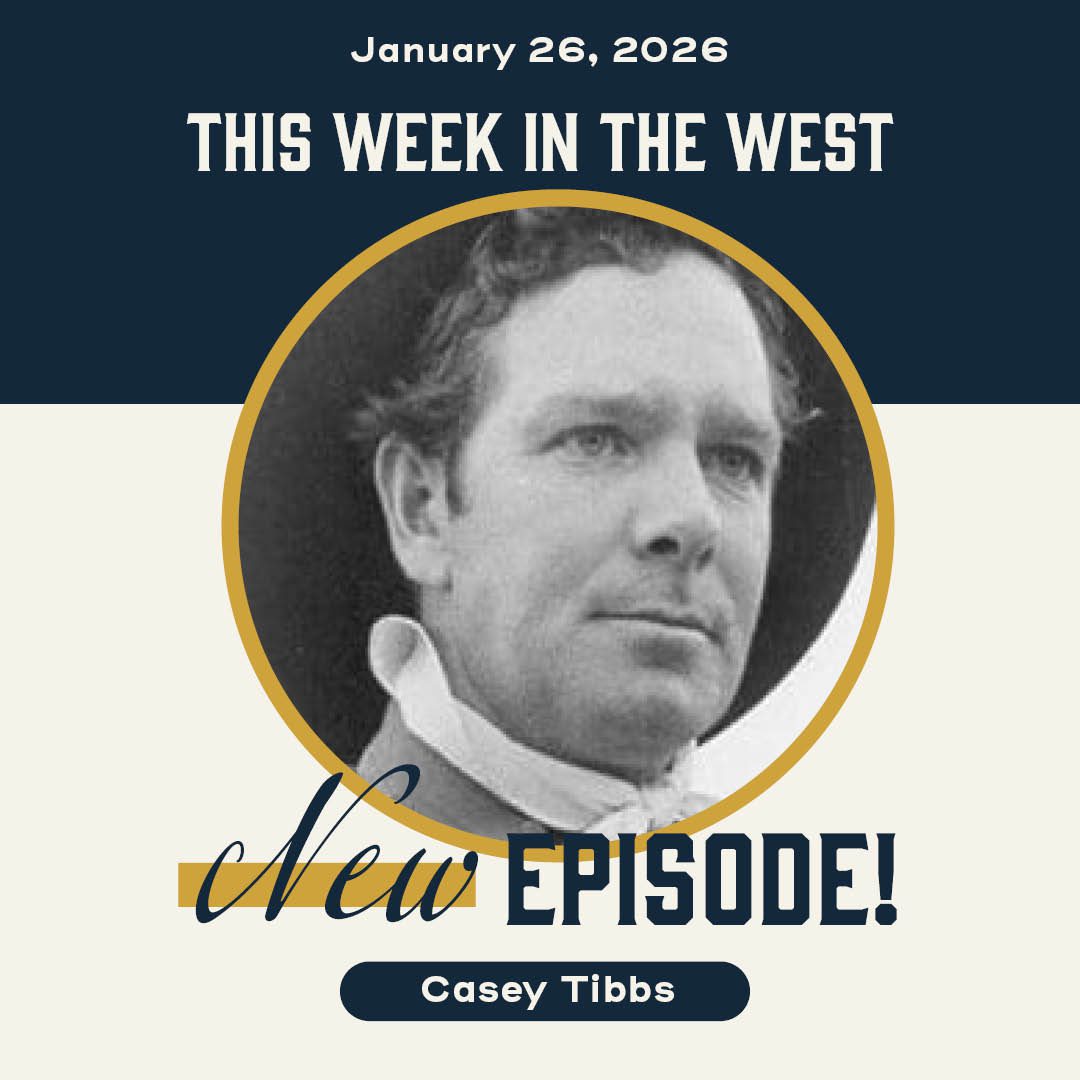
Today, we celebrate Casey Tibbs, one of the all-time rodeo greats, a member of the first class of the National Rodeo Hall of Fame, and the charismatic, towering figure of the sport on the week of his passing, January 28, 1990.
Casey Duane Tibbs was born March 5, 1929, in a meager log cabin 50 miles northwest of Fort Pierre, South Dakota, the youngest of ten children.
His parents, John and Florence Tibbs, were homesteaders who fought the elements to carve out a life along the Cheyenne River.
Ranch life meant a young Casey Tibbs had to ride a horse to school and spent every other moment tending livestock on the 7,000-acre spread.
The cowboy bug bit him early. He first left home to join the rodeo after dropping out of the eighth grade at age 13. That’s when his dad told him just what he thought of rodeo life. Casey was too young to perform anyway. There was no way rodeo organizers would let the teenager into the competition.
That was until he was 15, and he presented them with a letter from his mother, giving him permission to perform. (A letter which was notably not signed by his father.)
He became a quick success on the rodeo circuit. By age 16, he won his first purse at Madison Square Garden of all places. Three years later, at 19, he became the youngest man ever to win the Saddle Bronc Riding Championship of the World.
Between 1949 and 1955, he carved out one of the most significant competitive careers the sport had ever seen: six world saddle bronc riding championships, two all-around cowboy crowns, and one world bareback riding title.
He won world championships in 1949, 1951–54, and 1959, and twice held the title of World All-Around Champion Cowboy.
His flamboyant skill, snazzy outfits and golden-boy looks made him a sensation.
In 1951, he appeared on the cover of Life magazine; in time, he would be described as “probably the most famous of all rodeo cowboys.”
With his trademark purple shirt, high-crown hat, and effortless grace in the saddle, Casey Tibbs would come to define what a rodeo star could be.
Remember, when our National Rodeo Hall of Fame inducted its first class in 1955, Tibbs was included, even though he was still actively competing!
“My life has been one rodeo after another,” he said during those glory days. “About all I’ve done up to now is straddle a horse, eat, and sleep.”
He rode in 80 to 85 rodeos a year, hitting the legendary stops in Cheyenne, Pendleton, Calgary, and Madison Square Garden.
Injuries came with the territory, but Casey shrugged them off. “I guess I’ve broken about 36 or 38 bones,” he once estimated, including “11 broken ribs,” fractured ankles, and a leg broken three different times.
After breaking four ribs in Cheyenne, he still won the saddle bronc title at Fort Worth the following week. After a blood clot on his spine put him in the hospital for six weeks of bed rest, he checked himself out after nine days.
By age 26, Tibbs shocked the sport by announcing he was stepping away from full-time competition.
“Mainly,” he explained, “I want time to make some western pictures and television shows.”
Hollywood had already taken notice of the blue-eyed cowboy with natural charisma. He appeared on To Tell the Truth and made the rounds in Los Angeles, eventually becoming John Wayne’s trusted technical adviser.
He performed stunts and acted alongside Henry Fonda. Later, he wrote, produced, and starred in his own films, including the semi-documentary Born to Buck. When Hollywood executives frustrated him, Tibbs simply took matters into his own hands—personally booking his film The Younger Rounders in nearly 100 theaters across the country.
Tibbs also built a Wild West Show and rodeo company, taking American rodeo abroad. In 1958, he led a troupe to the World’s Fair in Belgium; in 1973, he staged 162 performances in Japan, introducing bronc riding to audiences who had never seen anything like it.
He took pride in his horses: Red River, his first, was a chestnut pony who survived a deadly drought of 1934, and Midnight, a black Thoroughbred that Casey transformed into a trained performer.
Despite his fame, Casey dreamed of something simple: a ranch of his own, saying he’d “run like the old-time cowboys used to run them, with the old brandin’ irons and real ropin.”
In 1976, he moved to Ramona, California, to breed and raise horses. He appeared at the National Finals Rodeo, an event he helped found, just a month before he died in 1990.
In 1989, a statue of Casey riding the bucking horse Necktie was dedicated at the Pro Rodeo Hall of Fame in Colorado Springs.
After a yearlong battle with bone and lung cancer, Casey Tibbs died at home in Ramona on January 28, 1990. He was 60.
Last year, he was honored here at The Cowboy with the Ty Murray Top Hand Award by the Professional Bull Riders.
And with that, we’ve stayed in the saddle for another episode of “This Week in the West.”
Our show is produced by Chase Spivey and written by Mike Koehler.
Follow us and rate us on Apple Podcasts or wherever you hear us. That helps us reach more people.
Come visit us in Oklahoma City! You can now buy tickets online at thecowboy.org/tickets
Got a question or a suggestion? Drop us an email at podcast@thecowboy.org
We leave you today with the words from Life Magazine’s article on Casey Tibbs in October 1951: “Casey usually travels from rodeo to rodeo in a $4,000 Cadillac, which he drives on the highway at 95 mph. He likes to drink and stay up late. Unlike other professional athletes, he doesn’t have to worry about his physical condition. ‘I don’t have to last 15 rounds like a boxer,’ he explains. “I’m on and off a bronc before I can take a deep breath.”
Much obliged for listening, and remember, come Find Your West at the National Cowboy & Western Heritage Museum.