


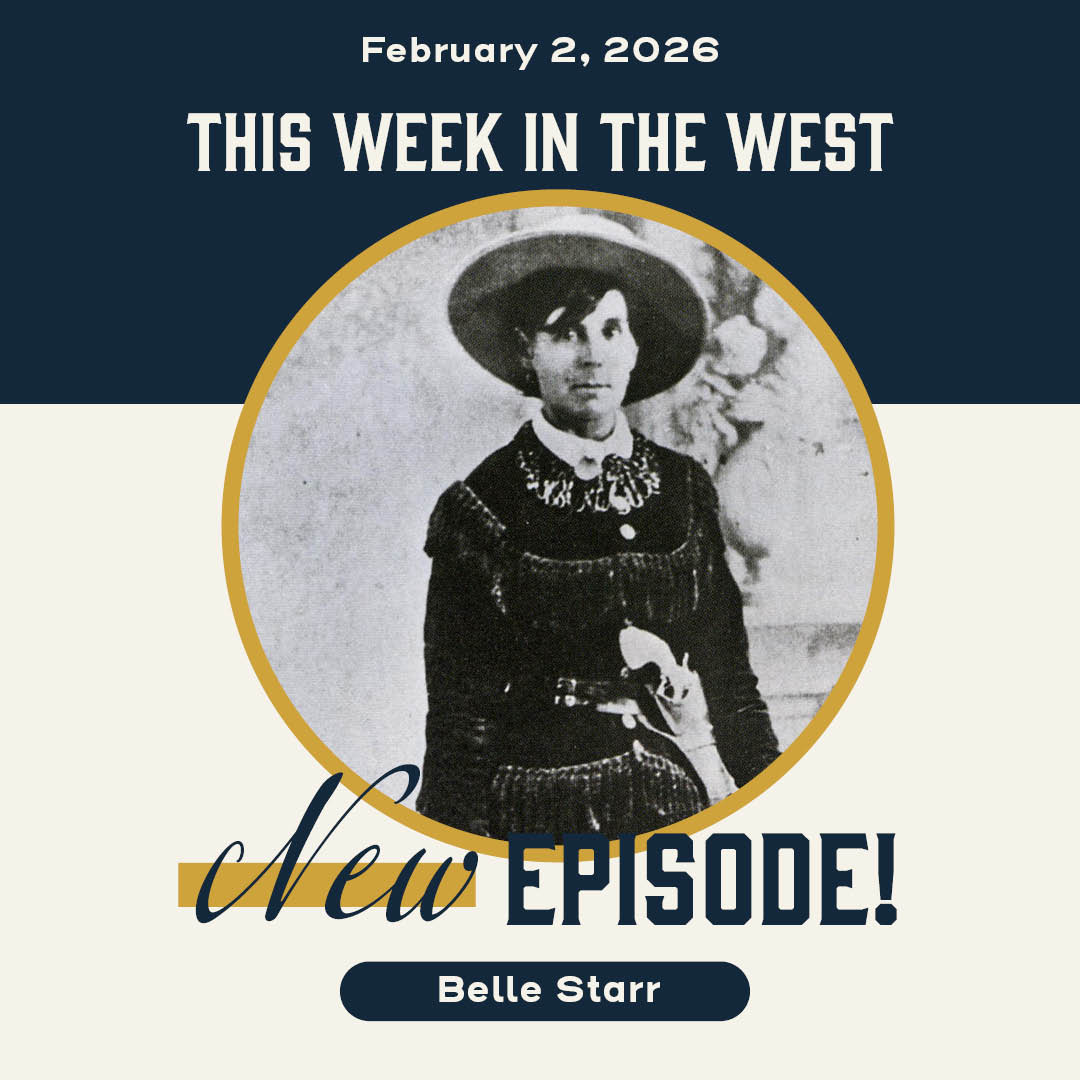
As often happens on the “Wild West” chapters in our retellings of the history of the American West, separating fact from myth in the life of Belle Starr isn’t an easy task.
We know she was called the Bandit Queen and the Queen of the Oklahoma Outlaws.
And we know that she was born Myra Maybelle Shirley on this week in history – February 5, 1848, on her father’s farm near Carthage, Missouri. And we know she’s buried near the Lake Eufaula dam here in Oklahoma.
Those first and last chapters nailed down, let’s fill in the middle.
Her father, John Shirley, was a prosperous farmer and later a businessman who owned a livery stable and blacksmith shop on the town square of Carthage. Her mother, Elizabeth “Eliza” Hatfield Shirley, was a distant relative of the Hatfields of the infamous Hatfield-McCoy feud.
Young Bell Starr would receive a classical education at the Carthage Female Academy, a private school her father helped establish. She learned piano and studied literature. Teachers described her as bright, willful and occasionally “wild.”
How true that turned out to be.
When the Civil War rolled into Missouri, there were no clear-cut battle lines. As a border state, Missouri saw clashes pitting neighbor against neighbor and family against family.
Starr’s older brother, John A. M. “Bud” Shirley, became a Confederate bushwhacker. He was killed by federal troops in 1864. Soon after, Carthage was torn apart by battle, and the family’s property was ruined. They packed up their wagons and headed south to Texas.
It was during the war years that Starr moved in circles that would later define her reputation. She was acquainted with future members of the James-Younger Gang, including Cole Younger and Jesse James, who reportedly hid out near the Shirley property during the war.
Whether she actively aided Confederate guerrillas remains debated, but there is no doubt she grew up in an atmosphere where people in her community were fighting for their survival.
In 1866, Starr married James C. Reed, a former Confederate guerrilla and childhood acquaintance. Two children followed. Her husband was a failure at farming, so he drifted into crime, eventually associating with the Starr clan, a Cherokee family notorious for horse theft, cattle rustling and bootlegging in Indian Territory.
By the early 1870s, Reed was wanted for serious crimes, including murder. He was killed in 1874 while attempting to evade law enforcement in Texas, leaving Starr a widow with two young children and a growing reputation as an outlaw’s wife.
Sometime after Reed’s death, she joined the Starr family in Indian Territory and began calling herself Belle: a name that signaled both reinvention and defiance. In 1880, she married Sam Starr, a Cherokee outlaw, and settled near Youngers’ Bend, not far from present-day Eufaula, Oklahoma.
Here, Belle became what she likely was all along: not a cliched gunfighter, but a skilled organizer. She coordinated crimes, moved stolen goods, harbored fugitives and navigated a confusing patchwork of tribal, territorial, and federal law.
Her cabin became a known refuge for criminals, and her enterprises were profitable enough that she could sometimes bribe her way out of trouble.
Belle also cultivated a striking public image: riding sidesaddle in a black velvet habit, an ostrich-plumed hat, cartridge belts around her waist, pistols at her side.
Whether this was daily attire or calculated theater is unclear, but the image stuck.
In 1882, Belle and Sam Starr were charged with horse theft—her only documented conviction. They were tried in Fort Smith, Arkansas, before Isaac C. Parker, the infamous “Hanging Judge.”
Despite his fearsome reputation, Parker sentenced them relatively lightly, noting it was their first conviction and expressing hope they might reform.
Belle served nine months in prison, which only made her more notorious.
Sam Starr was killed in a gunfight in 1886. In the years that followed, scandal sheets linked her romantically to a series of men with colorful names: Blue Duck, Jim French, Jack Spaniard. She eventually entered into a common-law marriage with Jim July Starr, a younger relative of Sam.
On February 3, 1889 (also this week in history), Belle Starr was ambushed while riding home from a neighbor’s house. She was shot from behind with a shotgun and killed.
Some claimed she was murdered with her own weapon. Suspects ranged from disgruntled tenants to former lovers, her husband and even her own son. One man, Edgar Watson, was tried and acquitted. Officially, the case remains unsolved.
After her death, she became a national sensation. Publisher Richard K. Fox published a popular 1889 dime novel, Bella Starr, the Bandit Queen, and successfully transformed her into a female Jesse James.
The book was wildly fictionalized, but it cemented her place in popular culture.
Films, television shows and more pulp novels followed. Starr became the Wild West’s villainess: a woman who defied gender norms, challenged authority and lived outside the law.
She remains on the roll call of those bandits who held up banks and rode into the night—one of the black hats of cowboy and cowgirl lore.
And with that, we’ve rung the final bell on another episode of “This Week in the West.”
Our show is produced by Chase Spivey and written by Mike Koehler.
Follow us and rate us on Apple Podcasts or wherever you hear us. That helps us reach more people.
Come visit us in Oklahoma City! You can now buy tickets online at thecowboy.org-slash-tickets
Got a question or a suggestion? Drop us an email at podcast@thecowboy.org
We leave you today with the words of writer Dane Huckelbridge, author of a 2025 biography of Belle Starr: “Belle simply had no use for sewing circles or calico dresses; she would not be cosseted inside any farmhouse kitchen or be seen as less than equal to any man. In her own words: ‘So long had I been estranged from the society of women (whom I thoroughly detest) that I thought I would find it irksome to live in their midst.’ The very rights and privileges that nineteenth-century America denied her because of her sex, Belle Starr decided to acquire by the gun.”
Much obliged for listening, and remember, come Find Your West at the National Cowboy & Western Heritage Museum.