






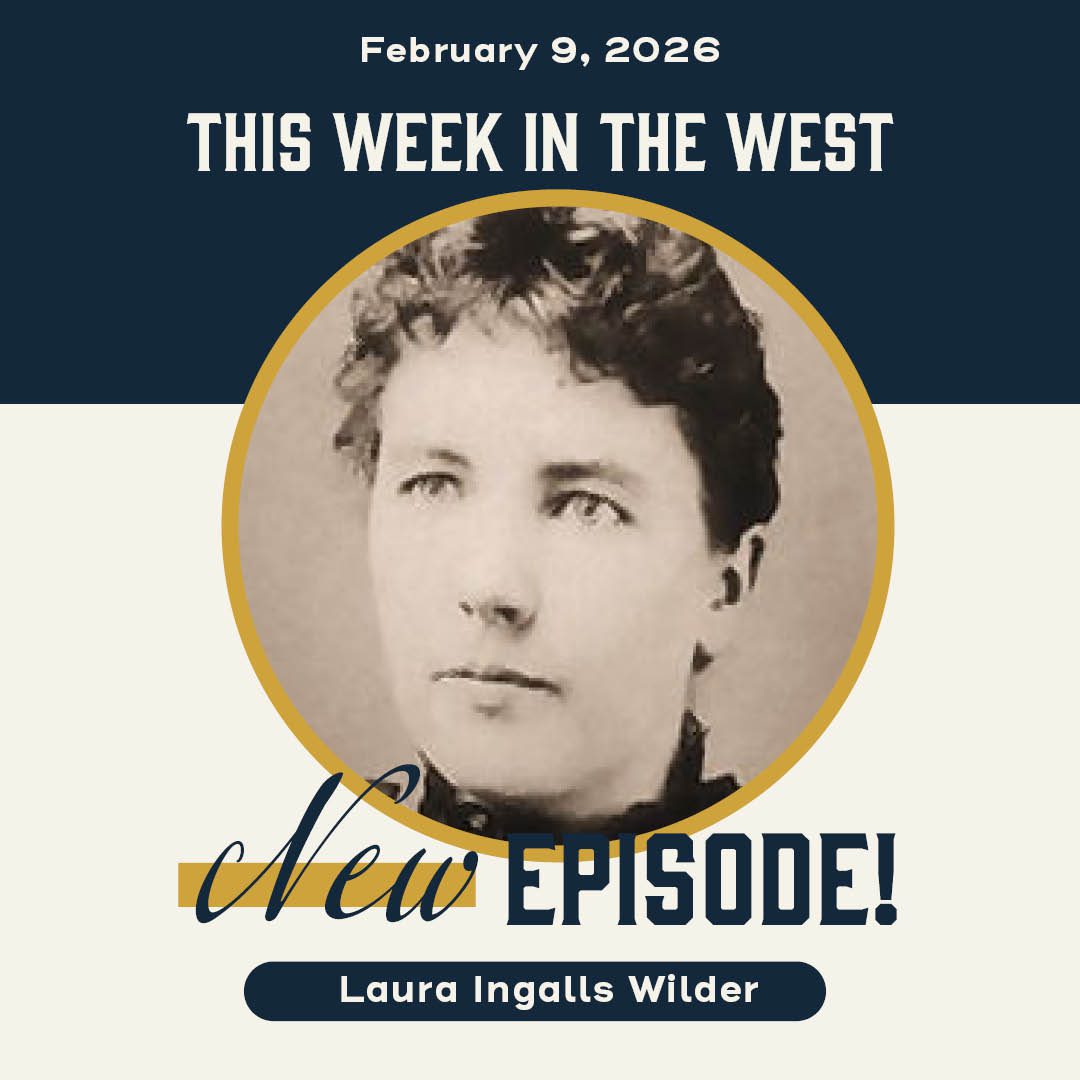
Howdy folks, it’s the second week of February 2026, and welcome to This Week in The West.
I’m Seth Spillman, broadcasting from the National Cowboy & Western Heritage Museum in Oklahoma City.
On this podcast, we share stories of the people and events that shaped the history, art and culture of the American West—and those still shaping it today.
For millions of people, how they imagine life in the American frontier has been forever shaped by a young girl’s memories of survival in the northern Plains.
Through her Little House books, Laura Ingalls Wilder created one of the most influential narratives of Western settlement in American culture. Wilder was born this week, February 7, 1867, in the Big Woods near Pepin, Wisconsin.
Wilder was the second of five children born to Charles and Caroline Ingalls, and from an early age, her family was on the move, looking for opportunity and stability.
The Ingalls family chased land and work across Wisconsin, Kansas, Minnesota, Iowa and the Dakota Territory, often living just one failed crop or harsh winter away from disaster.
The true story of the Ingalls family was not a romantic adventure. The family squatted illegally on Osage land in Kansas. They lived in dugouts carved into creek banks. They endured grasshopper plagues that stripped fields bare, crop failures that erased years of labor and one of the most brutal winters in Plains history — the “Hard Winter” of 1880–81.
Wilder attended one-room schoolhouses when she could, worked from a young age, and at age 15 accepted a teaching position to help support her family.
In De Smet, South Dakota, she met her future husband, Almanzo Wilder, a homesteader several years her senior. The two married in 1885. Their early married years were marked by loss and misfortune: the death of an infant son, a devastating case of diphtheria that left Almanzo partially paralyzed, crop failures, debt and multiple house fires that wiped out what little they owned.
These experiences were later chronicled in Laura Ingalls Wilder’s book The First Four Years, a stark and unsentimental account of frontier marriage that differs noticeably in tone from the gentler Little House books.
After years of instability and even a brief, unsuccessful attempt to start life over in Florida, the couple settled permanently at Rocky Ridge Farm near Mansfield, Missouri.
It was also there, well past the age when most writers begin their careers, that Wilder found her voice.
Encouraged by her daughter, Rose Wilder Lane, Laura began writing seriously in her 60s.
In the early years of the Great Depression, she turned to her memories, writing an autobiographical manuscript called Pioneer Girl. Publishers rejected it as too bleak, too adult and too honest.
So Wilder rewrote, envisioning writing for an audience of younger readers.
The result was Little House in the Big Woods, published in 1932 when Laura was 65 years old. It was an immediate success. More books followed: Little House on the Prairie, On the Banks of Plum Creek, By the Shores of Silver Lake, The Long Winter, Little Town on the Prairie and These Happy Golden Years.
In each book, Laura grew older, and the stories grew more complex. The series provided a rich example of the day-to-day living of pioneers in the 19th Century.
She wrote “I realized that I had seen and lived it all. All the successive phases of the frontier. First the frontiersman, then the pioneer. Then the farmers and the towns. And then I understood that in my own life, I represented a whole period of American history.”
The collaboration between Wilder and her daughter has long been debated. Some critics have claimed that Lane was the true author, or at least a ghostwriter.
Surviving drafts, letters and manuscripts tell a more nuanced story: a demanding editorial partnership between two strong-willed women. Lane sharpened structure and pacing; Wilder supplied memories and details. As one historian put it, Lane had style, but Wilder had the substance.
Of course, many people know about Wilder’s work from its adaptations, including a long-running television series from the 1970s and 80s. The show was honored at the Western Heritage Awards here at The Cowboy, and in 1998, the entire cast was inducted into the Hall of Great Western Performers. A new version of the Little House series is coming to Netflix in 2026.
But Laura Ingalls Wilder’s legacy is not without complication.
In her books, Native Americans appear in simplified ways, often portrayed as obstacles more than people with their own histories. These portrayals have drawn criticism from modern readers and scholars.
In 2018, the American Library Association removed Laura Ingalls Wilder’s name from its lifetime achievement award for children’s literature.
Wilder’s more unfiltered view of her life was eventually heard. Her autobiography, Pioneer Girl, published in annotated form in 2014, shows a much rougher, more adult version of frontier life.
Laura Ingalls Wilder died in 1957 at the age of 90, long after the frontier she described had vanished. She is buried beside Almanzo in Mansfield, Missouri, with Rose nearby.
And with that, we say farewell to our Ma’s and Pa’s after another episode of “This Week in the West.”
Our show is produced by Chase Spivey and written by Mike Koehler.
Follow us and rate us on Apple Podcasts or wherever you hear us. That helps us reach more people.
Come visit us in Oklahoma City! You can now buy tickets online at thecowboy.org/tickets
Got a question or a suggestion? Drop us an email at podcast@thecowboy.org
We leave you today with the words of author Caroline Fraser, who won a Pulitzer Prize in 2017 for her biography of Wilder, entitled Prairie Fires: “The whole issue of how we develop an identity as Americans is really sharply brought into focus by these books and Wilder’s own life. So that is a real reason why people keep coming back to them.”
Much obliged for listening, and remember, come Find Your West at the National Cowboy & Western Heritage Museum. o focus by these books and Wilder’s own life. So that is a real reason why people keep coming back to them.”
Much obliged for listening, and remember, come Find Your West at the National Cowboy & Western Heritage Museum.