




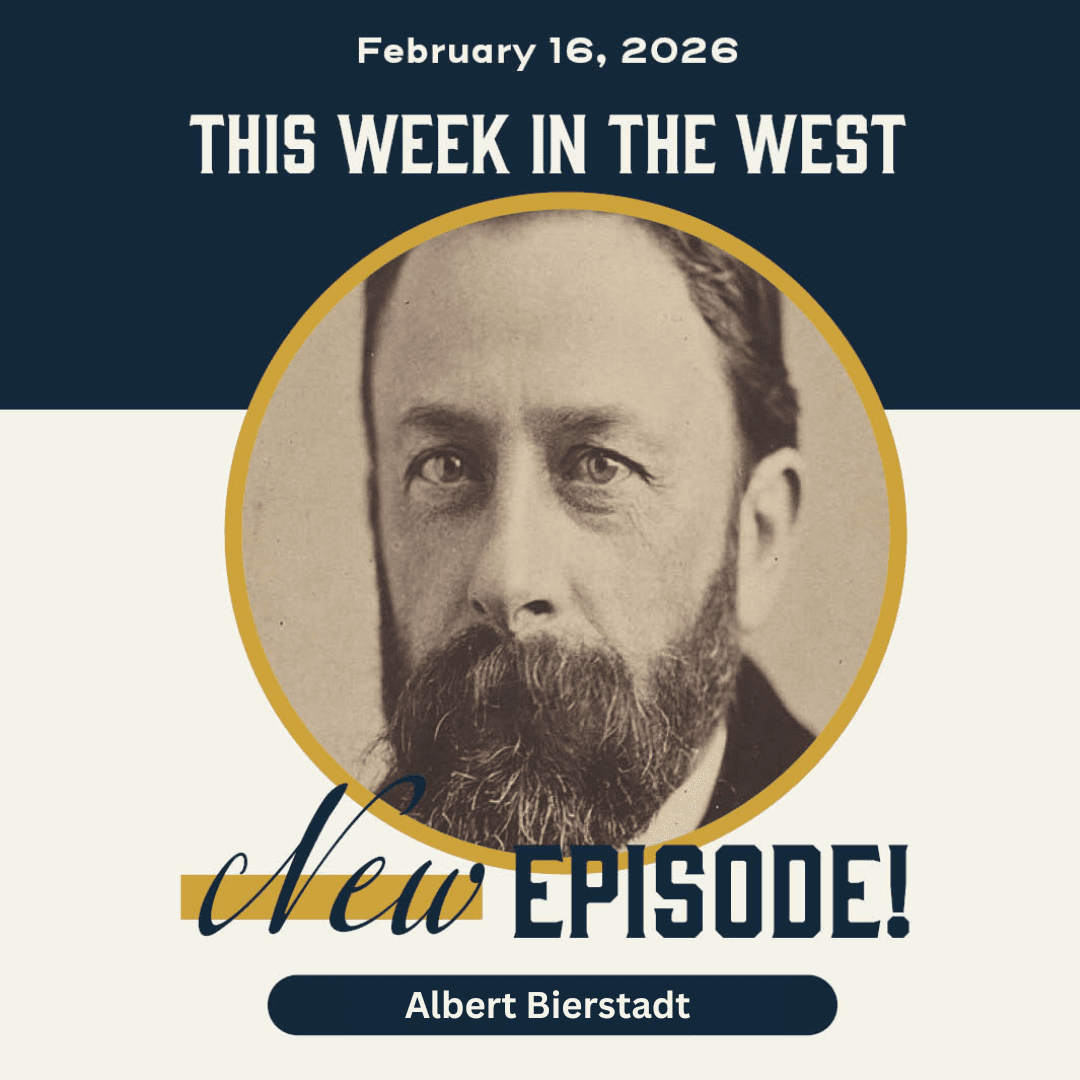
Howdy folks, it’s the third week of February 2026, and welcome to This Week in The West.
I’m Seth Spillman, broadcasting from the National Cowboy & Western Heritage Museum in Oklahoma City.
On this podcast, we share stories of the people and events that shaped the history, art, and culture of the American West—and those still shaping it today.
And if you’ve ever walked into a gallery, stopped dead in your tracks, and felt like you could step straight into the scene … today’s story is for you.
Because here at the Cowboy, one of the grand, sweeping visions of the American West hangs proudly on our walls: Albert Bierstadt’s Emigrants Crossing the Plains.
It’s a big painting — physically big; it took about a dozen folks to move it recently — and it tells an even bigger story: the pioneer era of wagon trains, long distances and the hope of families to find new life and opportunity after enduring a brutal journey.
Bierstadt didn’t just paint what he saw. He painted what the West felt like to the people who believed it was the fulfillment of the American Dream.
We remember Bierstadt this week, the anniversary of his death, February 18, 1902.
Bierstadt was born on January 7, 1830, in Solingen, Germany. His parents, Henry and Christina, already had five children, and when Albert was still a toddler, the family immigrated to the United States, settling in New Bedford, Massachusetts.
Bierstadt was a self-taught artist, and by the time he was about twenty, he was teaching art to make money. The newspaper ad during those years made bold promises about his classes: students would produce “a picture worthy of a frame” in just a handful of lessons.
A curator at the Museum of Fine Arts in Boston once described young Bierstadt as a P. T. Barnum-like character because he understood that people would pay to be amazed.
He developed a working method that feels surprisingly modern. He began using photography as a tool, a still-new technology in the mid-1800s, and then scaled those ideas up into massive canvases in his studio.
And he wasn’t afraid to what he called “plus up” a landscape. Let’s be clear. The real setting was no barrier to Bierstadt’s embellishments. He adjusted geography, moved mountains and added people or animals for scale. He wanted scenes that landed with maximum impact. Sometimes it worked so well that viewers couldn’t even identify the real place, because the painting looked like a world more perfect than the one they knew.
That’s true of Emigrant’s Crossing the Plains. We are often asked which location is depicted, and it’s really an amalgamation of forest, mountains, and plains concocted in Bierstadt’s imagination.
In 1858, he exhibited a huge Swiss landscape at the National Academy of Design in New York. The painting was six feet by ten feet and earned serious acclaim, including honorary recognition.
Then, in 1859, he made a decision that changed American art.
He joined a government-contracted overland survey led by Colonel Frederick W. Lander, following routes along the major western corridors. Bierstadt traveled along the Platte River, sketching, taking notes and collecting references. He understood the East’s fascination with the West and planned to satisfy it through his work.
When he returned to New York, he rented space in the Tenth Street Studio Building, the first structure purpose-built for artists’ studios. This is where Bierstadt moved among the artists we now group under the label “Hudson River School,” a movement devoted to the idea of a “higher” landscape: part nature, part narrative, part spiritual mood.
In the early 1860s, he began turning the Western references he had seen into paintings. Some early works are now lost, but the arc is clear: bigger canvases, bigger skies and bigger emotional stakes.
He traveled again in 1863, this time with writer Fitz Hugh Ludlow, spending time in Utah and Northern California, and nearly two months in Yosemite Valley. Along the way, they encountered exactly the kind of scene that would later become central to Bierstadt’s legacy — and to our collection.
A wagon train of German emigrants near Fort Kearny, Nebraska.
Ludlow later described them as a “picturesque party of Germans,” traveling with cattle and wagons. It was a moving spectacle.
Bierstadt captured that moment in paint, creating two related works: Emigrants Crossing the Plains, completed November 27, 1867, and another version known as The Oregon Trail, dating to 1869.
Emigrants Crossing the Plains carries Bierstadt’s signature sense of scale. It is five feet by eight feet. And it romanticizes the emigrant experience as Americans wanted to remember it: determined, communal and set against a stunning landscape. Dive deep into the painting, and details abound: animals grazing in the forests, bones strewn on the ground, native dwellings in the distance.
Back in New York, Bierstadt’s career soared. During the Civil War, he was drafted in 1863 and paid for a substitute to serve in his place.
Bierstadt continued building his reputation, including with one of his most famous works: The Rocky Mountains, Lander’s Peak—a painting that brought him enormous attention and, in 1865, sold for $25,000, a staggering sum. That’s half a million in today’s dollars.
At this point, Bierstadt’s colorful and successful life becomes a bit of a soap opera.
Ludlow’s marriage to his wife Rosalie collapsed after his Western journeys. Rumors of infidelity swirled. Bierstadt painted a stormy mountain scene and titled it A Storm in the Rocky Mountains, Mount Rosalie—even though there is no Mount Rosalie. He was inspired by Ludlow’s wife, who happened to be Bierstadt’s lover.
After the Ludlows divorced in May 1866, Bierstadt and Rosalie married that November. Somehow, Bierstadt and Ludlow remained friends.
But by the late 1870s, Biertstadt’s story darkened.
Rosalie was diagnosed with tuberculosis in 1876, and warm climates became part of their survival plan. In 1882, a fire destroyed his home and many of his paintings, along with a significant collection of Indigenous artifacts he’d gathered as reference.
At the same time, America’s tastes shifted. The grand, theatrical landscapes that once felt like the visual anthem of expansion began to look old-fashioned to new audiences, who turned to modern styles.
Rosalie died in 1893 after years of frail health. Bierstadt remarried in 1894, but financial strain crushed him. He declared bankruptcy and sold a large number of paintings. They were works that would have made him rich a generation earlier, but were treated as leftovers from a fading style.
On February 18, 1902, Albert Bierstadt died in New York. He was buried in New Bedford.
Decades later, the world circled back to his work.
In the mid-20th century, interest in Bierstadt revived. People looked again and saw what earlier critics dismissed: technical brilliance, a master’s control of light and a set of images that helped define how Americans imagined the West.
Which brings us back to Emigrants Crossing the Plains—here at the National Cowboy & Western Heritage Museum.
Because whatever you think of Bierstadt’s romantic vision, the painting still does what he always intended it to do: it stops you. It draws you in. It makes you feel the vastness, the movement and the promise of the American West — and the always complex story behind it.
And with that, we’ve put down our brushes on another episode of “This Week in the West.”
Our show is produced by Chase Spivey and written by Mike Koehler.
Follow us and rate us on Apple Podcasts or wherever you hear us. That helps us reach more people.
Come visit us in Oklahoma City! You can now buy tickets online at thecowboy.org/tickets
Got a question or a suggestion? Drop us an email at podcast@thecowboy.org
We leave you today with the words Anne F. Hyde: “Bierstadt painted the West as Americans hoped it would be, which made his paintings vastly popular and reinforced the perception of the West as either European or sublime Eden.”
Much obliged for listening, and remember, come Find Your West at the National Cowboy & Western Heritage Museum.