





Howdy folks, it’s the last week of February 2026, and welcome to This Week in The West.
I’m Seth Spillman, broadcasting from the National Cowboy & Western Heritage Museum in Oklahoma City.
On this podcast, we share stories of the people and events that shaped the history, art and culture of the American West—and those still shaping it today.
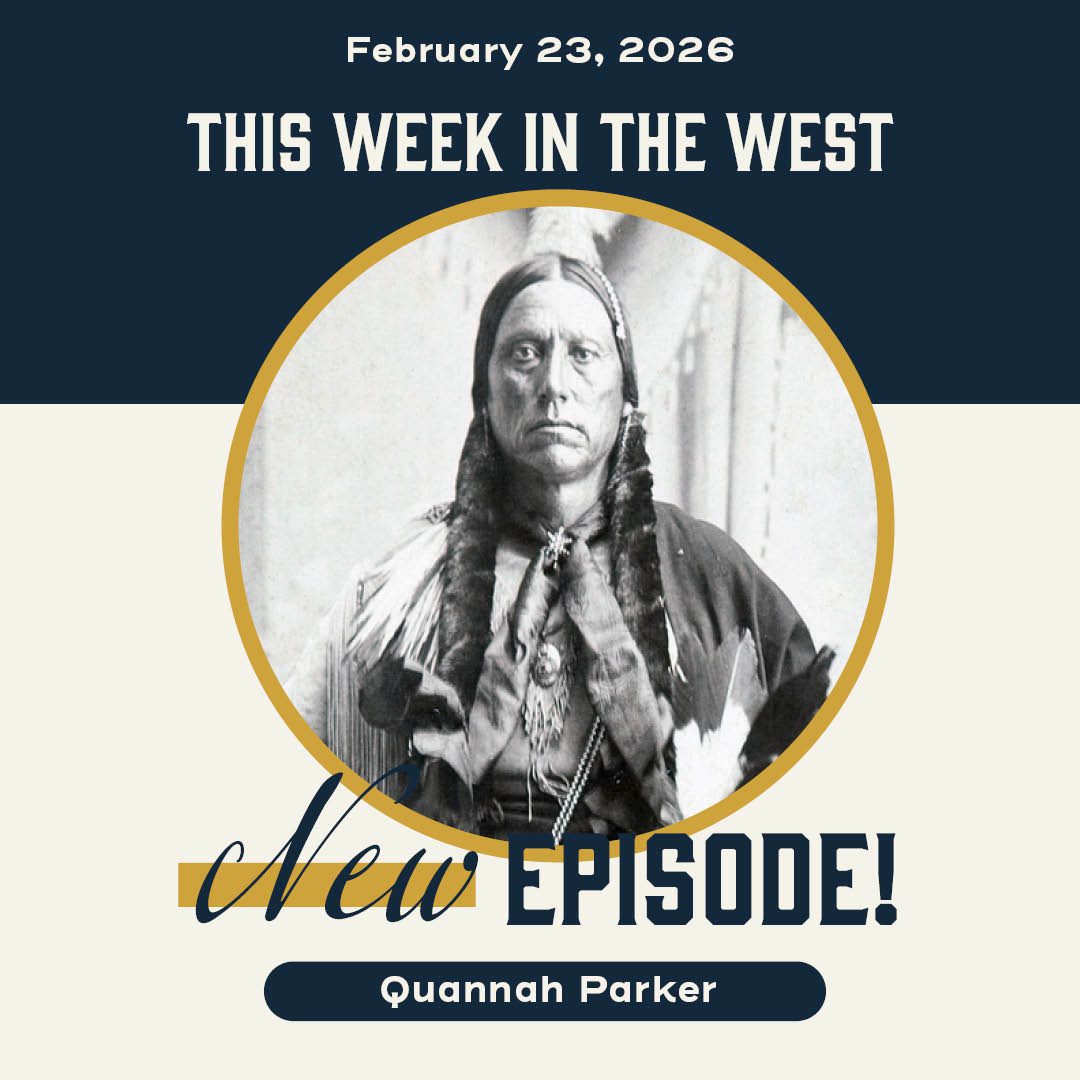
Quanah Parker lived a life defined by transition. Transition between cultures, between eras, between survival and adaptation.
We remember Parker, the famed Comanche chief, this week on the anniversary of his death, February 23, 1911.
He was born around the middle of the 19th Century, somewhere near the Wichita Mountains in Oklahoma.
He was the son of Peta Nocona, an influential war chief, and Cynthia Ann Parker, a white woman who had been captured as a child during a raid on her family’s Texas frontier settlement and who had fully assimilated into life with the Comanche.
Known to the Comanche as Nautda (na-doo-ah)— a word meaning “Someone Found” — Cynthia Ann married Nocona and raised her children entirely within the tribe.
Quanah Parker grew up steeped in Comanche culture. He spoke the language, mastered horsemanship, hunted buffalo, and learned warfare in a society that, in the 19th Century, was still built around mobility and survival on the plains. Comanche power still mattered, but it was already under threat.
As American expansion accelerated after the Civil War, pressure on the Comanche homeland, known as the Comancheria, intensified. All around them, the tribe saw encroachment. Railroads sprang up across the land, and settlers poured in.
Commercial bison hunters began slaughtering the vast herds that sustained Plains cultures for generations. For the Comanche, the loss of the buffalo threatened to collapse their entire way of life.
Parker came of age during this period of upheaval. When he was still a boy, Texas Rangers attacked his band along the Pease River. His mother and younger sister were captured and forcibly removed from the Comanche world.
His sister soon died of illness. His mother, heartbroken and kept from returning to her Comanche family, eventually starved herself to death. Parker never saw her again.
S.C. Gwynne, author of the 2010 book “Empire of the Summer Moon” on Parker, said of Cynthia: “…The great tragedy of her life was that she was captured the second time by the whites, because she never adjusted. She tried to escape for the rest of her life and never adjusted. She had adapted once brilliantly to a foreign culture, but she couldn’t do it twice.”
In the years that followed, Parker emerged as a formidable war leader among the Kwahadi band of the Comanche. He led raids across Texas, attacked supply lines and pioneer settlements, and became a symbol of resistance during the final years of open conflict between Plains tribes and the United States government.
In 1874 at Adobe Walls, a remote outpost in the Texas Panhandle, Parker helped lead an attack against heavily armed bison hunters, fueled by an anger over the destruction of the buffalo. The raid failed. But the hunters’ long-range rifles drove them back, and Parker was wounded.
The conflict at Adobe Walls triggered the Red River War, a brutal campaign by the U.S. Army to force the remaining free-roaming tribes onto reservations in Indian Territory.
With the buffalo nearly gone and survival increasingly impossible, Parker was faced with the difficult choice to surrender.
In 1875, Parker led his people to Fort Sill in Indian Territory, ending the Comanche’s nomadic life on the Southern Plains.
Parker was never elected chief by traditional Comanche methods. Instead, the federal government appointed him principal chief of the Comanche Nation. It was an imposed role, but Quanah used it to become an advocate for his people and a bridge between cultures.
He encouraged education, learned English and worked with government officials. But all the while, he refused to abandon his Comanche identity and urged his people to do the same.
Parker wore traditional braids alongside tailored suits. He embraced ranching and modern technology while maintaining Comanche customs.
His home near Cache, Oklahoma, known as the Star House, became a gathering place for Native leaders, cattlemen and politicians.
Quanah forged relationships with Texas ranchers he once fought, leasing grazing land to cattle operations and securing payments that benefited his people. With those earnings, he became a prosperous rancher himself.
Yet his wealth did not isolate him. Star House regularly fed hungry families, sheltered children and welcomed guests from across the country.
Parker became a vocal advocate for Native rights in Washington, traveling to meet lawmakers and argue for fair treatment, land protections and economic opportunities for his people. He served as a judge in tribal courts and even as a deputy sheriff.
Perhaps most enduring was Parker’s role in preserving Native spiritual practices. Though he encouraged education and tolerated Christianity, he became a leading advocate for the peyote religion, which later evolved into the Native American Church. Parker believed peyote was a sacred medicine, meant to heal and guide its practitioners.
For Parker, faith did not belong to one culture. He once said: “The White Man goes into his church house and talks about Jesus. The Indian goes into his tipi and talks to Jesus.”
By the turn of the 20th century, Parker had become somewhat of a national celebrity. He rode in parades, appeared in silent films and hosted dignitaries at Star House.
When Parker died in 1911, thousands of mourners, native and non-Native, gathered to pay their respects.
After his death, his body was interred at Post Oak Mission Cemetery near Cache, Oklahoma. In 1957, his remains were moved to Fort Sill Post Cemetery at Fort Sill, Oklahoma, along with his mother, Cynthia Ann Parker and his sister.
His gravestone reads
“Resting Here Until Day Breaks
And Shadows Fall and Darkness
Disappears is
Quanah Parker, Last Chief of the Comanches”
Parker’s life marked the end of an era for nomadic tribes of the Plains. He was between two worlds and, in doing so, helped his people survive the crossing.
And with that, we’ve transitioned to the end of another episode of “This Week in the West.”
Our show is produced by Chase Spivey and written by Mike Koehler.
Follow us and rate us on Apple Podcasts or wherever you hear us. That helps us reach more people.
Come visit us in Oklahoma City! You can now buy tickets online at thecowboy.org-slash-tickets
Got a question or a suggestion? Drop us an email at podcast@thecowboy.org
We leave you today with the words of author S.C. Gwynne about Quanah Parker: “He’s one of the greatest Americans I’ve ever heard of. He is such a remarkable man, and he does what so many great Americans have done in the past, which is he reinvents himself. He puts the past behind him. Who knows how many people he killed and in what ways he killed them? Now, we don’t know what he did personally, but everybody was doing them, and maybe he was doing them, and they were extremely violent, extremely brutal raids, even by Comanche standards. So OK, this guy’s this brutal warrior, and he leaves it all behind and reinvents himself in this remarkable way.”
Much obliged for listening, and remember, come Find Your West at the National Cowboy & Western Heritage Museum.West at the National Cowboy & Western Heritage Museum.