


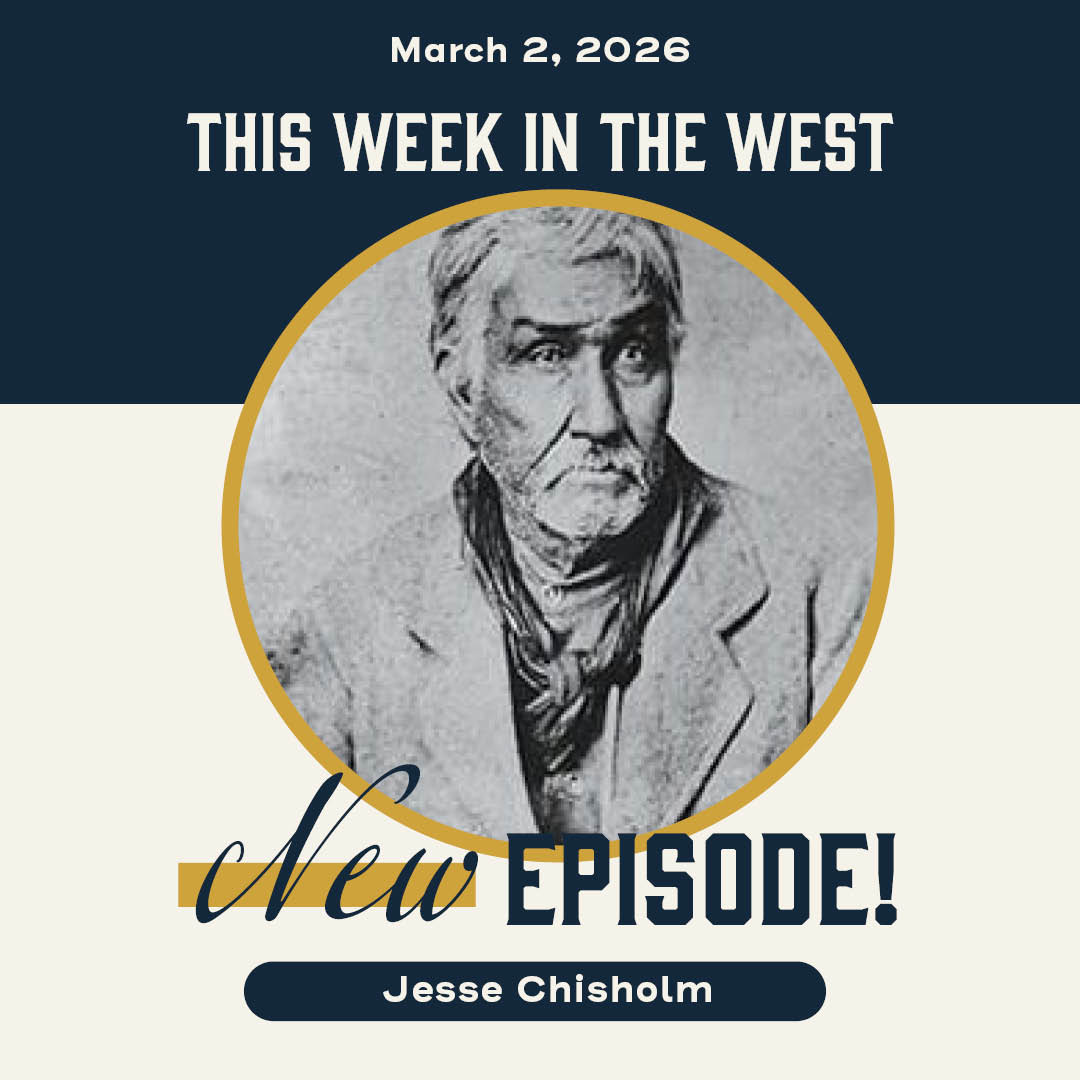
Howdy folks, it’s the first week of March 2026, and welcome to This Week in The West.
I’m Seth Spillman, broadcasting from the National Cowboy & Western Heritage Museum in Oklahoma City.
On this podcast, we share stories of the people and events that shaped the history, art and culture of the American West—and those still shaping it today.
Doubtlessly, you have heard of the famous trail that bears Jesse Chisholm’s name.
But what’s left to learn about the man himself shows how he carved out a place in Western history not by conquering territory, but by talking his way through it.
We remember Chisholm, a member of our Hall of Great Westerners, this week on the anniversary of his death, March 4, 1868.
Chisholm never intended to become famous — or infamous.
He wasn’t a politician, a general or an outlaw. He was a trader, an interpreter and a guide, proving to be someone who knew how to listen, how to travel and how to move between cultures in a time when the American frontier was a patchwork of tribal nations, pioneer settlements, Army outposts and unclaimed, unforgiving landscapes.
Chisholm was born around 1805 in the Hiawassee region of present-day Tennessee. His father was of Scottish descent. His mother, Martha “Patsy” Rodgers, was Cherokee and the daughter of a respected Cherokee leader.
Since his mother was considered a member of the tribe, so was Chisholm. He learned their customs and worldview.
As a boy, Chisholm’s family relocated west into Arkansas as part of an early, so-called “voluntary” Cherokee removal. Tensions with neighboring tribes were constant, and violence was never far away.
Chisholm grew up learning how to survive on the edge of expanding American settlement.
One skill that Chisholm picked up was the ability to learn languages. That set him apart from other men of his era and became a keystone in how he would stake his place in history.
By adulthood, he could speak numerous Native languages, as well as Spanish and Plains sign language. Some accounts say he spoke more than a dozen Indigenous languages fluently.
His ability to communicate made him invaluable to those looking to secure a foothold in the West.
In the 1820s and 1830s, Chisholm worked as a scout and guide for U.S. Army expeditions across what is now Oklahoma and Kansas. He traveled with gold-seeking parties, government surveyors and diplomatic missions, gaining a rich understanding of the Southern Plains, its rivers, grasslands and tribal territories.
By the 1830s, Chisholm had become a trader, hauling goods between Kansas, Arkansas, Texas and Indian Territory. He established trading posts along the Canadian River and near Council Grove, west of present-day Oklahoma City.
Chisholm made sure these outposts were places where knowledge could be exchanged and peace could be maintained.
Chisholm became known as a fair dealer. When disputes arose between tribes or between Native leaders and government officials, he was often called in to interpret and mediate.
Over the years, he worked as an interpreter for the Republic of Texas and later the United States government, including during treaty negotiations involving Comanche, Kiowa, Wichita, and Cherokee leaders.
At one point, he even traveled to Washington, D.C., interpreting for tribal delegations meeting with President James K. Polk.
According to the book “Jesse Chisholm: Ambassador of the Plains” by author Stan Hoig, “President Polk addressed the visitors with a short speech, assuring them that they could rely on the friendship and protection of the United States as long as they themselves were friendly. Chisholm interpreted the president’s words into the Comanche tongue for Chief Santa Anna. The Comanche war leader replied that once he had thought his nation could whip any nation in the world.”
In Texas, Chisholm was personally requested by Sam Houston to assist with delicate negotiations aimed at preventing violence between Natives and settlers.
But then came the Civil War.
Indian Territory was devastated by the conflict. Tribes were divided in their loyalties. Trade collapsed. Chisholm himself led groups of refugees westward, trying to keep people alive in a region stripped of resources and stability.
After the war, Chisholm settled near present-day Kingfisher, Oklahoma, and resumed trading. To move his wagons more efficiently, he improved and widened a route he had traveled for years: one that followed natural terrain, water sources and established Native paths.
Soon, that road became a crucial part of the Western economy. After the war, beef was scarce in the East, while millions of Texas longhorns roamed freely on open range. Ranchers were cattle-rich but cash-poor. If they could get their herds to railheads in Kansas, fortunes could be made.
Enter Joseph McCoy, who established shipping facilities in Abilene, Kansas. The problem was how to get the cattle there.
The answer was already on the map: Jesse Chisholm’s route.
Cattlemen adopted the path Chisholm had carved across Indian Territory, renaming it the Chisholm Trail.
Between 1867 and 1884, more than five million cattle were driven north along that road, transforming Abilene, Wichita and other Kansas settlements into legendary cow towns. These were ground zero for cementing the image of the American cowboy in popular culture.
Chisholm never drove cattle himself. He never profited from the cattle boom. And he never lived to see the trail that bore his name explode into legend.
He died in 1868, just as the great cattle drives were beginning.
While camped near the Canadian River, Chisholm accidentally poisoned himself after eating bear grease contaminated by a brass or copper pot. He was buried near the campsite, his funeral attended and honored by Native leaders, including Comanche chief Ten Bears, who reportedly led the burial procession.
Today, there are few physical traces of the Chisholm Trail left on the landscape. Here in Oklahoma, State Highway 81 runs through towns like El Reno, Duncan, Chickasha and Enid.
And with that, we’ve talked our way through another episode of “This Week in the West.”
Our show is produced by Chase Spivey and written by Mike Koehler.
Follow us and rate us on Apple Podcasts or wherever you hear us. That helps us reach more people.
Come visit us in Oklahoma City! You can now buy tickets online at thecowboy.org/tickets
Got a question or a suggestion? Drop us an email at podcast@thecowboy.org
We leave you today with the words Jesse Chisholm himself, shortly before his death, according to author Stan Hoig: “I know little about the Bible and churches, but the good God who sent me here gave me the knowledge of right and wrong. I have never wronged anyone in my life. I have been a peacemaker among my brethren. No man ever went from my camp hungry or naked, and I am ready and willing to go to the home of the Great Spirit just as I am, whenever he calls for me.”
Much obliged for listening, and remember, come Find Your West at the National Cowboy & Western Heritage Museum.