


Howdy folks, it’s the last week of March 2026, and welcome to This Week in The West.
I’m Seth Spillman, broadcasting from the National Cowboy & Western Heritage Museum in Oklahoma City.
On this podcast, we share stories of the people and events that shaped the history, art and culture of the American West—and those still shaping it today.
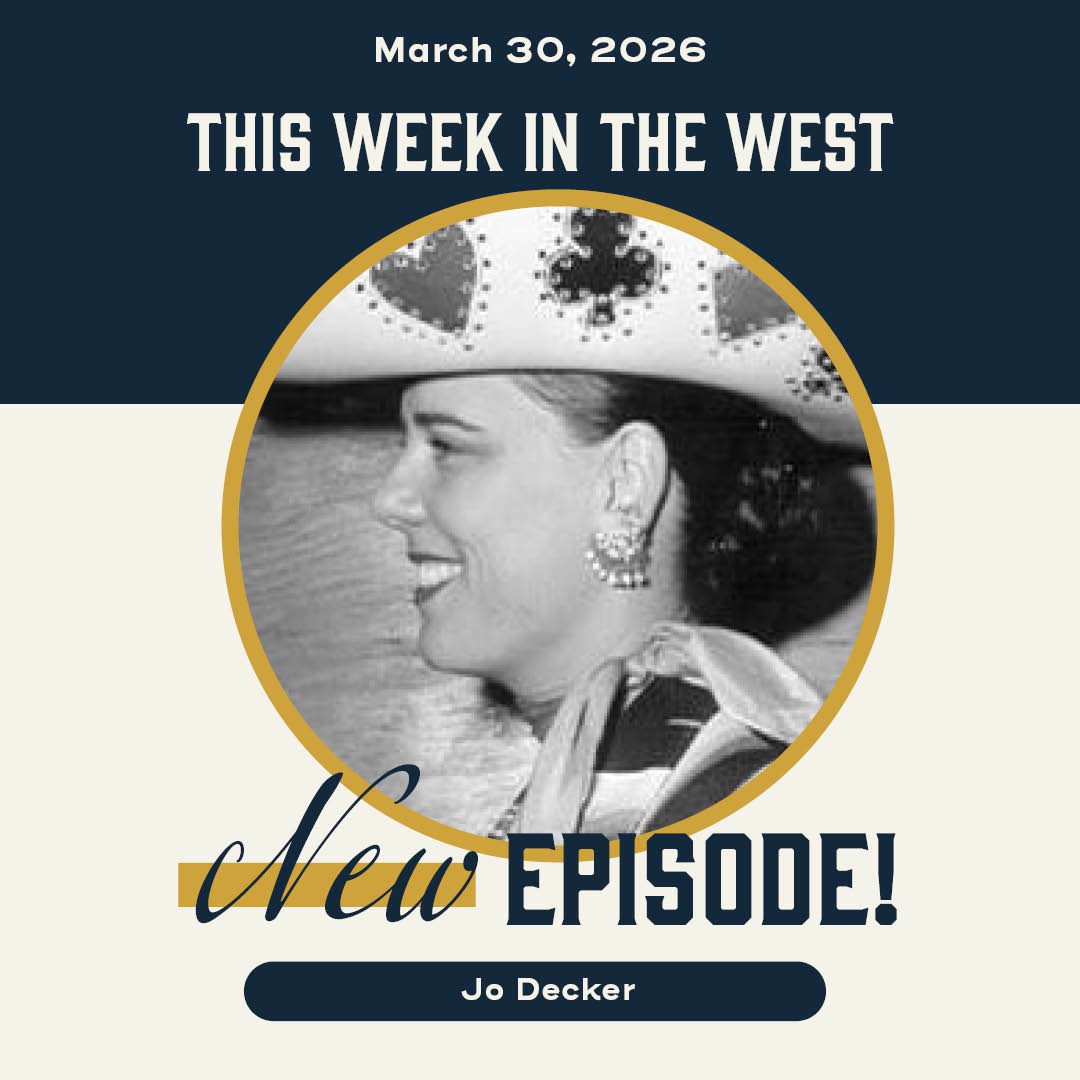
If you were at the first National Finals Rodeo back in 1959, it would have been hard to miss Jo Ramsey Decker.
She had helped organize that inaugural event in Dallas after years of being a competitor herself. She worked behind the scenes, coordinating production and ensuring cowboys, contractors, and the crowd had a good experience. She seemed to be doing it all.
And she even rode into the arena, leading the procession at the grand opening of the event, carrying the American flag.
Today, we remember Jo Decker—a member of the National Rodeo Hall of Fame here at The Cowboy and a recipient of our Tad Lucas Award—during the week of her birth, March 30, 1925.
Jo was one of a pair of twins born to the Ramseys in San Angelo, Texas. She and her twin brother, Jack, grew up on the family ranch, doing chores alongside the adults and riding horses for fun. The Ramseys traveled often, overseeing ranch operations across the West.
Jo quickly fell in love with life on horseback, and by age four, she was already competing in her first rodeo.
In 1944, just after graduating high school, she was selected as one of the prestigious “Ranch Sponsor Girls” at the Madison Square Garden Rodeo in New York City—one of the most visible stages in rodeo. She returned again in 1946.
Those appearances were more than pageantry. They were part of a broader effort to present Western heritage to national audiences. Jo carried herself with confidence and caught the eye of rodeo cowboy Tater Decker. The two married in 1946, beginning a partnership that would last decades, both in life and in rodeo.
During the 1940s and 50s, Jo Decker was an active competitor, earning multiple world championship titles in women’s rodeo competition.
But during those years, women’s events weren’t always well organized. Sanctioning bodies came and went, and opportunities could disappear overnight. That wouldn’t do for Decker, who became instrumental in supporting and promoting the Girls Rodeo Association—now known as the Women’s Professional Rodeo Association.
At a time when women’s rodeo needed structure, visibility and legitimacy, Decker helped provide it.
If Jo Decker had only been a champion competitor, her place in rodeo history would have been secure. But she went further.
She began working as a rodeo secretary in 1946, launching a 25-year career that made her one of the most trusted administrators in the business.
What is a rodeo secretary? It’s the person who makes the whole show run—handling entries, payouts, records and coordination between contestants, judges and stock contractors.
In her book Oklahoma Rodeo Women, author Tracey Hanshew held up Decker as a prime example of the role.
Hanshew wrote: “Central to the success of any rodeo is the job of rodeo secretary.”
Decker worked with some of the biggest names in stock contracting, including the Beutler Brothers, Harry Vold, Mike Cervi and Hoss Inman. She even handled rodeo details for Gene Autry.
Then came the National Finals Rodeo.
The rodeo world had long wanted a championship event to cap the season. Decker was among those who helped bring that vision to life, working behind the scenes to ensure the first NFR in Dallas in 1959 lived up to its promise.
The March 1960 issue of Western Horseman captured the moment:
The March 1960 issue of Western Horseman Magazine remembered the event like this, writing “In December, rodeo’s top cowboys and outstanding bucking stock, followed by a host of fans from all sections of the country, came to Dallas for the first National Finals Rodeo. For long, big league baseball has ended each season with its World Series playoffs. Now, annually, rodeo is to have its world series, the National Finals. In the dim and distant future, many an old cowboy grandpa will be able to say, “Yep, I contested at the first National Finals Rodeo in Dallas, Tex., way back in December, 1959.”
Decker would go on to serve as secretary of the National Finals Rodeo six times.
Her creativity extended beyond livestock and ledgers.
In the 1950s, she launched a Western wear clothing line that became popular with celebrities and even royalty. Rex Allen wore her designs. So did Princess Grace of Monaco.
For two decades, she balanced fashion design with rodeo work, helping bring Western style into the national spotlight.
Jo and Tater eventually settled on their ranch near Clayton, Oklahoma. After Tater’s death, Jo moved to Talihina, where she died of natural causes in 2010 at the age of 85.
And with that, we’ve tallied up the score for another episode of This Week in The West.
Our show is produced by Chase Spivey and written by Mike Koehler.
Follow us and rate us on Apple Podcasts or wherever you hear us. That helps us reach more people.
Come visit us in Oklahoma City! You can now buy tickets online at thecowboy.org/tickets
Got a question or a suggestion? Drop us an email at podcast@thecowboy.org
We leave you today with more from author Tracey Hanshew:
“(A rodeo secretary) is valued by contestants and other workers who recognize her importance; she is often referred to as the storekeeper and absolute boss.”
Much obliged for listening, and remember, come Find Your West at the National Cowboy & Western Heritage Museum.