




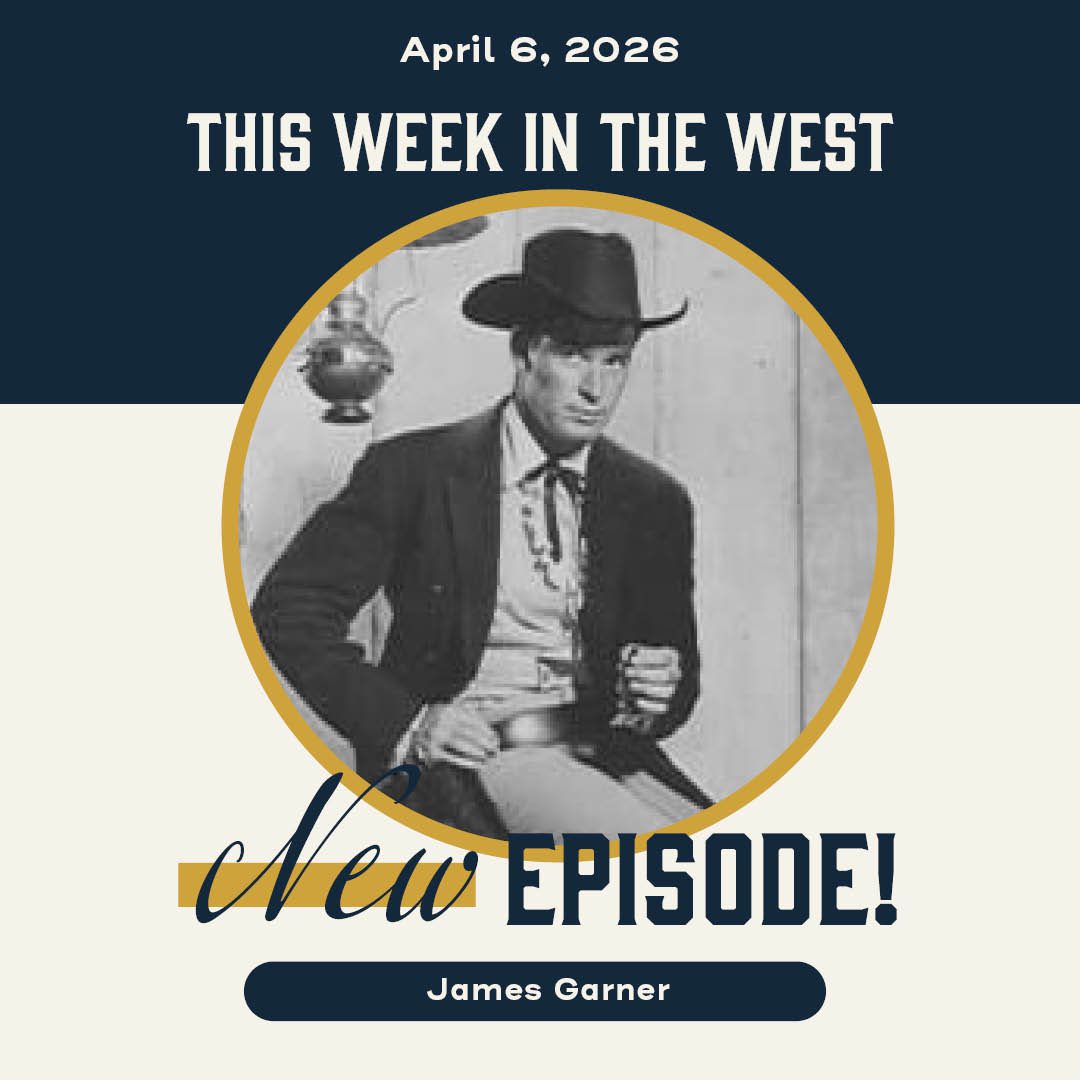
Howdy folks, it’s the first week of April 2026, and welcome to This Week in The West.
I’m Seth Spillman, broadcasting from the National Cowboy & Western Heritage Museum in Oklahoma City.
On this podcast, we share stories of the people and events that shaped the history, art and culture of the American West—and those still shaping it today.
Today’s story begins just down the highway from us in Norman, Oklahoma, with a boy who never planned on becoming a movie star.
He was just happy to survive a tough childhood and then find whatever job he could as he grew up. He dropped out of high school and then worked in the oil fields. He drove trucks, then found some direction in military service.
But after stints in World War II and Korea, the bumpy path the boy was on eventually led to the stage and screen.
And that boy – James Garner – could always look back at the Oklahoma roots that reared him.
“With the exception of my wife and children, there’s nothing I value more than my Oklahoma heritage,” said Garner, who we remember this week in remembrance of his birth, April 7, 1928.
Garner is a member of our Hall of Great Western Performers here at The Cowboy.
He was born James Scott Bumgarner. By age 5, he had lost his mother and was abused by one of his stepmothers. Leaving school early, he first joined the Merchant Marine, though chronic seasickness cut that career short. Not long after, he enlisted in the California Army National Guard and was deployed to Korea during the Korean War.
Garner spent fourteen months in combat and was wounded twice. He earned two Purple Hearts and the Combat Infantryman Badge.
When he later reflected on the experience, Garner rarely romanticized it.
He simply said, “It was cold and hard. I was one of the lucky ones.”
After returning from Korea, Garner found himself back in California, unsure of what direction his life might take. He tried acting, and by 1954, a friend had helped him land a very small role in the Broadway production of The Caine Mutiny Court-Martial.
How small? Well, he didn’t have any lines.
But night after night, he watched actor Henry Fonda perform.
Garner later said that simply observing Fonda, another member of our Hall of Great Westerners, taught him one of the most important lessons he ever learned about acting: subtlety.
That quiet, natural style would soon become Garner’s signature.
Television was booming in the 1950s, and Garner began picking up small roles and commercial work. But his big break came in 1957 when he was cast as Bret Maverick in the iconic television Western Maverick.
At a time when Western heroes were usually stoic gunslingers, Bret Maverick was something different.
He was a professional gambler who talked and smirked his way through trouble instead of drawing guns at High Noon.
Audiences loved it. Maverick quickly became one of television’s most popular shows, turning Garner into a household name.
His easygoing charm and self-deprecating humor gave the Western genre a fresh new kind of hero—one who was clever, reluctant to fight and deeply human.
But Garner wasn’t content to stay in one place for long.
After leaving Maverick amid a contract dispute with Warner Brothers, he moved into film and quickly built a career spanning multiple genres.
At a 2001 Tribute to Garner, Clint Eastwood credited the actor as one of the first stars to make the successful leap to the big screen.
“Nowadays, television actors become movie stars all the time, but back then, in the late ‘50s, it wasn’t easy. There was a sort of prejudice … the theory being that if you saw him every week on television for free, why pay to see him in a movie?” Eastwood said.
He appeared in the major 1963 film The Great Escape, alongside Steve McQueen and an all-star cast, in one of the most famous World War II films ever made.
He starred opposite Doris Day in hit comedies like The Thrill of It All and Move Over, Darling.
And in 1964, he delivered what he later called his favorite performance in the anti-war drama The Americanization of Emily with Julie Andrews.
Garner’s career in film continued through the 1960s, creating fan favorite Westerns, including Support Your Local Sheriff!—a comedic Western that perfectly captured his blend of humor and heroism.
But television would call him back again.
In 1974, Garner returned to the small screen with the show that many fans consider his greatest role: The Rockford Files.
Garner played Jim Rockford, a private detective in Los Angeles who lived in a trailer on the beach and rarely seemed to get paid for the trouble he got into.
Rockford wasn’t glamorous or adventurous. But beneath the weary cynicism was a good man who kept helping people anyway.
The role earned Garner an Emmy Award in 1977 and cemented his reputation as one of television’s most beloved actors.
Unlike many stars, Garner also insisted on doing many of his own stunts. That wasn’t always the best idea. By the end of the show’s run, injuries and exhaustion forced him to slow down.
In 1985, he received his only Academy Award nomination for the romantic comedy Murphy’s Romance, starring opposite Sally Field.
He appeared in Victor/Victoria and Space Cowboys, and, if romantic movies are your jam, he, of course, played the older version of Ryan Gosling’s character in the hit film The Notebook.
Along the way, he earned Emmy Awards, Golden Globes and a lifetime achievement award from the Screen Actors Guild.
But despite decades in Hollywood, Garner never quite lost the perspective of the Oklahoma kid who never planned to become famous.
In interviews, he often said that fame wasn’t something he particularly wanted. He was just trying to make a living.
James Garner passed away on July 19, 2014, at the age of 86.
Today, a bronze statue of Bret Maverick stands in his hometown of Norman, Oklahoma.
And with that, we’ve pushed all of our chips into the middle of another episode of “This Week in the West.”
Our show is produced by Chase Spivey and written by Mike Koehler.
Follow us and rate us on Apple Podcasts or wherever you hear us. That helps us reach more people.
Come visit us in Oklahoma City! You can now buy tickets online at thecowboy.org-slash-tickets
Got a question or a suggestion? Drop us an email at podcast@thecowboy.org
We leave you today with the words of Garner’s frequent co-star Julie Andrews: “(James Garner was) a man’s man, a ladies’ man, a good ol’ boy in the best sense of the word, a curmudgeon (he’ll be the first to tell you)…and a sweetheart. I don’t know a lady who isn’t a little bit in love with him.”
Much obliged for listening, and remember, come Find Your West at the National Cowboy & Western Heritage Museum.