

Howdy folks, it’s the second week of July 2026, and welcome to This Week in The West.
I’m Seth Spillman, broadcasting from the National Cowboy & Western Heritage Museum in Oklahoma City.
On this podcast, we share stories of the people and events that shaped the history, art and culture of the American West—and those still shaping it today.
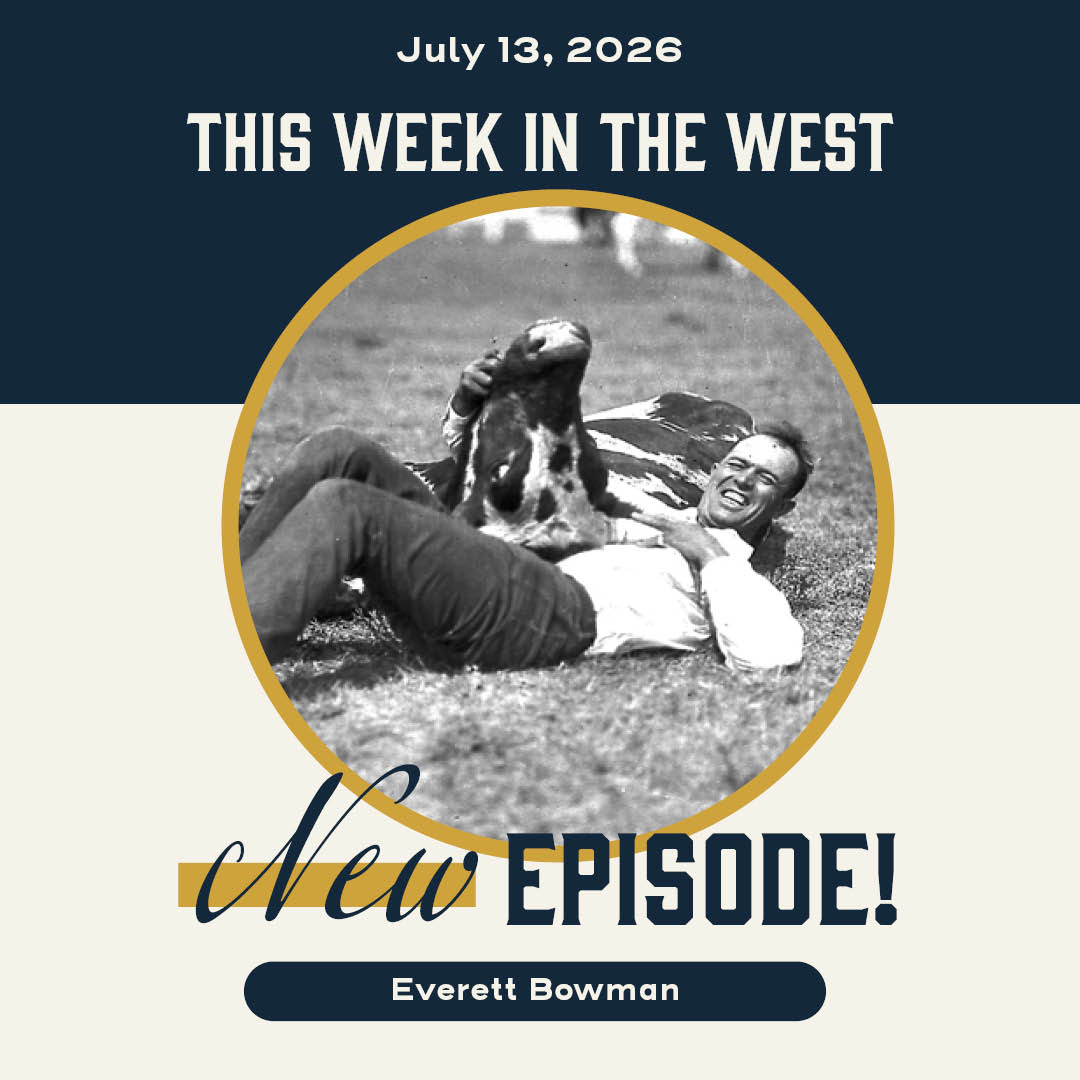
Everett Bowman was called the “most forceful man in rodeo” during the 1930s and 1940s, not because of what he did with the broncs, bulls or calves, but what he did with the turtles.
Today we remember Bowman, the National Rodeo Hall of Famer, who was born this week, July 12, 1899 and who helped organize rodeo from a wild-frontier sport into its revered place in Western culture.
It’s a story we first told on Episode 40 of This Week in the West. It was November 1936, and rodeo cowboys about to perform in Boston had had enough.
The sport had become a mishmash of inconsistent contests around the country. Their list of complaints was long: Entry fees were not always added back into prize money. Judging standards varied. Rules were inconsistent. Cowboys had little control over the events they made possible.
So they went on strike, organized themselves and from the chaos came the Cowboys’ Turtle Association, the first major organization for professional rodeo competitors.
They called themselves “Turtles” because, as Bowman said, it had taken them so long to get organized.
Bowman signed up as member number 15 and soon became the organization’s first president. He would serve in that role from 1936 until 1945, when the CTA reorganized as the Rodeo Cowboys Association. That organization later became today’s Professional Rodeo Cowboys Association, or PRCA.
Under Bowman’s leadership, the CTA pushed for changes that became the foundation of modern professional rodeo: fair and impartial judging, codified rules and regulations, humane treatment of livestock and minimum standards for approved professional rodeos.
Bowman was not always known as a diplomat. He could be stubborn, forceful and difficult to move once his mind was made up. But many cowboys believed that was exactly what the sport needed.
Fellow cowboy Everett Shaw said young rodeo competitors would never fully realize how much they owed to Everett Bowman.
Bowman’s own road from a journeyman cowboy to a competitor had been wild in those early days. But by his peak, he was one of the sport’s best.
Bowman was born in Hope, New Mexico, spent part of his youth in Texas, and moved with his family to the Safford, Arizona area when he was about 13.
One of his first full-time jobs away from his family’s ranch was with the Chiricahua Cattle Company, known in those days as “the Cherries” or “the Three C’s.” The company ran cattle across the rough border country of Arizona and New Mexico. It was hard country, not easy on the ranch hands working it, but those tough conditions just made Bowman a better cowboy.
His foreman was wowed by Bowman’s skills, calling him a top roper who was “tougher than leather” and one of the strongest men he had ever known.
At age 23, Bowman and his brother Skeet joined eight other cowboys on a long cattle drive from Globe, Arizona, to Ely, Nevada. The trip stretched more than 900 miles and may have been one of the last great old-time cattle drives.
After a failed venture in Nevada, Everett and Skeet turned their attention toward rodeo.
Bowman joined the professional rodeo circuit in the 1920s. Some accounts place the start of his career in 1924, others in 1925, after he attended a rodeo in Salt Lake City. However it began, once Bowman entered the arena, he quickly established himself.
In 1926, he won two events and the all-around title at the Ellensburg Rodeo. That same year, he finished second in the all-around at the Pendleton Round-Up. In 1927, he won the steer wrestling title at Ellensburg for the second straight year and tied for the all-around title.
That same year, Bowman teamed with Jack Traynor to win a team steer roping world championship and set a single-run speed record.
By the end of the decade, Bowman was no longer just a promising cowboy. He was one of the names to beat.
In 1929, he won the all-around title at the Calgary Stampede, even though he did not compete in bronc riding. That same year, he won his first Rodeo Association of America season championship in tie-down roping. In 1930, he added a steer wrestling championship.
At the Calgary Stampede in 1931, Bowman set the fastest recorded time for a calf roping run. In 1932, he won his third Ellensburg steer wrestling title and claimed the all-around title at Frontier Days in Prescott, Arizona. In 1933, he won his second steer wrestling season championship.
Then came 1935, one of the greatest years of his career. Bowman was named the RAA All-Around Cowboy and also won season championships in steer wrestling and tie-down roping. He had captured rodeo’s Triple Crown — three season championships in one year.
He did it again in 1937, winning his second all-around championship, his third calf roping title and his only steer roping championship.
Only a very small group of cowboys has won the rodeo Triple Crown more than once. Bowman did it twice. Later legends Jim Shoulders and Trevor Brazile are among the few who would match the accomplishment.
In all, Bowman is officially credited with 10 world championships in nine years: two all-around titles, four steer wrestling titles, three tie-down roping titles and one steer roping title.
Some family accounts argue that the true number may be higher because rodeo records before 1929 were incomplete and championships were sometimes tied to victories at major rodeos.
Maybe that’s why Bowman needed to help them get organized.
He won or placed at many of the biggest rodeos of the era, including Madison Square Garden, Cheyenne, Calgary, Ellensburg, Prescott and Pendleton.
After retiring from full-time competition in 1943, Bowman settled near Wickenburg, Arizona, where he ranched, served in law enforcement and remained deeply connected to rodeo. He worked as a deputy sheriff in Maricopa and Pinal counties, served as a captain in the Arizona Highway Patrol and twice ran for sheriff of Maricopa County.
Bowman also loved aviation. He was among the first rodeo cowboys to use airplanes to reach more events, chartering a private plane as early as 1929. By the late 1930s, he owned his own plane and had learned to fly it himself.
He kept flying for the rest of his life.
Bowman also continued to make public appearances well into his later years. He served as grand marshal of a Prescott Frontier Days parade in 1966. At age 70, he even accepted a small movie role as a pastor in The Great White Hope.
On October 25, 1971, Everett Bowman died when his single-engine plane crashed in rugged country southwest of Bagdad, Arizona. He was 72.
Friends from across the West gathered to pay their respects. PRCA president Dale Smith spoke at his service, and famed cowboy entertainer Rex Allen sang a cowboy hymn.
Bowman’s legacy only grew after his death. He was inducted into the ProRodeo Hall of Fame in 1979, the Pendleton Round-Up and Happy Canyon Hall of Fame in 1985 and the Ellensburg Rodeo Hall of Fame in 2004.
Here at the National Cowboy & Western Heritage Museum, Bowman was a member of the inaugural class of the National Rodeo Hall of Fame in 1955. We are also honored to hold many of his trophies and championship saddles.
And with that, we’ve come out of our turtle shell for another episode of “This Week in the West.”
Our show is produced by Chase Spivey and written by Mike Koehler.
Follow us and rate us on Apple Podcasts or wherever you hear us. That helps us reach more people.
Come visit us in Oklahoma City! You can now buy tickets online at thecowboy.org/tickets
Got a question or a suggestion? Drop us an email at podcast@thecowboy.org
We leave you today with the words of R. Lewis Bowman, rancher, rodeo historian and nephew of Everett: “He got the Turtles started with his fists. The time I was at Cheyenne with him, he and another big cowboy got into an argument about associations and unions. The other cowboy threw a punch at Everett. Everett busted his nose, dragged him unconscious by his shirt front to the door of the rodeo headquarters, dropped him there and left a $50 bill on his chest for the doctor.”
Much obliged for listening, and remember, come Find Your West at the National Cowboy & Western Heritage Museum.