




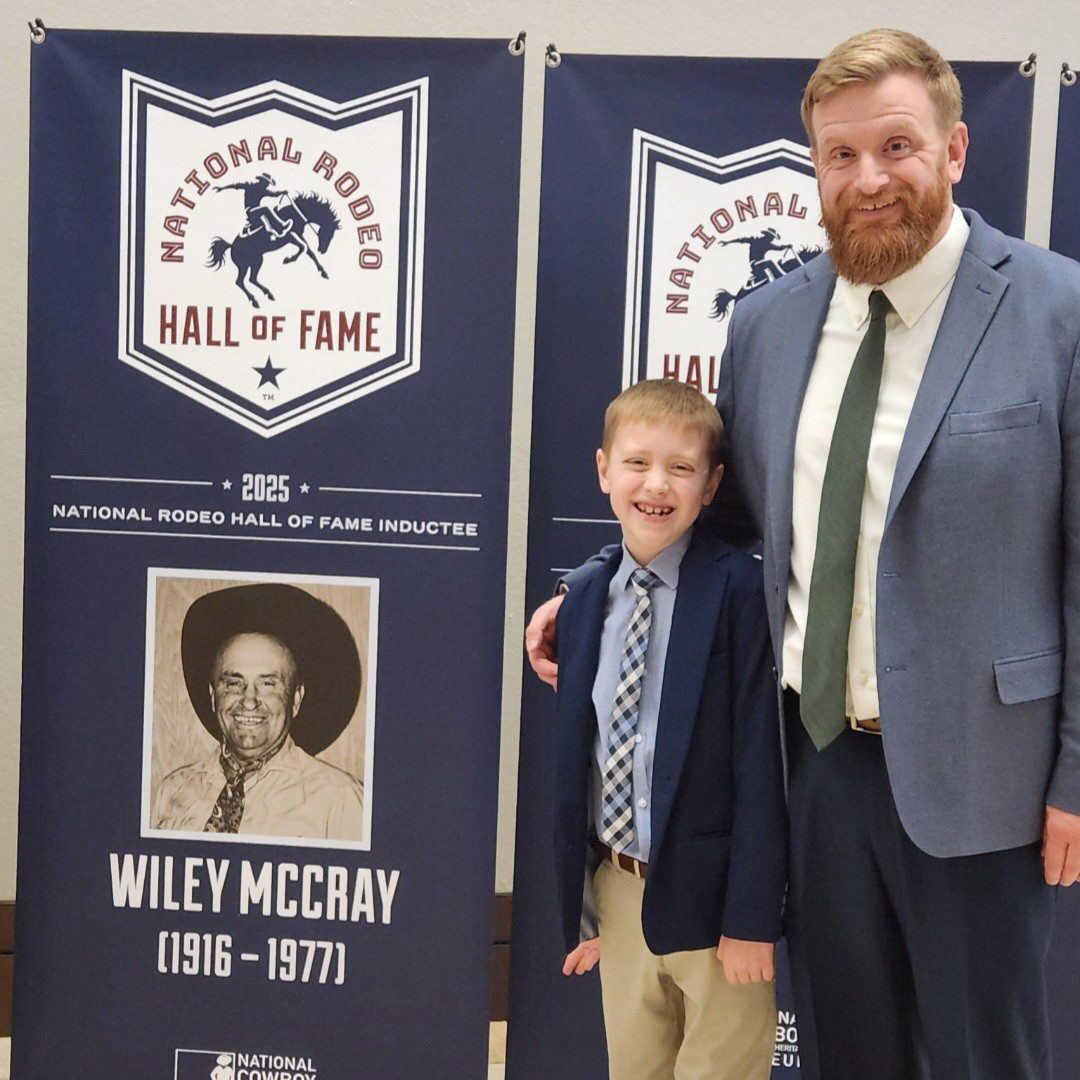
As National Rodeo Hall of Fame voting continues this month, we asked Patrick McCray to share more about his story. Patrick researched the career of his grandfather, rodeo clown Wiley McCray, put together a National Rodeo Hall of Fame nomination and was on hand last November when Wiley became an honored inductee.
Are you a fan of rodeo? We’d encourage you to follow Patrick’s lead and become a Rodeo member, which gives you nominating and voting privileges for the National Rodeo Hall of Fame. Find out more by clicking HERE.
By Patrick McCray
The two most important things in life are family and history. When I began my research on my grandfather, Wiley McCray, I never realized how much I would learn. After learning in 2017 that I was going to be a father myself, I tried to recall every story my father had told me about growing up with a legendary rodeo performer. I saw building a record of family history as just as important as building all the furniture we would need to care for my son, also named Wiley.
One of the first people I contacted was Chuck and Nancy Henson. I found Chuck’s name next to Wiley’s in a Santa Rosa Roundup program from the 1970s. Chuck Henson, a legendary rodeo figure himself, had worked with my grandfather throughout the 1960s until my grandfather’s death in 1977.
Chuck and Wiley shared the arena as a featured pair, working over 120 performances annually at places like Calgary, Salinas and La Fiesta de los Vaqueros. Chuck was as close as anyone had ever been to Wiley. My grandmother, Mardell, and Chuck’s wife, Nancy, were also very close. Chuck and Nancy were incredibly kind, providing me with details I had never known about my grandfather. Their stories made me realize there was far more to his life than I had anticipated.
I performed several internet searches on my grandfather, but they did not yield much. I decided to contact various halls of fame to locate more information. I began in the Fort Worth Stockyards, walking the hall with my wife and infant son. After making several trips around the plaques, I realized he was not an inductee of the Texas Rodeo Cowboy Hall of Fame. I reached out to other halls and learned the same. I did locate a 1964 induction into the Ak-Sar-Ben Western Hall of Fame, which had unfortunately closed years earlier. Still, each organization was generous with the information they did have.
As I spoke with each hall of fame, they all gave the same advice: I should contact Gail Woerner.
Each organization explained that if anyone knew details about my grandfather, it would be Gail. When I reached out to her, she guided me through how to approach my research. She emphasized the importance of understanding rodeo history: learning about stock contractors, the eras of rodeo clowns and the regions where they worked. Gail shared the file she had on my grandfather and even reached out to retired rodeo clowns to see if anyone remembered working with him.
As a high school teacher, I was able to dedicate my summer to the project. I would wake up early, before my son, to get a few hours of research in, then stay up late after my family went to sleep. I searched newspaper archives and state historical websites from regions known for major rodeos. I compiled everything into a spreadsheet, tracking dates, locations, stock contractors, rodeo personnel and other key details.
I also began organizing old photos of Wiley. When I was lucky, they included handwritten notes. I learned about notable rodeo photographers such as Ralph Doubleday, James Fain, DeVere Helfrich and Ferrell Butler, and I applied the same research methods to studying their work. I examined images of old rodeo arenas to identify locations and studied the clothing worn by other rodeo clowns to help identify people in unmarked photos. Everything went into my growing spreadsheet.
Through Gail’s efforts, she connected me with Marvin Klein, a rodeo clown and bullfighter who had worked with my grandfather. Marvin shared vivid memories of the rodeo circuits, including the schedules, locations, and routines that defined that life. He recalled specific details about working alongside Wiley and provided additional names and places for me to investigate.
To expand my search, I created a tribute Facebook page dedicated to my grandfather, sharing everything I had uncovered and reaching out to retired rodeo personnel. I also began watching old rodeo films — often at double speed — to maximize my time. I searched through any footage I could find, including home videos, focusing on cities and states with known rodeo histories.
As my research deepened, I discovered that my grandfather had never been inducted into any major halls of fame. I decided to make that my goal. I expanded my search to include his pseudonym, “the Canadian Kid,” as well as common misspellings of his name. By tracking patterns in his yearly travels, I uncovered additional rodeo appearances I had previously missed.
I even traveled to the Beutler Museum in Elk City, where I examined exhibits and discovered my grandfather in photographs and old labor lists displayed in glass cases. Through careful attention to detail, my spreadsheet grew to more than 350 entries, revealing a career that spanned Canada, the United States and Mexico.
Wiley began his legendary career at just 15 years old, working alongside a who’s who of rodeo. He performed in over 150 cities and worked more than 120 performances each year. Even now, I am only scratching the surface of his story, and I plan to continue my research.
Today, he is an inductee of both the National Rodeo Hall of Fame and the Texas Rodeo Cowboy Hall of Fame. His Facebook reels have surpassed one million views, and his legacy continues to grow. In a world full of ordinary people, my grandfather was anything but ordinary. I owe it to him — and to future McCrays —to make sure he is never forgotten.