




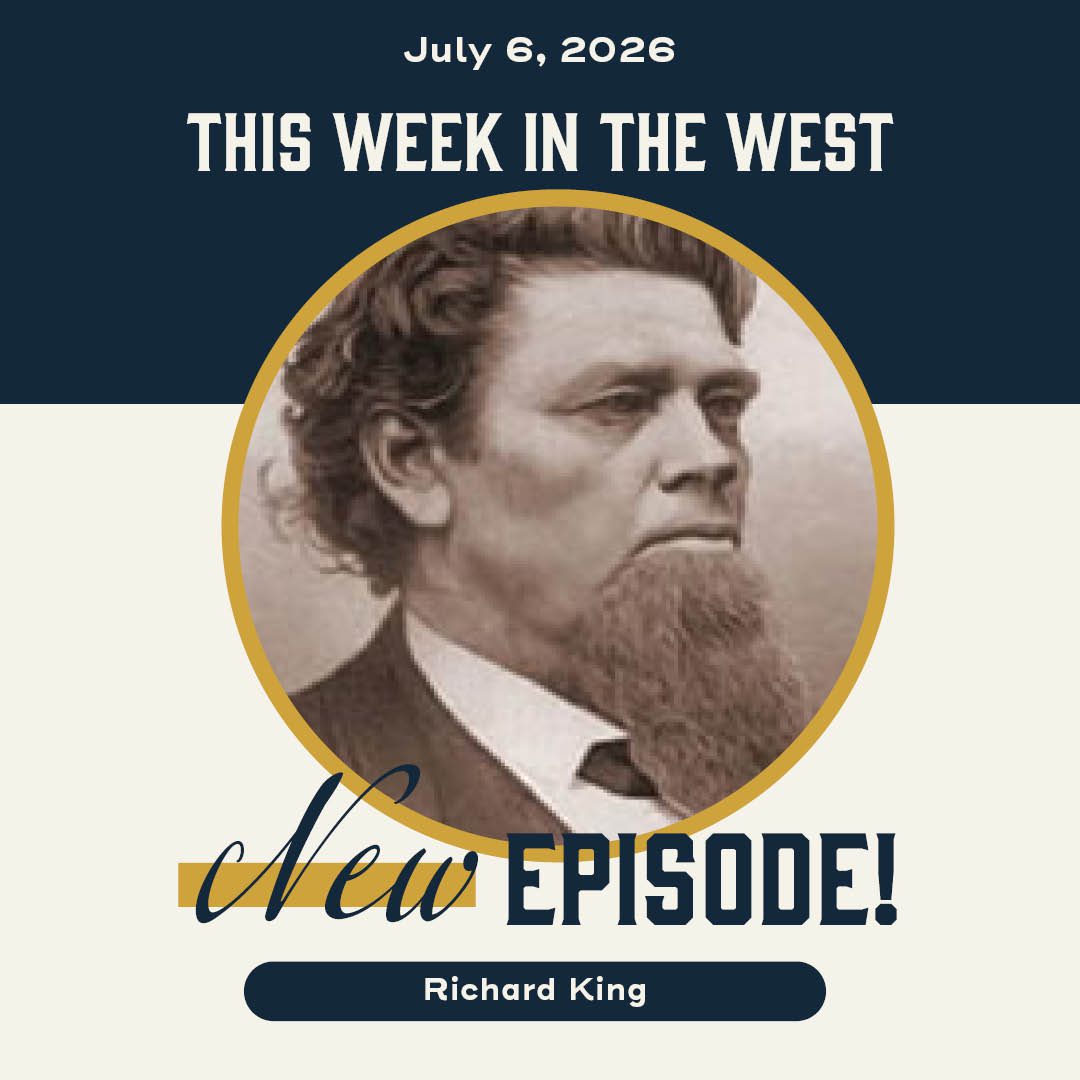
Howdy folks, it’s the first week of July 2026, and welcome to This Week in The West.
I’m Seth Spillman, broadcasting from the National Cowboy & Western Heritage Museum in Oklahoma City.
On this podcast, we share stories of the people and events that shaped the history, art and culture of the American West—and those still shaping it today.
Tighten up your lassos, listeners; this might be the wildest rags-to-extreme riches story we’ve told on our podcast.
The story is big: As big as the biggest cattle ranch in Texas.
Imagine a poor Irish boy living in New York City in the 1830s. At just nine years old, he’s apprenticed to a jeweler but hates it, so he sneaks aboard a ship bound for Alabama, hiding among the cargo until he’s discovered at sea.
The young stowaway was put to work, learning all he could about boats to keep himself from being thrown off at the next port.
His name was Richard King, and that decision would change the history of the American West.
King quickly proved himself useful aboard riverboats operating throughout Alabama, Florida and Georgia. He learned navigation, piloting and the demanding business of moving people and goods along America’s waterways.
By age sixteen, he was a steamboat pilot. And by his early twenties, he was helping supply American troops during the Mexican-American War along the Rio Grande.
Along the way, he met another ambitious riverboat operator named Mifflin Kenedy. The two men formed a friendship and business partnership that would last for decades.
After the war, they built a steamboat empire.
Operating on the Rio Grande, King and Kenedy eventually controlled much of the river trade between Texas and Mexico. Their boats transported soldiers, merchants, settlers and cargo through one of the busiest commercial corridors on the frontier.
But while riverboats had made him wealthy, his next journey changed his life.
In 1852, King traveled overland between Brownsville and Corpus Christi through a vast stretch of South Texas then known as the Wild Horse Desert.
It was remote. There were only a few settlements. Vast herds of wild horses roamed the grasslands. The region was rugged, isolated and often dangerous.
Even with all of those factors, King saw opportunity.
When he reached the clear waters of Santa Gertrudis Creek, he saw an area that supported abundant wildlife and lush grazing land. King believed it could support cattle on a scale few people had imagined.
He began purchasing land.
In 1853 and 1854, he acquired two large ranch properties that became the nucleus of what would eventually become King Ranch.
At first, the holdings totaled about 68,500 acres.
That alone would have made it a substantial ranch.
But Richard King wasn’t interested in staying small.
Over the next three decades, he relentlessly expanded his holdings, eventually assembling more than 600,000 acres. By some estimates, the ranch would grow even larger in the years following his death.
King Ranch became one of the largest and most famous ranches in the world.
Then came the Civil War.
Like many Texas businessmen, King found opportunities amid the conflict.
He supplied cattle to the Confederacy and participated in the Cotton Road trade that moved cotton through Mexico in exchange for supplies.
Union forces eventually targeted these operations.
In December 1863, federal troops raided King Ranch, looting property and searching for King himself. The ranch suffered damage, but King rebuilt and continued expanding after the war ended.
An article in The Atlantic Magazine in 1957 summarized King’s war years this way: “The Civil War did two things to Richard King. It gave him one of the most formidable characters on the frontier. And it brought him the big stake … which enabled him not merely to weather hard times of reconstruction after the war but to make the ranch on the Santa Gertrudis into the great enterprise it finally became.”
In the years after the Civil War, demand for beef exploded in northern markets. Railroads created a way to meet the demand, but reaching those railheads required moving cattle hundreds of miles across difficult terrain.
King was among the early ranchers who helped launch the great era of Texas cattle drives.
His cattle joined the streams of livestock moving north toward Kansas and beyond.
Between 1869 and 1884, more than 100,000 head of livestock were driven from King Ranch to northern markets.
These drives helped stock ranches across the American West and played a major role in establishing the cattle industry that became synonymous with cowboy culture.
Around this time, King registered the famous Running W brand — one of the most recognizable ranch brands in American history.
Long before terms like genetics and animal science became common in ranching, King invested in breeding programs designed to improve the quality of his livestock.
He also invested in railroads, packing houses, harbor improvements and other infrastructure that would help move his products efficiently to market.
He wasn’t simply building a ranch; he was building an entire business ecosystem.
Future generations of King Ranch leadership developed the Santa Gertrudis breed, the first officially recognized beef cattle breed developed in the United States.
The ranch also became famous for its Quarter Horses and Thoroughbreds, producing champions that gained national recognition.
By the time Richard King died of stomach cancer in 1885, he had transformed himself from an impoverished runaway into one of the most influential ranchers in American history.
After his death, the ranch survived droughts, economic downturns and changing times. It helped give rise to the town of Kingsville, Texas, and remains one of the most recognizable ranching operations in the world.
In 1959, Richard King was inducted into our Hall of Great Westerners here at The Cowboy.
And with that, we’ve expanded our land with another episode of “This Week in the West.”
Our show is produced by Chase Spivey and written by Mike Koehler.
Follow us and rate us on Apple Podcasts or wherever you hear us. That helps us reach more people.
Come visit us in Oklahoma City! You can now buy tickets online at thecowboy.org/tickets
Got a question or a suggestion? Drop us an email at podcast@thecowboy.org
We leave you today with the words of Richard King to his partner Mifflin Kenedy: “Land and livestock have a way of increasing in value. Cattle and horses, sheep and goats, will reproduce themselves into value. But boats have a way of wrecking, decaying, falling apart, decreasing in value and increasing in cost of operation. Buy land, and never sell.”
Much obliged for listening, and remember, come Find Your West at the National Cowboy & Western Heritage Museum.