





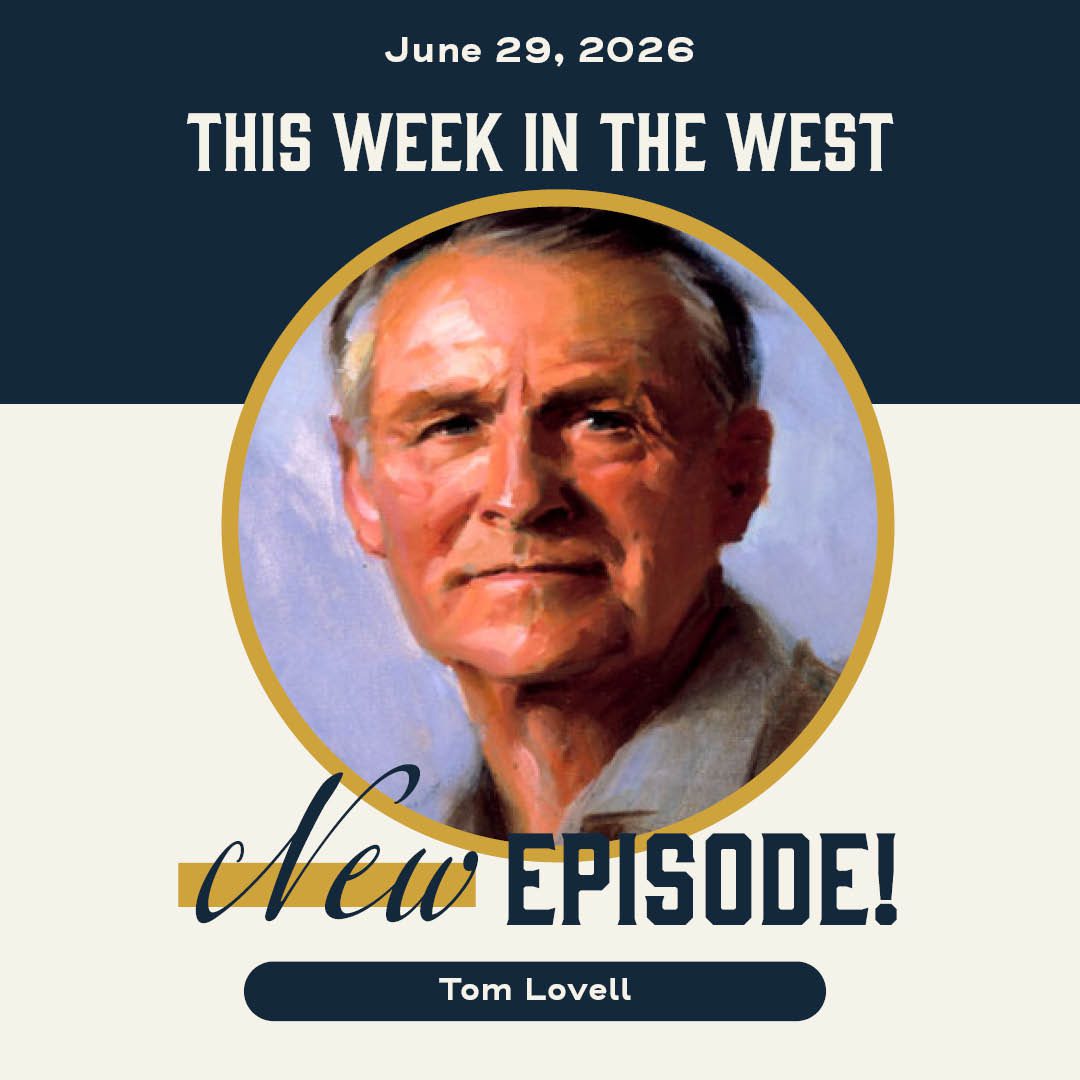
Howdy folks, it’s the last week of June 2026, and welcome to This Week in The West.
I’m Seth Spillman, broadcasting from the National Cowboy & Western Heritage Museum in Oklahoma City.
On this podcast, we share stories of the people and events that shaped the history, art and culture of the American West—and those still shaping it today.
The painting is simply titled “Target Practice.”
A frontier woman stands next to a cowboy, as he peers into the distance. As her dress and apron move in the breeze, she has shouldered a rifle and stares down its barrel.
The winner of the Ann Noble Brown Purchase Award at the 1986 Prix de West Invitational Art Exhibition & Sale here at The Cowboy, it’s a work that tells a rich story using only two figures and the brushy landscape of the West.
It was Tom Lovell at his best.
This week, we remember the acclaimed Western artist who died on June 29, 1997.
Born in New York City on February 5, 1909, Lovell grew up thousands of miles from the deserts, plains and mountain landscapes that would later define his art. Yet even as a young boy, he was fascinated by Native American history.
His mother often took him to the American Museum of Natural History in New York. While other kids might have been rushing toward the dinosaur bones, Lovell lingered and sketched. Studying the details of Native American clothing, weapons and artifacts.
In 1927, Lovell graduated as valedictorian of his high school class. For his graduation speech, he chose an unusual subject for the time: the mistreatment of Native Americans by the United States government.
Lovell attended Syracuse University, where he studied art. While still in college, he began selling illustrations to popular pulp magazines.
It wasn’t glamorous work. The pulp magazines of the 1920s and 1930s were inexpensive publications filled with Western adventures, detective stories and crime fiction. The deadlines were fast, the pay was modest, and the competition was fierce.
Lovell later joked that he earned just a few dollars for illustrations and a little more for magazine covers. But the experience taught him an important lesson.
Years later, he said that painting for the pulps was “great training.”
There wasn’t time or room for unnecessary details. Everything in the art had to contribute to and be drawn from the story it accompanied.
The grind from the pulp work eventually graduated to illustrations for more renowned national magazines like Cosmopolitan, Collier’s and Life.
He also created artwork for stories by prominent authors, including Sinclair Lewis and Edna Ferber.
By the late 1930s and early 1940s, Lovell had become one of America’s most successful illustrators.
Then came World War II. Although Lovell was well into his 30s, he joined the Marine Corps Reserve and became one of a group of military artists tasked with documenting Marine Corps history.
Alongside fellow illustrator John Clymer, Lovell worked on publications such as Leatherneck Magazine and the Marine Corps Gazette.
He also created large-scale historical paintings depicting Marine Corps actions and traditions. Many of those works remain in Marine Corps collections today.
Lovell knew those works demanded accuracy: in weaponry, uniforms and settings. He brought that eye for detail to all of his creations, no matter the time period.
When painting Vikings, he studied Viking weapons and ships. When illustrating Alexander the Great, he researched armor, geography and military tactics. When depicting frontier life, he wanted to know exactly how people dressed, what equipment they carried and how they traveled.
He once explained that a writer can establish a scene with a few carefully chosen words. An artist doesn’t have that luxury. It was the countless details that make a scene believable.
As Lovell put it, “I wasn’t there when Alexander marched across India. But I was able to do a painting of what Alexander did by working like hell at it.”
Following the war, Lovell’s career expanded even further.
He created historical artwork for National Geographic Magazine, illustrating stories about the Vikings, the Norman invasion of England, Alexander the Great, the Bible, the American Civil War and many other subjects.
In 1969, Texas oilman George Abell commissioned Lovell to create a series of paintings documenting the history of the Permian Basin and the American Southwest.
What began as a handful of paintings eventually grew into a major project spanning more than a dozen works.
And the commission changed the direction of Lovell’s career.
Researching the history of the Southwest rekindled the fascination with Native American life and Western history that had first begun during those childhood visits to the museum in New York.
From that point forward, much of Lovell’s attention turned toward the American West.
He painted Native American communities, explorers, traders, mountain men and frontier encounters. His paintings emphasized human stories found only in the history and culture of the American West.
In 1972, Lovell moved to Santa Fe, New Mexico, placing himself in the landscapes that inspired much of his work.
A few years later, he became a member of the Cowboy Artists of America and continued earning recognition as one of the nation’s leading Western painters.
Lovell became a charter member of the National Academy of Western Artists, the precursor to the Prix de West.
“Target Practice” made Lovell the first artist to win the Ann Noble Brown Purchase Award at the Prix de West twice. His painting “The Wolfmen” had been honored in 1974 in the exhibition’s second year.
Tom Lovell’s life came to a tragic end on June 29, 1997, when he and his daughter Deborah were killed in an automobile accident near their home in Santa Fe.
He was 88 years old.
His paintings continue to live on in museums, galleries and private collections across the country.
Here at The Cowboy, we are proud to be home not just to his paintings but also to his collected papers and artifacts from his art studio in Santa Fe.
Nearly three decades after his death, his stories continue to speak to us—reminding us that history isn’t just a collection of dates and events.
It’s a collection of people and places, down to the finest detail.
And with that, we’ve hit our target on another episode of “This Week in the West.”
Our show is produced by Chase Spivey and written by Mike Koehler.
Follow us and rate us on Apple Podcasts or wherever you hear us. That helps us reach more people.
Come visit us in Oklahoma City! You can now buy tickets online at thecowboy.org/tickets
Got a question or a suggestion? Drop us an email at podcast@thecowboy.org
We leave you today with the words of Tom Lovell himself: “I consider myself a storyteller with a brush. I try to place myself back in imagined situations that would make interesting and appealing pictures. I am intent on producing paintings that relate to the human experience.”
Much obliged for listening, and remember, come Find Your West at the National Cowboy & Western Heritage Museum.