






Howdy folks, it’s the fourth week of June 2026, and welcome to This Week in The West.
I’m Seth Spillman, broadcasting from the National Cowboy & Western Heritage Museum in Oklahoma City.
On this podcast, we share stories of the people and events that shaped the history, art and culture of the American West—and those still shaping it today.
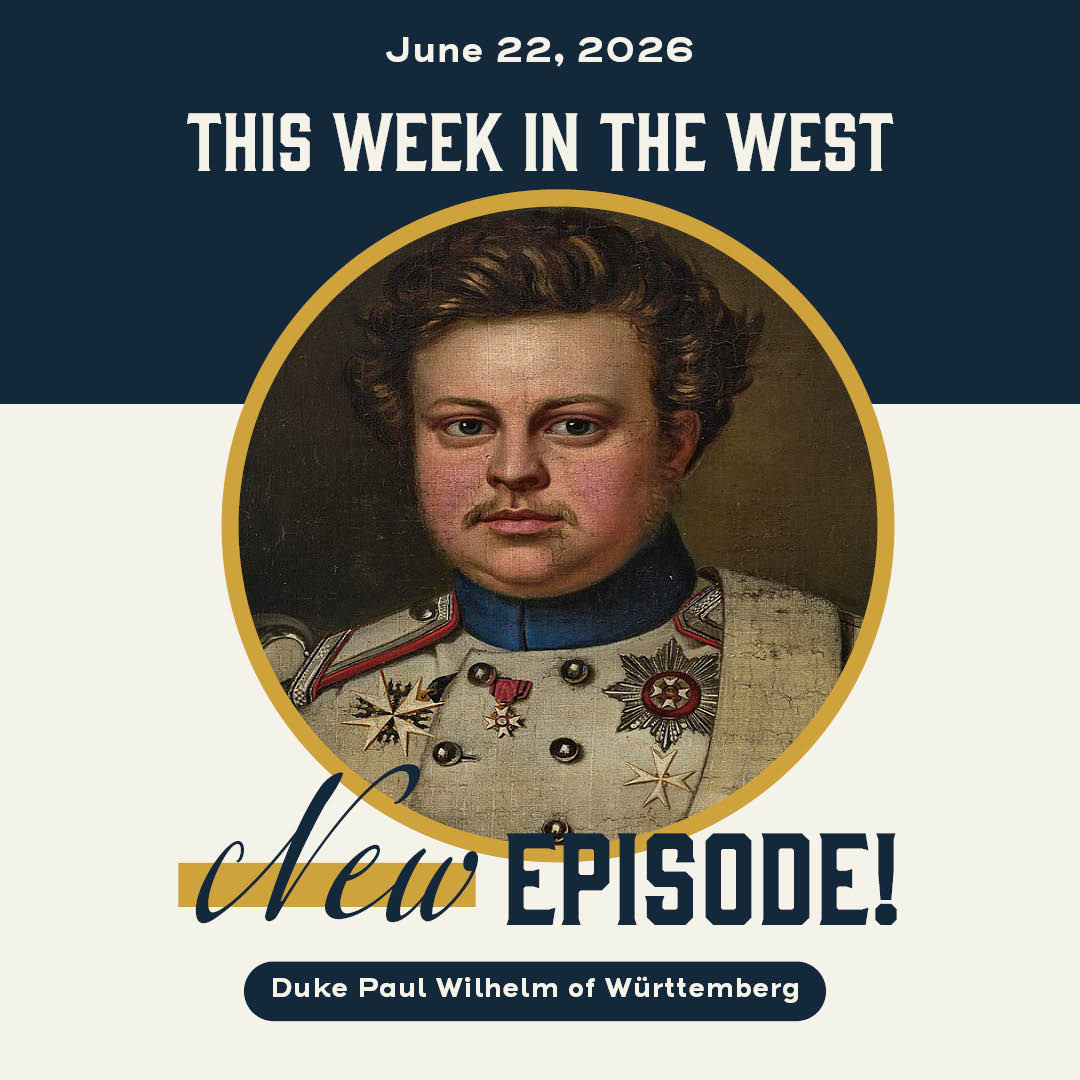
So, today’s episode is about Duke Paul Wilhelm of Württemberg, a 19th-century German Duke.
Let’s go ahead and address the obvious question: Why would a German noble be on a podcast about the American West?
Because, as familiar as we are with explorers like Lewis and Clark, few people know about the nature-loving, slightly rotund, mustachioed Prussian who tromped his way through the American frontier in the 1820s and 30s.
Born into European royalty, Paul Wilhelm could have lived a comfortable life in palaces and courts. Instead, he became one of the earliest European explorers to travel deep into the American frontier. Following in the footsteps of Lewis and Clark, he journeyed through the Mississippi and Missouri river valleys, traveled among Indigenous tribes, collected scientific specimens, and documented the rapidly changing West.
Why? A curiosity about science and a lust for adventure.
His travels took him from the swamps of Louisiana to the Great Plains and even to the headwaters of the Missouri River.
We remember him on the week of his birth, June 25, 1797. Born in what is now Poland, Paul Wilhelm was part of the powerful House of Württemberg and a nephew of the king. But unlike many European nobles, his mind was not on military endeavors or laissez-faire lifestyles, but on a fascination with the natural world.
He studied under scholars influenced by the great naturalist Alexander von Humboldt, whose ideas inspired a generation of scientific explorers.
But where to explore? His eyes turned across the Atlantic to the still wild United States of America.
By the early 1820s, the American West represented one of the most mysterious and scientifically interesting regions on Earth. Much of the territory beyond the Mississippi River was still unfamiliar to Europeans. The Lewis and Clark Expedition had returned less than twenty years earlier, and stories of vast grasslands, Indigenous nations, strange wildlife and immense rivers captured imaginations across Europe.
In October of 1822, Duke Paul Wilhelm sailed from Hamburg to North America. He arrived first in New Orleans, one of the most colorful and chaotic cities in the young United States. From there, he began traveling up the Mississippi River and its tributaries. He explored the Red River, the Yazoo River and the Ohio River before eventually making his way to St. Louis, then considered the gateway to the American frontier.
The Duke approached the West as a naturalist and ethnographer. He meticulously collected plant specimens, animal remains and Indigenous artifacts. He recorded detailed observations about geography, weather, and the cultures he encountered.
One of the most fascinating surviving examples of his observations comes from his visit to a tiny Louisiana settlement called La Balize, located near the mouth of the Mississippi River. At the time, La Balize was a fragile community built on piles above mud and marshland. The settlement existed primarily to guide ships safely through the dangerous Mississippi Delta into New Orleans.
Wilhelm described the village vividly, writing that the few wooden houses “stand … in the midst of the water and slime, between high reeds.” He noted that residents traveled from one house to another on plank walkways suspended above the swamp. He also described the enormous alligators inhabiting the riverbanks, marveling at the sheer number of them lurking in the marshes.
An engraving based on his drawing of La Balize survives today and offers a rare visual glimpse into a vanished frontier settlement. Hurricanes repeatedly destroyed the town over the years until it disappeared entirely.
As he pushed farther west, the Duke entered the fur-trade country along the Missouri River. There he met legendary American explorer William Clark, who had become Superintendent of Indian Affairs in St. Louis after the Lewis and Clark Expedition. Clark helped introduce the Duke to several important frontier figures, including Toussaint Charbonneau and Jean Baptiste Charbonneau, the son of Sacagawea.
The Duke was fascinated by the young man. After traveling together in the West, Jean Baptiste eventually accompanied Paul Wilhelm back to Europe.
For several years, the two journeyed together through Europe and North Africa, creating one of the strangest and most remarkable cultural pairings in frontier history.
With Charbonneau serving as an interpreter, Paul Wilhelm spent months traveling through the upper Missouri River country. He visited trading forts and observed Indigenous nations, including the Sioux, Blackfoot and Mandan peoples.
In 1829, he reached the Three Forks of the Missouri River in present-day Montana, becoming one of the earliest European explorers to document the area after Lewis and Clark.
Some accounts credit him with identifying the headwaters of the Missouri River. At a time when maps of the American West still contained enormous blank spaces, these journeys added meaningful scientific and geographic knowledge.
But what makes Duke Paul Wilhelm especially interesting today is the way he documented Indigenous cultures. Compared to many 19th-century contemporaries, he showed genuine curiosity and respect toward the Native American nations he encountered. His journals contained detailed ethnological observations, descriptions of daily life, and records of languages, customs, clothing, and ceremonies.
By the time many Americans became interested in preserving frontier history, countless details had already vanished. Paul Wilhelm’s writings captured moments and places during a brief transitional era before railroads, large-scale settlement and industrialization transformed the West forever.
His travels did not end with America. Over the course of his life, the Duke explored parts of Mexico, Egypt, South America, Australia, and the Middle East. He amassed enormous collections of scientific specimens and filled journals with sketches, maps, and observations.
Unfortunately, much of his collection and many of his unpublished writings were destroyed during World War II. What survived still reveals the astonishing scope of his curiosity and ambition.
Duke Paul Wilhelm eventually returned to Germany, where he spent his later years organizing his collections and living at Mergentheim Palace. He died in 1860 at the age of 63.
And with that, we say “Auf Wiedersehen” to another episode of “This Week in the West.”
Our show is produced by Chase Spivey and written by Mike Koehler.
Follow us and rate us on Apple Podcasts or wherever you hear us. That helps us reach more people.
Come visit us in Oklahoma City! You can now buy tickets online at thecowboy.org/tickets
Got a question or a suggestion? Drop us an email at podcast@thecowboy.org
We leave you today with the words of Duke Paul Wilhelm upon meeting the great explorer William Clark, who was serving as Superintendent of Indian Affairs in St. Louis: “(Clark’s) entire effort aims at reconciling the indians with the new immigrants and by a generous and sane behavior of the latter toward their often very unhappy red brothers, to blot out, as much as possible, that stain so sadly blemishing the history of former centuries and the occupation of America.”
Much obliged for listening, and remember, come Find Your West at the National Cowboy & Western Heritage Museum.