




Howdy folks, it’s the third week of June 2026, and welcome to This Week in The West.
I’m Seth Spillman, broadcasting from the National Cowboy & Western Heritage Museum in Oklahoma City.
On this podcast, we share stories of the people and events that shaped the history, art and culture of the American West—and those still shaping it today.
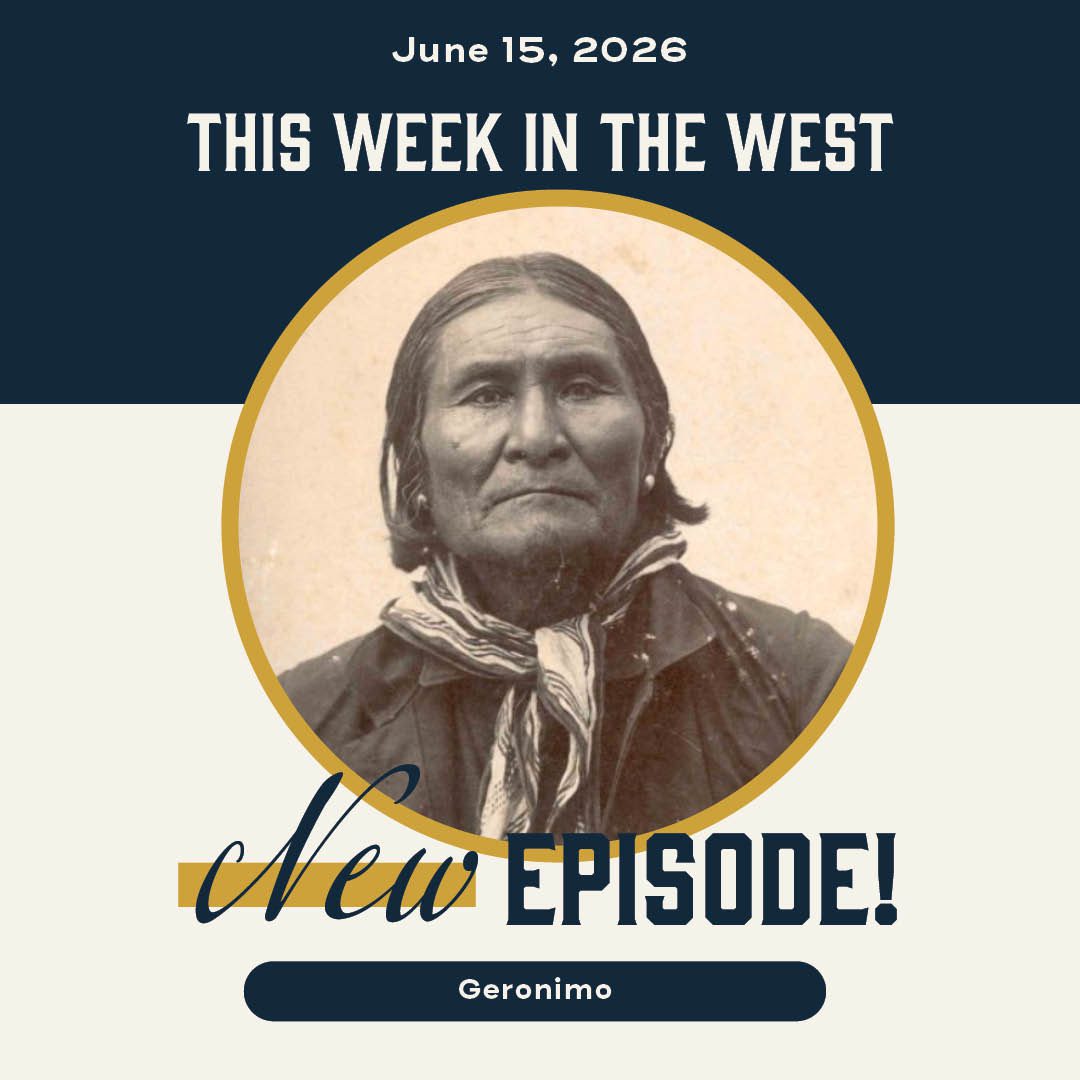
When he was young, he was named “One Who Yawns” and was just an Apache boy trying to survive with his people as more people – settlers, soldiers and the government – explored the Southwest.
The One Who Yawns would grow up and have much to say about the interactions between Native tribes and American pioneers. The world would come to know him as Geronimo — a name associated with the resistance and struggle of Native people fighting to preserve their homeland and traditions.
We remember Geronimo today during the week of his birth, June 16, 1829.
His Apache people had lived for generations across what is now Arizona, New Mexico and northern Mexico. They were skilled hunters, warriors and traders who understood the harsh desert and mountain landscape. But by the early 1800s, pressure from encroaching settlements created constant conflict across the region.
By his late teens, Geronimo had already taken part in raids and battles involving Apache groups and Mexican forces. But the defining tragedy of his life came in 1851.
While Geronimo and many of the men in his band were away trading, Mexican soldiers attacked their camp. When he returned, he discovered that his wife, his children and his mother had been killed. According to his later autobiography, the grief and rage from that moment never left him.
“I did not pray, nor did I resolve to do anything in particular, for I had no purpose left,” he wrote.
His sense of loss would eventually transform into a devotion to fighting those he believed threatened his people and their way of life.
It was during these years of warfare that he earned the name “Geronimo.” Historians still debate its exact origin, but many believe Mexican soldiers shouted prayers to Saint Jerome — “Jerónimo!” in Spanish — during fierce battles against him.
Whatever the source, the name stayed with him for the rest of his life.
Geronimo was not technically a chief of the Chiricahua Apache, but he became an influential spiritual leader, warrior and strategist. Other Apache leaders like Cochise also resisted Mexican and American expansion into Apache lands.
Together, they fought a long series of conflicts now known as the Apache Wars.
The situation grew even more tense after the end of the Mexican-American War in 1848.
The Treaty of Guadalupe Hidalgo transferred vast amounts of territory from Mexico to the United States, including lands long used by the Apache.
Suddenly, American settlers, miners, railroads and soldiers swarmed into the region in larger numbers.
The United States government was increasingly forcing Indigenous people onto reservations. In the 1870s, Geronimo and thousands of Apache people were confined to the San Carlos Reservation, a chunk of land in southeastern Arizona filled with pine forest and desert.
Conditions there were difficult, and many Apache resented the restrictions on their traditional customs and loss of freedom.
Geronimo refused to accept the reservation life quietly.
Over the next decade, he led several breakouts from the reservation. Small groups of Apache men, women and children would flee into the mountains of Arizona, New Mexico and northern Mexico, surviving through their knowledge of the terrain and conducting raids against settlements and military forces.
Apache raids often targeted isolated settlers and ranches, while American and Mexican military campaigns responded with equally brutal force.
The cycle of revenge and retaliation stretched across decades. Geronimo became both feared and legendary throughout the Southwest.
Newspapers and dime novels turned him into a larger-than-life figure, often portraying him as the symbol of Apache resistance. At one point, nearly a quarter of the entire standing United States Army was involved in the hunt for Geronimo and his small band.
General George Crook pursued him first, relying heavily on Apache scouts familiar with the region. Later, General Nelson Miles took over the campaign. Again and again, Geronimo escaped capture, sometimes surrendering and then fleeing once more when he feared mistreatment or execution.
Finally, with few options remaining, Geronimo surrendered for the last time on September 4, 1886, at Skeleton Canyon in Arizona. He was 57 years old.
His surrender marked the end of the major Apache resistance campaigns in the American Southwest.
Geronimo and the Chiricahua Apache were declared prisoners of war. They were first transported to Florida, then Alabama and eventually to Fort Sill in Oklahoma Territory in 1894. Many Apache people died during these years from disease and harsh conditions.
At Fort Sill, Geronimo adapted to reservation life as best he could and became something of a national celebrity.
Americans who had once feared him now paid money to see him at fairs and expositions. He appeared at the 1898 Trans-Mississippi Exposition in Omaha, the 1901 Pan-American Exposition in Buffalo and the 1904 St. Louis World’s Fair. He even rode in President Theodore Roosevelt’s 1905 inaugural parade.
But Geronimo never stopped asking to return to his homeland in Arizona. The federal government repeatedly denied those requests. Roosevelt himself refused Geronimo’s appeal, pointing to the violence of the Apache Wars and lingering anger among settlers in the Southwest.
Roosevelt is reported to have said. “If he went back there, he’d be very likely to find a rope awaiting him, for a great many people in the Territory are spoiling for a chance to kill him,”
In 1905, Geronimo published his autobiography, giving readers his own account of his life, beliefs and struggles. It remains one of the most important firsthand narratives from an Indigenous leader of the American West.
Four years later, in February 1909, Geronimo became ill after being thrown from his horse and spending a cold night outdoors. He died of pneumonia at Fort Sill on February 17, 1909, still officially classified as a prisoner of war.
And with that, we’ve ended the battle of another episode of “This Week in the West.”
Our show is produced by Chase Spivey and written by Mike Koehler.
Follow us and rate us on Apple Podcasts or wherever you hear us. That helps us reach more people.
Come visit us in Oklahoma City! You can now buy tickets online at thecowboy.org/tickets
Got a question or a suggestion? Drop us an email at podcast@thecowboy.org
We leave you today with the words of Geronimo from his memoirs: “We are vanishing from the earth, yet I cannot think we are useless or else (God) would not have created us. He created all tribes of men and certainly had a righteous purpose in creating each.”
Much obliged for listening, and remember, come Find Your West at the National Cowboy & Western Heritage Museum.