





Howdy folks, it’s the second week of June 2026, and welcome to This Week in The West.
I’m Seth Spillman, broadcasting from the National Cowboy & Western Heritage Museum in Oklahoma City.
On this podcast, we share stories of the people and events that shaped the history, art and culture of the American West—and those still shaping it today.
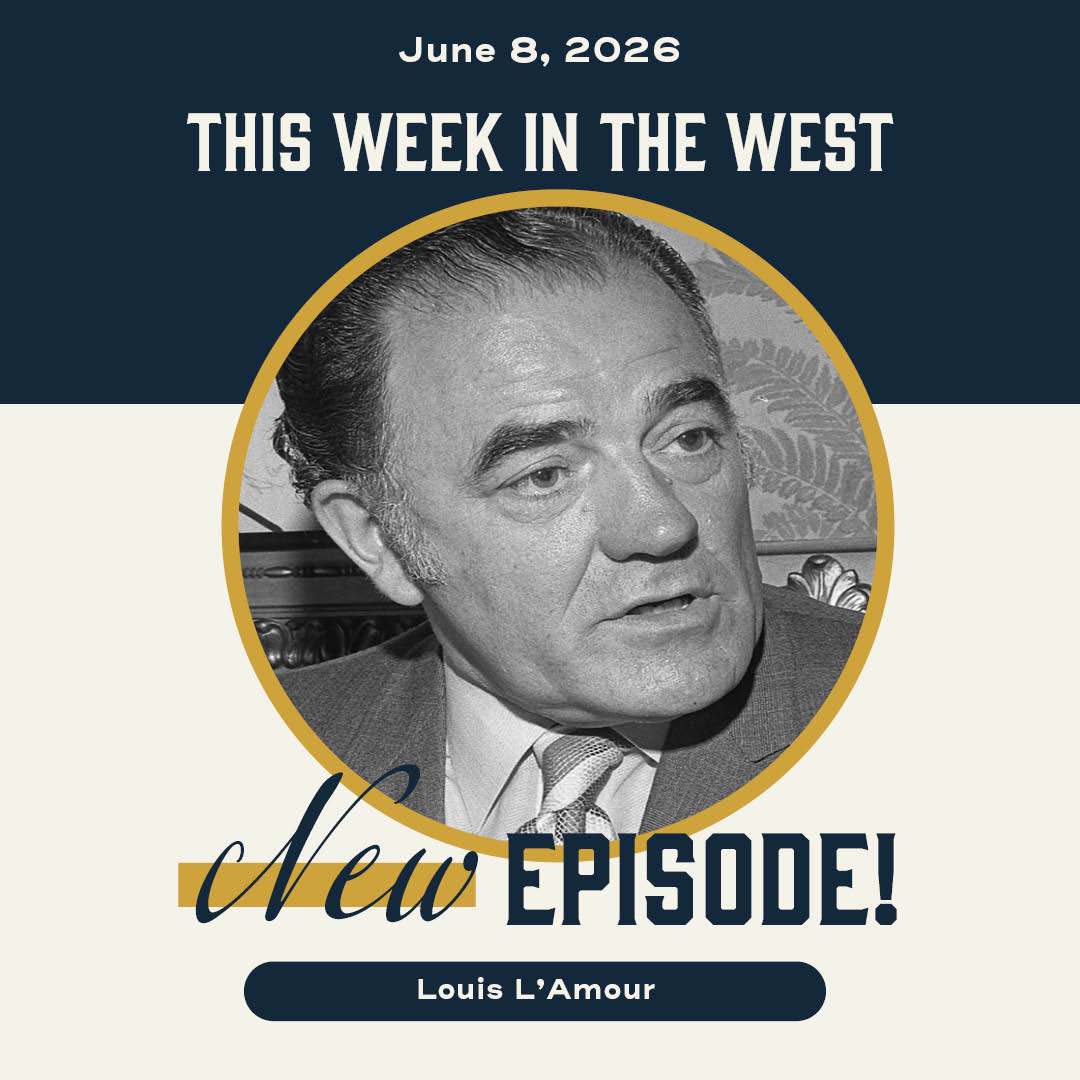
One day, as the story goes, Louis L’Amour was pounding away at his typewriter when his young daughter asked, “Daddy, why are you writing so fast?”
L’Amour smiled and answered, “Because I want to see how the story turns out.”
That simple answer may explain more about L’Amour than any review.
L’Amour found out how many stories turned out, crafting a career that helped capture and define the West as much as any other figure in popular culture.
He worked prodigiously until his death on June 10, 1988, the anniversary we remember this week.
Louis Dearborn L’Amour was born on March 22, 1908, in Jamestown, North Dakota. His family originally spelled their name “LaMoore,” though Louis later returned to the French spelling.
Young Louis spent countless hours in the local library devouring adventure stories, history books and tales of exploration. He later credited those books with educating him far beyond the classroom.
But the real education of L’Amour came on the road.
When economic hardship struck the Midwest in the 1920s, his family traveled throughout the American West searching for work. L’Amour baled hay in New Mexico, worked in mines across Arizona and Nevada, labored in sawmills and lumber camps and spent time around ranchers, cowboys and drifters.
Those experiences would later become the foundation for his stories.
L’Amour had lived among hard-working people in rough country. He knew the loneliness of the plains and the dangers of frontier life. He once said he wanted readers to feel that his stories were real.
Work continued to consume his life before he transformed those experiences into fiction. He worked as a merchant seaman and traveled the world, visiting places like China, Egypt, India and the South Pacific. He boxed professionally for prize money. He slept in boxcars.
By the time of the Great Depression, L’Amour started to churn out short stories, which were gobbled up by popular pulp magazines — inexpensive adventure publications printed on cheap paper and sold in drugstores and newsstands.
He wrote crime stories, boxing stories and sea adventures before finally finding his true home in Western fiction.
In 1953, L’Amour published Hondo, a novel based on one of his short stories. It became a bestseller and was later adapted into a film starring John Wayne.
The success of Hondo changed everything.
Over the next three decades, Louis L’Amour became a publishing phenomenon. He wrote nearly 100 novels and more than 250 short stories. His books sold hundreds of millions of copies worldwide and were translated into numerous languages.
His stories featured ranchers, gunfighters, settlers, prospectors and wanderers trying to survive in a harsh and unpredictable world. Popular titles included The Burning Hills, The Sackett series and Last of the Breed.
In 1985, he was honored here at The Cowboy with a special Trustees’ Award at the Western Heritage Awards.
Readers loved the action and adventure, but they also appreciated the authenticity.
L’Amour was obsessive about research. He collected thousands of books and maps and carefully studied geography and history so his settings would feel accurate.
That attention to detail helped separate him from many other paperback Western writers of his era.
And while critics sometimes dismissed Western fiction as formula entertainment, readers never stopped buying his books. L’Amour believed he was writing for ordinary working people.
“I think that if I’ve got one thing going for me, both in my writing and other things, it’s that I love people. A lot of writers despise people. They don’t want to be social; they avoid it. I don’t; I like people,” L’Amour said in an interview.
“I hope I have something to offer the world. I’m trying; I believe I have a very perceptive audience out there. But for that reason, I take it for granted that my audience is intelligent. I write a book that appeals to their intelligence. Sure, I’m writing about the romantic periods of the West, but I try to tell not only how it was, but show how things happened in those days—what kind of world they lived in.”
L’Amour understood that the West was more than gunfights and outlaws. In his nonfiction writing, he reflected on frontier history and the relationship between people and the land. In one passage, he wrote about walking where Native peoples once walked and hoping to leave “no more mark than the passing of a soft wind.”
Like many Western writers of his generation, some aspects of L’Amour’s work have drawn criticism over time, particularly his portrayals of Native Americans and women. But his impact on popular culture and the Western genre is undeniable.
Hollywood adapted many of his stories into films and television productions. Even after becoming wealthy and famous, L’Amour maintained a relentless work ethic. He wrote every single day. He often produced five to ten pages before lunch and would immediately begin another novel after finishing the last one.
Late in life, when asked which of his books he liked best, L’Amour answered, “I like them all.” Then he added something revealing. He said he felt he was “just now getting to be a good writer.”
Louis L’Amour died in 1988 from lung cancer at the age of 80. But his books remain in print and continue finding new readers around the world.
And with that, we’ve added another chapter to “This Week in the West.”
Our show is produced by Chase Spivey and written by Mike Koehler.
Follow us and rate us on Apple Podcasts or wherever you hear us. That helps us reach more people.
Come visit us in Oklahoma City! You can now buy tickets online at thecowboy.org/tickets
Got a question or a suggestion? Drop us an email at podcast@thecowboy.org
We leave you today with the words of L’Amour himself, talking about his love of reading and books: “It is often said that one has but one life to live, but that is nonsense. For one who reads, there is no limit to the number of lives that may be lived, for fiction, biography, and history offer an inexhaustible number of lives in many parts of the world, in all periods of time.
“So it was with me. I saved myself much hardship by learning from the experiences of others, learning what to expect and what to avoid. I have no doubt that my vicarious experience saved me from mistakes I might otherwise have made—not to say I did not make many along the way.”
Much obliged for listening, and remember, come Find Your West at the National Cowboy & Western Heritage Museum.