



Howdy folks, it’s the first week of June 2026, and welcome to This Week in The West.
I’m Seth Spillman, broadcasting from the National Cowboy & Western Heritage Museum in Oklahoma City.
On this podcast, we share stories of the people and events that shaped the history, art and culture of the American West—and those still shaping it today.
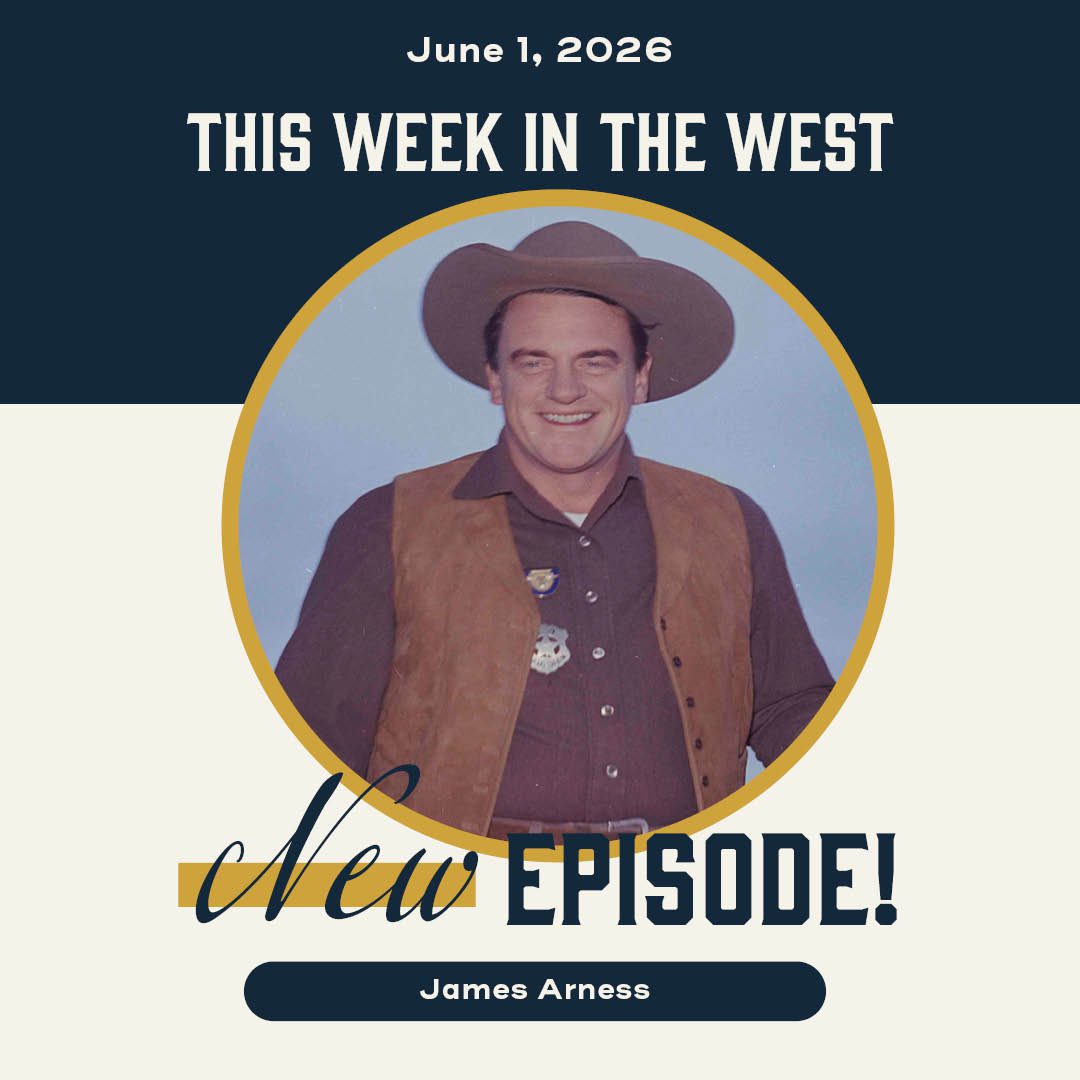
He was a monster before he was a marshal, but in either role, actor James Arness’ imposing stature left its mark on Hollywood and, eventually, on television’s most iconic Western series.
But how did the lanky fellow get from Minnesota to the fictional Dodge City?
Today, we remember the actor who died this week, June 3, 2011.
He was born James King Aurness (spelled A-U-R-N-E-S-S) in Minneapolis, Minnesota, in 1923, the son of a businessman and a journalist.
Tall even as a young man, he eventually grew to an incredible 6-foot-7.
Before acting ever crossed his mind, he worked ordinary jobs: loading railroad cars, delivering packages, even logging timber in Idaho. By his own admission, he was shy, awkward and uncertain about his future.
Then World War II changed everything.
Arness was drafted into the U.S. Army in 1943. Though he had hoped to become a fighter pilot, his height made that impossible. Instead, he became a rifleman in the 3rd Infantry Division. In January 1944, during the Allied landings at Anzio, Italy, Arness was one of the first soldiers ordered off the landing craft to measure the water depth for the troops behind him. Standing waist-deep under enemy fire, he entered one of the bloodiest campaigns of the war.
Not long afterward, he was severely wounded during combat. The injury required multiple surgeries and left him with chronic pain for the rest of his life. Arness earned the Bronze Star, and a Purple Heart.
Like many veterans returning home after the war, he struggled to figure out what came next.
His younger brother — who would later become famous as actor Peter Graves — encouraged him to try radio work. Arness became a radio announcer in Minneapolis before eventually hitchhiking to Hollywood to pursue acting.
At first, the jobs were small, including a breakout role as the monstrous creature in the science-fiction classic The Thing from Another World and a turn as an FBI agent in the giant-ant thriller Them!.
But while he was grinding out work on the studio lot, he ended up making friends. Including with Western icon John Wayne.
Wayne recognized something in the quiet, towering Minnesotan. Arness was not flashy. But he had presence. Wayne cast him in supporting roles in films like Hondo, Big Jim McLain and Island in the Sky.
In 1955, CBS was adapting the successful radio drama Gunsmoke for television. The role of Marshal Matt Dillon required authority, toughness and moral gravity. John Wayne personally introduced Arness to television audiences in a filmed prologue for the show’s first episode, essentially giving the young actor his blessing.
At the time, television Westerns often portrayed clean-cut heroes who rarely doubted themselves. But Gunsmoke was different. Matt Dillon was not a superhero.
He wore one gun, which he fired only reluctantly. He often seemed tired by the responsibility of keeping order on the frontier. One quote from Arness later perfectly captured the character:
“If Matt Dillon had to shoot somebody, you’d cut around to him. You could see that he just hated to have to do that and he felt a sort of revulsion over it,” Arness said.
The show slowly built an audience before exploding into a phenomenon. From 1957 to 1961, Gunsmoke became the number-one show on television. At its height, more than 40 million Americans watched each week.
Its success sparked an explosion of television Westerns: Bonanza, Rawhide, Wagon Train and many others followed. But Gunsmoke remained the gold standard.
For millions of Americans, Arness’ Matt Dillon defined the West. Calm. Steady. Quiet. A man who did not look for trouble but faced it when it arrived in Dodge City.
In an era filled with fast-drawing heroes and black-and-white morality, Arness helped create a more human kind of Western character — a man who understood that every gunfight carried consequences.
Gunsmoke lasted an astonishing 20 seasons and produced 635 episodes. Arness appeared in every single one.
After the series ended in 1975, Arness continued acting in Western productions, most notably as Zeb Macahan in How the West Was Won, another sweeping frontier saga that became especially popular overseas.
Despite his fame, Arness remained intensely private. He disliked publicity, rarely gave interviews and stayed far from the Hollywood spotlight.
In many ways, James Arness represented a certain kind of Western hero both on and off screen: modest, dependable and deeply shaped by hardship.
In 1981, he was inducted into the Hall of Great Western Performers here at the National Cowboy & Western Heritage Museum.
His supporting cast became one of television’s most beloved ensembles: Milburn Stone as Doc Adams, Amanda Blake as Miss Kitty and Dennis Weaver as Chester Goode. All of them have also been inducted into our Hall of Great Western Performers.
Arness’ portrayal of Matt Dillon helped define how generations of Americans imagined the frontier lawman: not as a stereotypical white-hat-wearing gunfighter, but as a thoughtful man burdened by duty.
James Arness died in 2011 at the age of 88, but through reruns, reunion movies and decades of television history, Marshal Matt Dillon still rides the streets of Dodge City.
And with that, we’ve gotten the heck out of Dodge on another episode of “This Week in the West.”
Our show is produced by Chase Spivey and written by Mike Koehler.
Follow us and rate us on Apple Podcasts or wherever you hear us. That helps us reach more people.
Come visit us in Oklahoma City! You can now buy tickets online at thecowboy.org/tickets
Got a question or a suggestion? Drop us an email at podcast@thecowboy.org
We leave you today with the words of Burt Reynolds, who wrote the foreword to James Arness’ autobiography: “He was totally without ego. He never imposed his position on anyone. Not once did I or anyone else ever see Jim being rude, overbearing, self-righteous or selfish to anyone, whether crew member, extras, day players or co-stars.”
Much obliged for listening, and remember, come Find Your West at the National Cowboy & Western Heritage Museum.