

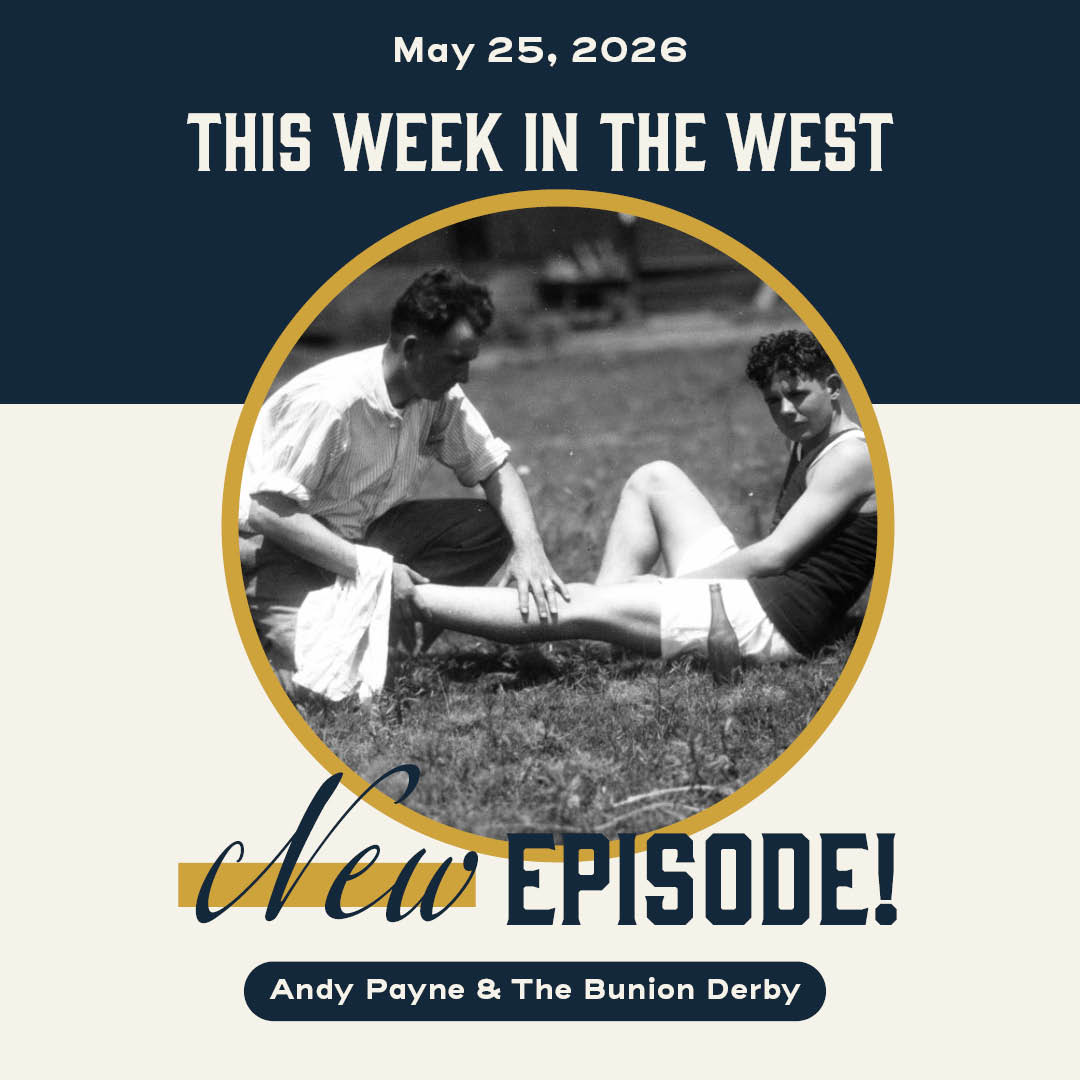
Howdy folks, it’s the fourth week of May 2026, and welcome to This Week in The West.
I’m Seth Spillman, broadcasting from the National Cowboy & Western Heritage Museum in Oklahoma City.
On this podcast, we share stories of the people and events that shaped the history, art and culture of the American West—and those still shaping it today.
We’ve been spending time this year celebrating the 100th Anniversary of Route 66, the Mother Road, which runs past us here at The National Cowboy & Western Heritage Museum.
It’s hard to imagine that one Spring in the Roaring Twenties, the road that ambles from Los Angeles to Chicago was just part of a punishing course that challenged athletes of all kinds to run across the country.
The entire country.
It was this week – May 26, 1928 – that the Transcontinental Footrace finished in New York City, with a young Cherokee runner from Oklahoma ending up the winner.
It became known as “The Bunion Derby” and was the brainchild of Charles C. Pyle, a sports promoter with a flair for spectacle. This brilliant (and humble) idea was officially called “C. C. Pyle’s International Transcontinental Footrace, 3,400 miles from Los Angeles to New York City.
The prize? Twenty-five thousand dollars. That’s more than four hundred thousand dollars today.
The race began on March 4, 1928, at Ascot Speedway in Los Angeles. Nearly 300 runners. They came from across the United States and around the world, drawn by the promise of money, fame and adventure.
The route followed what we now know as Route 66, cutting across the Southwest, through Texas and Oklahoma, up to Chicago, and then east to New York.
It became a traveling circus with a caravan of support vehicles following the runners, including journalists, trainers, a rolling shoe repair shop and one of the first mobile radio stations broadcasting updates.
Towns paid to host stops on the route; inevitably, carnivals would pop up, and crowds would gather. The runners (nicknamed “bunioneers) could even earn a little extra money selling programs or signing autographs.
Among those runners was a 20-year-old Cherokee man from the small town of Foyil, Oklahoma, named Andy Payne.
Payne had been running his entire life. As a boy, while others rode horses to school, Payne ran. He competed in track in high school and developed a reputation for endurance.
He had a reason for trying the crazy idea of winning the Bunion Derby.
His family’s farm carried a mortgage. Payne believed that winning the race could change their lives. As he reportedly said, he could accomplish more in three months than years of farm work might provide.
With financial help from his parents and the Claremore Chamber of Commerce, Payne entered the race.
He trained on the rough roads of eastern Oklahoma in all weather conditions. His father described his running style as a “machine-like trot.”
By the time Payne arrived in California, he was running up to 30 miles a day, preparing himself for what lay ahead.
Others were not so ready. Seventy-seven runners dropped out after just one day.
Within a week, so many competitors were suffering from blistered and broken feet that the press gave the race its lasting nickname—the “Bunion Derby.”
Conditions were not ideal: Runners crossed the Mojave Desert under intense heat and wind. Dust from passing cars made it difficult to breathe. Some runners were even struck by vehicles along the route.
They ran marathon distances or more every single day.
Remember the tortoise and the hare? That was Andy Payne.
He didn’t try to win early. Instead, he held back, letting the early favorites burn out.
Even when he fell ill with tonsillitis during the race, Payne refused to quit. He dropped behind briefly, then fought his way back into contention.
As the race entered Oklahoma, something changed. Payne became the hometown hero.
Crowds lined the roads to watch Payne run. Schools closed. Businesses shut their doors. People ran alongside him for miles, asking for autographs and cheering him on.
In Oklahoma City, the governor greeted him, and in Claremore, Will Rogers, one of the most famous Oklahomans of all, was there to welcome him.
As the race pushed eastward into the Midwest, the field continued to shrink.
By the time the runners reached Illinois, traffic had become one of the greatest dangers. Some runners dropped out after accidents or near misses with cars and motorcycles.
By Chicago, only about 65 runners remained.
And then it became a battle of attrition.
One by one, Payne’s strongest competitors dropped out, felled by injuries, illness and exhaustion.
The final major challenger, Peter Gavuzzi, built a strong lead until he, too, was forced to quit due to illness.
Suddenly, the race belonged to Andy Payne.
Payne knew all he needed to do was finish.
On May 26, 1928, after 84 days on the road, Andy Payne entered Madison Square Garden in New York City.
Out of the hundreds who started, only 55 runners finished.
Payne had crossed more than 3,400 miles in 573 hours, 4 minutes and 34 seconds.
He had worn out five pairs of shoes.
And he had won by more than 15 hours.
Payne returned home with his prize money. He paid off the family farm mortgage. He built a new home. He invested in land in northeastern Oklahoma. Land that would later produce oil and gas.
Payne retired from competitive running soon after the race. He later served as the Clerk of the Oklahoma Supreme Court for nearly four decades.
He died in 1977. In Foyil, a statue stands along Route 66, honoring the hometown boy who ran across America.
And with that, we’re finished bunion-free on another episode of “This Week in the West.”
Our show is produced by Chase Spivey and written by Mike Koehler.
Follow us and rate us on Apple Podcasts or wherever you hear us. That helps us reach more people.
Come visit us in Oklahoma City! You can now buy tickets online at thecowboy.org/tickets
Got a question or a suggestion? Drop us an email at podcast@thecowboy.org
We leave you today with the words of author Charles B. Kastner in his book on the Bunion Derby: “Andy Payne was the Oklahoma poster boy. He was one-eighth Cherokee, humble and tough with a quiet, unassuming attitude that hid his sharp mind. The combination was hypnotic and drew fans like ants to honey.”
Much obliged for listening, and remember, come Find Your West at the National Cowboy & Western Heritage Museum. um.