

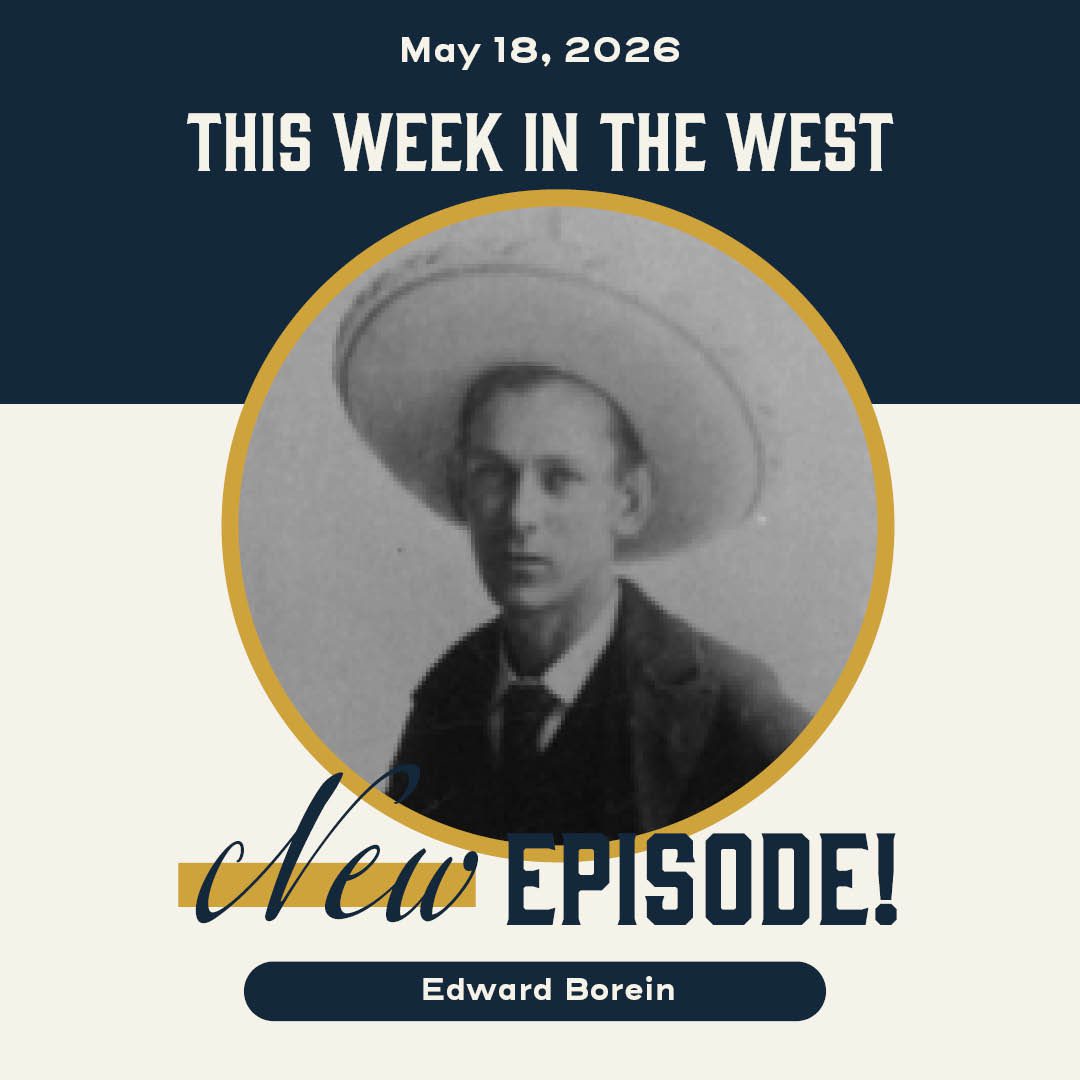
Howdy folks, it’s the third week of May 2026, and welcome to This Week in The West.
I’m Seth Spillman, broadcasting from the National Cowboy & Western Heritage Museum in Oklahoma City.
On this podcast, we share stories of the people and events that shaped the history, art and culture of the American West—and those still shaping it today.
The check that came in the mail didn’t make too much difference to the life of Edward Borein.
It was 1896, smack dab in the middle of the heyday of the American West, and Borein was a working cowboy.
But the check wasn’t for handling cattle, though; it was from The Land of Sunshine magazine and paid him for some sketches he had sent to publisher Charles Loomis.
Art was a passion for Borein, who died this week, May 19, 1945, but being a ranch hand was his profession.
By the end of his life, Borein would be known as one of the finest painters and illustrators of authentic cowboy life.
Born in 1873 in San Leandro, Edward Borein watched cattle being driven past his home as a boy. By the age of 5, he was already sketching horses as a budding artist, and by the time he was a teenager, he was a cowboy-in-training who could ride, rope and handle cattle.
At eighteen, he set out from home and officially became one.
He rode the ranges of California, worked massive ranches, and eventually pushed farther south into Mexico, where he learned Spanish and worked as a vaquero.
He would record this life through sketches, making sure to get everything correct about how cowboys worked and lived. There may have been Easterners drawing cowboys and telling tales of the West, but there was no stretching the truth for Borein.
As he later said, “I will leave only an accurate picture of the West, nothing else but that. If anything isn’t authentic or just right, I won’t put it in any of my work.”
That commitment to authenticity usually gets Borein mentioned in the same breath as Charlie Russell, another Western art legend who knew the cowboy life firsthand.
The two would cross paths, and Russell would later encourage Borein’s work, suggesting he might become one of the finest oil painters of the Western genre.
At his mother’s urging, he briefly attended the Art School of the San Francisco Art Association, but lasted only about a month. Formal training didn’t suit him, but those early connections mattered. He met artists like Maynard Dixon and Jimmy Swinnerton, who encouraged him to keep going.
While working on ranches, Borein began submitting drawings to publications. One of his early breaks came in that sale to The Land of Sunshine.
By 1900, growing older, Borein began working as an illustrator for the San Francisco Call. His pen-and-ink drawings began appearing in major publications like Harper’s, Collier’s Weekly, Sunset Magazine, and The Saturday Evening Post. He even created advertising art for brands like Stetson Hats and Pierce-Arrow automobiles.
Borein would spend about 12 years living in New York City, working as an illustrator and artist. But even then, he brought the West with him, as his studio hosted icons like Will Rogers and Buffalo Bill Cody.
Despite the distance, Borein never left the West behind. His subjects remained cowboys, Native peoples, vaqueros, missions and the wide-open landscapes he knew so well.
New York eventually lost its appeal.
In 1921, Borein returned to California and settled in Santa Barbara, where he opened a studio that would become a hub for artists, writers and cultural figures. His home, La Barranca, became a gathering place for conversation, storytelling and artistic exchange.
It was during these years that Borein refined the medium for which he would become best known: etching.
Through etching, watercolor and drawing, he produced some of the most detailed and authentic visual records of the West ever created. His work captured everything from stagecoaches and ranch life to Spanish missions and Indigenous communities. It was precise, just the way Borein liked it.
In 1932, his work was even included in the art competition at the Summer Olympics.
Edward Borein died in Santa Barbara in 1945 at the age of 72.
Borein’s works are included in our permanent collection here at The National Cowboy & Western Heritage Museum and stand as some of the most accurate visual records of a rapidly changing West.
In 1971, he was posthumously inducted into our Hall of Great Westerners, one of only a few artists so honored, including his hero, Charlie Russell.
And with that, we’ve cashed our checks for another episode of “This Week in the West.”
Our show is produced by Chase Spivey and written by Mike Koehler.
Follow us and rate us on Apple Podcasts or wherever you hear us. That helps us reach more people.
Come visit us in Oklahoma City! You can now buy tickets online at thecowboy.org/tickets
Got a question or a suggestion? Drop us an email at podcast@thecowboy.org
We leave you today with the words of the obituary written in the Santa Barbara News Press after Borein’s passing: “With etching tool and brush, with acid and paint, Ed Borein ‘wrote’ the history of America’s West, of a way of living and—all important—of a way of thinking, that will be part of America’s strength long after the details of the West are forgotten.”
Much obliged for listening, and remember, come Find Your West at the National Cowboy & Western Heritage Museum.