

Howdy folks, it’s the second week of May 2026, and welcome to This Week in The West.
I’m Seth Spillman, broadcasting from the National Cowboy & Western Heritage Museum in Oklahoma City.
On this podcast, we share stories of the people and events that shaped the history, art and culture of the American West—and those still shaping it today.
He was the Babe Ruth of Rodeo.
A giant. The definer of greatness in the sport.
As his friend and National Rodeo Hall of Fame announcer, Clem McSpadden, said:
“If Jim Shoulders was a tree, he’d be the biggest tree in the rodeo forest, period, over and out.”
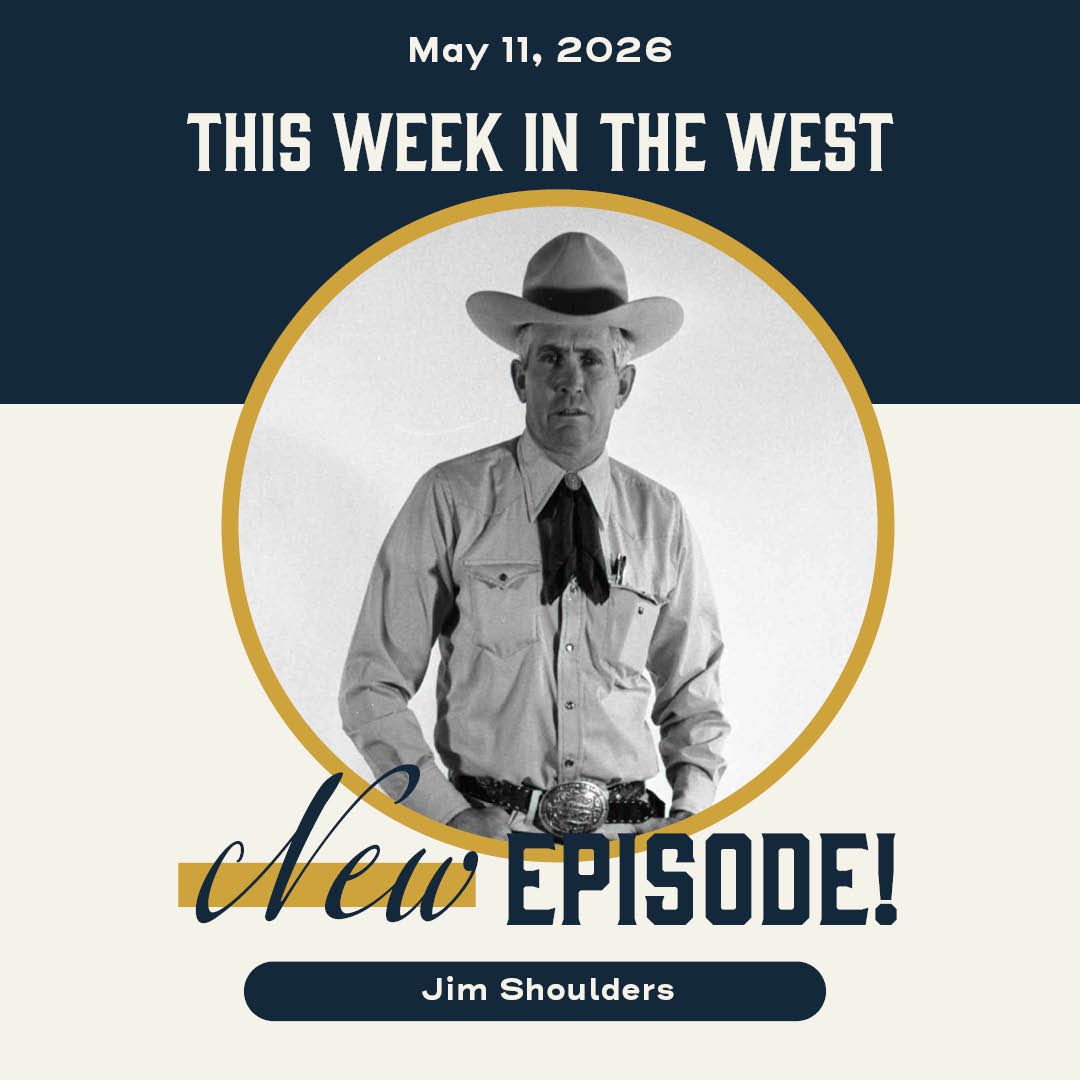
Today we remember the legendary Jim Should, born this week, May 13, 1928.
Born and raised in Tulsa, Shoulders didn’t come from a ranching background. He was a city kid who wanted to be a cowboy.
At 14, he entered his first rodeo in Oilton, Oklahoma, and that dream became a reality. He climbed on a bareback horse, held on, and walked away with $18 and something much more valuable: proof that he belonged in the area.
Shoulders recalled the moment in an interview with The Oklahoman newspaper, saying: “I had an older brother who was rodeoing and riding bulls, and that gave me the bug. The first time, I went to Oilton. It was the Fourth of July, and they had a minor league rodeo.
I had been working in the wheat harvest for 25 cents an hour, but they didn’t have a thrashing crew until after the fourth, so I went over to Oilton, and they had a bull riding, and I entered. I was 14. That would have been in ‘43, I guess. I won $1,8 and that sure beat that wheat harvest for 25 cents an hour for 10 hours a day.”
From that moment on, Shoulders focused on rodeo and chased competition and success. He paid his own entry fees, took every ride he could get and learned through experience.
Before graduating high school, he had joined the Cowboys’ Turtle Association, the early foundation of what would become the Professional Rodeo Cowboys Association.
By 1949, at just 21 years old, Shoulders claimed his first world championship.
It wouldn’t be his last.
Over the course of his career, Jim Shoulders captured 16 world championships—five all-around titles, seven in bull riding, and four in bareback bronc riding. In the 1950s, he was nearly unbeatable.
It was a much rougher sport back then. No training regimens, recovery protocols or much in the way of safety.
Said McSpadden: “Jim had none of that. He was just tough and would beat you. He had no pain level. He was impervious to pain.”
Should would later tell The Oklahoman newspaper: “I always thought I had a hell of a lot more (injuries) than my share. They hadn’t invented concussions when I was still in rodeoing. Back then, you just got knocked out, and they poured water on you and drug you out of the arena and let you come to. I had a few of them.”
Shoulders won across the rodeo map.
From Cheyenne Frontier Days, where he claimed the all-around title four times. At the Calgary Stampede, he won seven times,
Shoulders was as consistent as he was fearless, finishing as reserve world champion ten times in addition to his 16 titles.
It was his son Marvin Paul Shoulders who would later call him “the Babe Ruth of rodeo.”
Like Babe Ruth in baseball, Jim Shoulders didn’t just succeed. He changed expectations. He redefined what greatness looked like in his sport.
“Besides being one of the greatest rodeo cowboys,” his son said, “he was a great man.”
His honors here at The Cowboy are numerous.
A portrait of Shoulders painted by Charles Banks Wilson, hangs in our gallery of great Western Art.
He was in the first class of inductees into the National Rodeo Hall of Fame. In 2004, he was given the Ben Johnson Award.
Shoulders is also in the PBR’s Ring of Honor and is the namesake for the PBR’s Jim Shoulders Lifetime Achievement Award.
After retiring at age 42 due to injury, Shoulders stayed connected to rodeo as a stock contractor. He raised livestock on his Oklahoma ranch and supplied bucking bulls to rodeos, continuing to shape the sport from behind the scenes.
One of those bulls became legendary in his own right.
Tornado.
Over a 14-year career, Tornado threw more than 200 riders, becoming one of the most feared bulls in rodeo history.
Shoulders also found success off the dirt arena floor. His reputation opened doors in advertising, where he worked with brands like Miller Lite, Justin Boots and Wrangler. In fact, he helped design the Wrangler 13MWZ “cowboy cut” jeans—a piece of Western wear still widely used today.
But even with national recognition, Shoulders stayed rooted in Oklahoma.
He married Sharon Lee Heindselman in 1947, and together they raised four children. In 1951, the family settled in Henryetta.
When Jim Shoulders passed away on June 20, 2007, at his home in Henryetta, Oklahoma, he was 79.
And with that, we’ve immortalized another legend on “This Week in the West.”
Our show is produced by Chase Spivey and written by Mike Koehler.
Follow us and rate us on Apple Podcasts or wherever you hear us. That helps us reach more people.
Come visit us in Oklahoma City! You can now buy tickets online at thecowboy.org/tickets
Got a question or a suggestion? Drop us an email at podcast@thecowboy.org
We leave you today with the words Jim Shoulders himself: “Being an ol’ bull rider, I always said we carried the rest of the rodeo anyway because they always had the bull riding last and it was the most popular event. That’s the American way. When we go to a car race, if you don’t see a wreck, you are a little disappointed. If you go to a rodeo and don’t see some wrecks, you are disappointed. The American people don’t want to see anybody get killed, but if somebody gets killed, we don’t want to miss it.”
Much obliged for listening, and remember, come Find Your West at the National Cowboy & Western Heritage Museum.