


Howdy folks, it’s the last week of July 2026, and welcome to This Week in The West.
I’m Seth Spillman, broadcasting from the National Cowboy & Western Heritage Museum in Oklahoma City.
On this podcast, we share stories of the people and events that shaped the history, art and culture of the American West—and those still shaping it today.
Much of popular culture’s idea of the West can be traced back to one man: Buffalo Bill Cody.
His Wild West shows transformed the pivotal history of Westward expansion into show business and spectacle, turning the stories of frontier figures—from Wild Bill Hickok to Geronimo—into popular entertainment.
But before Buffalo Bill became the biggest star of them all, another frontier scout stood beside him—and for a time, rivaled him in fame.
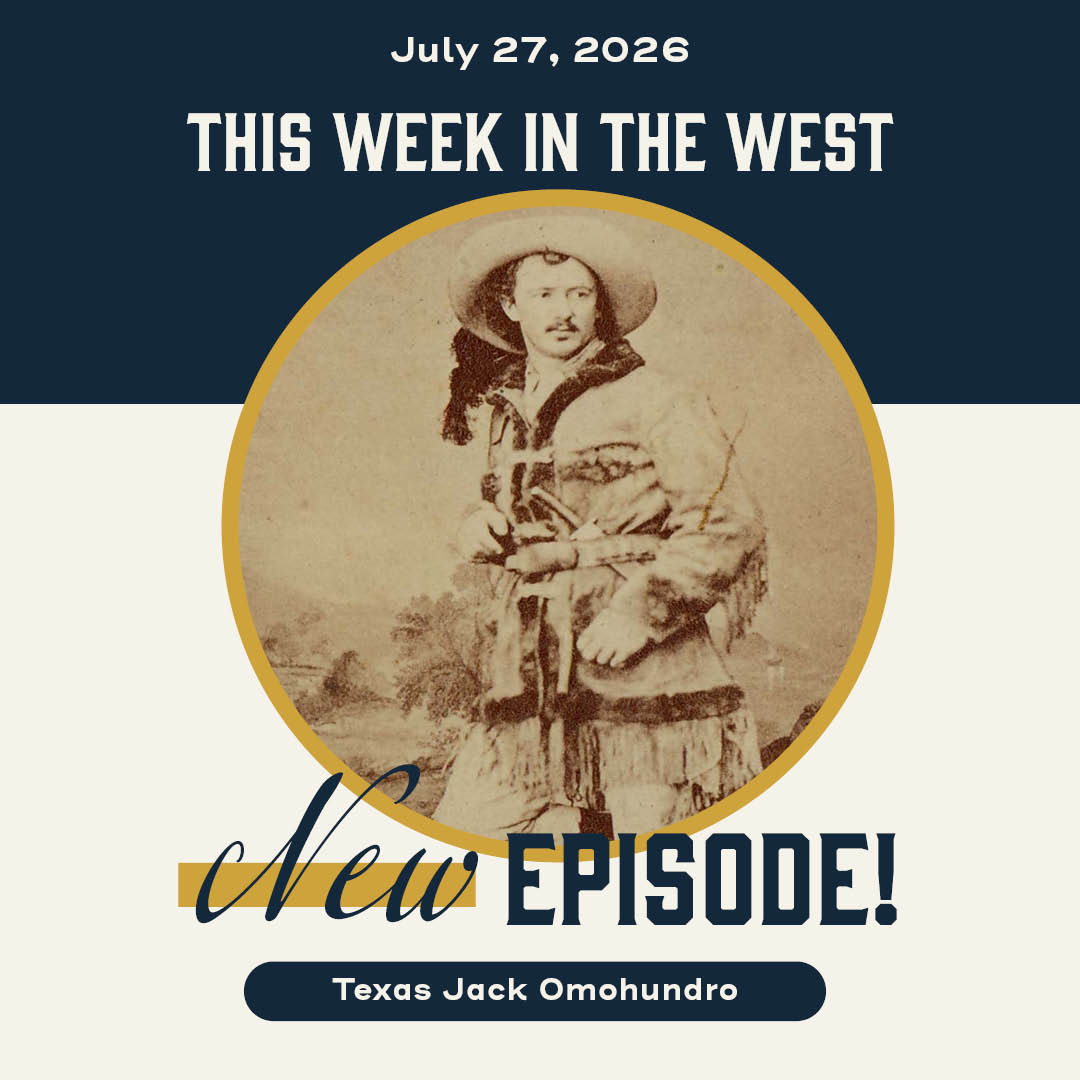
His name was John Baker Omohundro, though America knew him as Texas Jack.
We remember him on this, the week of his birth, July 27, 1846.
Today, Texas Jack is largely forgotten. He’s a member of our Hall of Great Western Performers, inducted in 1994.
But during the 1870s, he helped introduce the American cowboy to audiences across the country and became one of the West’s first true stars.
John Baker Omohundro was born in Virginia on July 27, 1846. When the Civil War began, he was eager to serve but was initially turned away for being too young.
Instead, he found work as a courier and scout. By age 17, he had enlisted in the Confederate cavalry and served under the famed General J.E.B. Stuart. During the war, he carried messages, gathered intelligence and even delivered a scouting report to Stuart shortly before the general was mortally wounded at the Battle of Yellow Tavern.
When the war ended, like many young veterans, Omohundro headed West in search of opportunity.
He spent time in Texas working as a cowboy on the growing cattle trails that connected ranches with markets across the country. He rode portions of the Chisholm Trail and other routes, driving herds through Texas, Kansas, Nebraska and Indian Territory.
It was during one of these cattle drives to drought-stricken Tennessee that he acquired the nickname that would follow him for the rest of his life. The story goes that locals were so impressed by the handsome young cowboy from Texas that they simply began calling him “Texas Jack.”
By 1869, Texas Jack had arrived in Kansas, where fate placed him among some of the most famous frontier figures of the age.
In Hays City, he met Hickok. Soon afterward, he met Cody at Fort McPherson in Nebraska.
The friendship between Cody and Omohundro grew as the two men hunted buffalo together, guided travelers across the frontier, and served as civilian scouts for the U.S. Army during the Indian Wars.
In 1872, Buffalo Bill and Texas Jack traveled to Chicago to join journalist and dime novelist Ned Buntline in an unusual theatrical experiment.
Rather than hiring actors to portray frontier heroes, Buntline decided to place actual frontier scouts on stage.
The production was called Scouts of the Prairie.
Its stars were Buffalo Bill Cody, Texas Jack Omohundro and an internationally famous Italian ballerina and actress named Giuseppina Morlacchi (Jew-sah-peena More-loch-ee).
The show was a sensation.
Audiences had never seen anything quite like it. Here were real scouts from the frontier demonstrating riding skills, shooting and rope tricks while reenacting adventures from the American West.
Historians consider these productions to be among the earliest Wild West shows and an important step toward the creation of Western pop culture.
Texas Jack became one of the production’s breakout stars.
He is often credited with introducing rope demonstrations to the American stage. For many eastern audiences, he represented their first glimpse of what a real cowboy looked and acted like.
What could make the story even better? A romance!
Texas Jack and Giuseppina Morlacchi fell in love.
The handsome Virginian and the celebrated Italian dancer married in 1873 and remained devoted to one another for the rest of Jack’s life.
Texas Jack became a household name and one of America’s first celebrity cowboys.
Dime novels fictionalized his adventures while newspapers published accounts of his real adventures. He was the choice to guide wealthy Americans and European aristocrats who wanted to experience the American West firsthand.
Many of these visitors returned home with stories that helped spread fascination with the American frontier around the world.
But unlike Buffalo Bill, who would later build a massive entertainment empire, Texas Jack never had the chance to fully capitalize on his fame.
He formed his own successful theatrical troupe and performed across the country. But in 1880, while traveling with his wife in the booming silver-mining town of Leadville, Colorado, Texas Jack contracted pneumonia.
He died on June 28, 1880.
He was just 33 years old.
His death shocked admirers across the country.
Newspapers mourned the loss of one of the frontier’s most colorful personalities. One publication declared that Omohundro was more refined than Wild Bill and more modest than Buffalo Bill.
Years later, Cody visited Jack’s grave in Leadville and arranged for a permanent granite marker to honor his memory.
And with that, we’ve departed the stage on another episode of “This Week in the West.”
Our show is produced by Chase Spivey and written by Mike Koehler.
Follow us and rate us on Apple Podcasts or wherever you hear us. That helps us reach more people.
Come visit us in Oklahoma City! You can now buy tickets online at thecowboy.org-slash-tickets
Got a question or a suggestion? Drop us an email at podcast@thecowboy.org
We leave you today with the words of author Matthew Kerns, writer of a biography of Texas Jack: “We believe that cowboys fought indians because Texas Jack fought indians. We know the cowboy was a rugged individualist because Texas Jack was a rugged individualist. We understand that the cowboy played a major role in American history because we see Texas Jack present at so many moments crucial not only to our shared history, but our understanding of that history.”
Much obliged for listening, and remember, come Find Your West at the National Cowboy & Western Heritage Museum.