


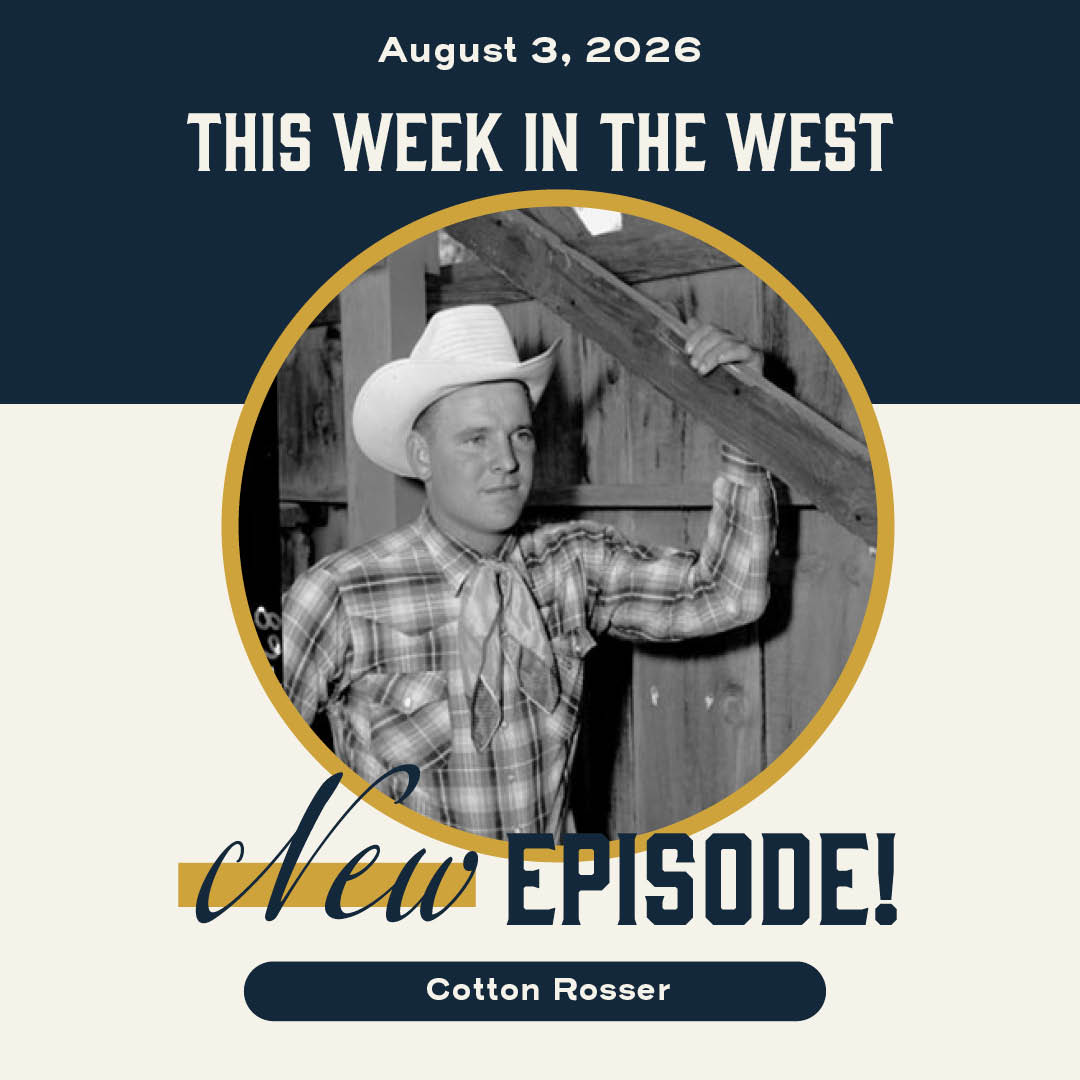
Howdy folks, it’s the first week of August 2026, and welcome to This Week in The West.
I’m Seth Spillman, broadcasting from the National Cowboy & Western Heritage Museum in Oklahoma City.
On this podcast, we share stories of the people and events that shaped the history, art and culture of the American West—and those still shaping it today.
It was 1956, and Cotton Rosser was lying in a heap on the ground, both legs broken after a horrible accident with a power post hole auger at his ranch.
He was rushed to the hospital. Doctors saved his legs from amputation but told him he’d never walk again.
The promising career for one of the country’s best young rodeo cowboys looked like it was over.
His friends in the rodeo world held a benefit to help with his bills and set him up for his post-rodeo life.
But for Rosser, there was no post-rodeo anything. He just changed his focus and became one of the sport’s greatest showmen and innovators. We remember him during the week of his birth, August 5, 1928.
Attend any rodeo nearly 100 years after Cotton Rosser was born and you can still see his fingerprints all over it.
The spectacles of modern-day rodeos- thunderous music, patriotic pageantry, perfectly timed spotlights are all part of Rosser’s legacy.
Rosser believed rodeo wasn’t just a competition.
It was a show.
Rosser grew up in California with a simple dream: to become a rodeo cowboy.
He attended California Polytechnic State University in San Luis Obispo, where he studied animal science while competing on one of the country’s strongest collegiate rodeo teams.
Rosser excelled in multiple events, winning the intercollegiate all-around championship and the saddle bronc riding title in 1950. His Cal Poly teams became a collegiate powerhouse, capturing dozens of national championships.
After college, Rosser stepped into the professional ranks, competing in every major roughstock event. In 1951, he captured the prestigious all-around championship at the Grand National Rodeo in San Francisco.
By every measure, Rosser appeared destined for a long career as one of rodeo’s top competitors.
But then came the accident.
He had to find a way to stay around the sport he loved, so that same year, Rosser purchased the Flying U Rodeo Company, one of the nation’s oldest rodeo livestock companies. Rather than simply providing bucking horses and bulls, he envisioned something much larger.
He wanted to create an entire rodeo experience.
Flying U became one of the first stock contracting companies to offer a complete package: championship livestock, specialty acts, promotional expertise and professionally produced entertainment.
Rosser often said, “You have to run the show. You can’t let the show run you. If you don’t keep the audience entertained, they will go somewhere else.”
Looking for inspiration, Rosser studied anything that drew a crowd: circuses, ice-skating shows, Broadway musicals and Hollywood premieres.
He introduced dramatic lighting, synchronized music, patriotic tributes and elaborate grand entries that made rodeo feel larger than life.
His opening ceremonies became legendary at events like the National Finals Rodeo, the Reno Rodeo, the Houston Livestock Show and Rodeo, and the Grand National Rodeo in San Francisco.
Some called him the “P.T. Barnum of Rodeo.”
But Rosser’s innovations didn’t stop there.
He also transformed the business of raising rodeo livestock.
He developed Flying U’s famous “Born to Buck” breeding program, carefully selecting bloodlines that produced generations of championship bucking horses and bulls. Year after year, Flying U livestock appeared in the chutes at the National Finals Rodeo, becoming favorites among both contestants and fans.
Under Rosser’s leadership, Flying U grew into a stock-contracting giant, producing more than 50 rodeos every year while remaining the oldest continuously operating rodeo livestock company in the United States.
Rosser’s greatest gift may have been recognizing that rodeo could appeal to the general public, not just those with roots in ranching.
His philosophy of marketing the sport focused on ensuring that first-time spectators would feel welcome rather than confused, and that any kid in the crowd, from any part of the country, would leave wanting to be a cowboy or cowgirl.
His work with youth also saw Rosser play an important role in bringing organized high school rodeo to California and in helping establish state associations that gave thousands of young people an opportunity to compete.
When the founders of Professional Bull Riders set out to create a new sports entertainment brand in the 1990s, they looked closely at what Cotton Rosser had already accomplished.
PBR co-founder Cody Lambert later described Rosser as a pioneer who wasn’t afraid to try something new, praising his ability to combine authentic Western traditions with first-class entertainment.
Rosser had been honored over and over again by the rodeo world.
Here at The Cowboy, Rosser is a member of the National Rodeo Hall of Fame, PBR’s Heroes & Legends and a recipient of the prestigious Ben Johnson Award for people who have contributed to the “growth and benefit” of the sport.
At the Reno Rodeo, where his productions made him famous, a bronze statue now stands outside the arena, honoring the man whose larger-than-life personality became part of the event’s identity.
Late in life, he reflected, “I never imagined my rodeo career would be like this. I’m the richest guy in the world with memories and friends. I’ve loved every minute of the rodeo business, and I would do it all over again.”
Cotton Rosser died at his home on June 22, 2022. He was 93.
And with that, we’ll exit the spotlight on another episode of “This Week in the West.”
Our show is produced by Chase Spivey and written by Mike Koehler.
Follow us and rate us on Apple Podcasts or wherever you hear us. That helps us reach more people.
Come visit us in Oklahoma City! You can now buy tickets online at thecowboy.org-slash-tickets
Got a question or a suggestion? Drop us an email at podcast@thecowboy.org
We leave you today with the words of Reno Rosser, vice president of Flying U Rodeo Company and one of Cotton’s five children: “I would say he’s by far the greatest innovator that the Western sports industry has ever seen. When you come to our rodeos, I mean, God, you’re going to watch guys do backflips on motorcycles (and) kids on sheep.”
Much obliged for listening, and remember, come Find Your West at the National Cowboy & Western Heritage Museum.