




Howdy folks, it’s the second week of August 2026, and welcome to This Week in The West.
I’m Seth Spillman, broadcasting from the National Cowboy & Western Heritage Museum in Oklahoma City.
On this podcast, we share stories of the people and events that shaped the history, art and culture of the American West—and those still shaping it today.
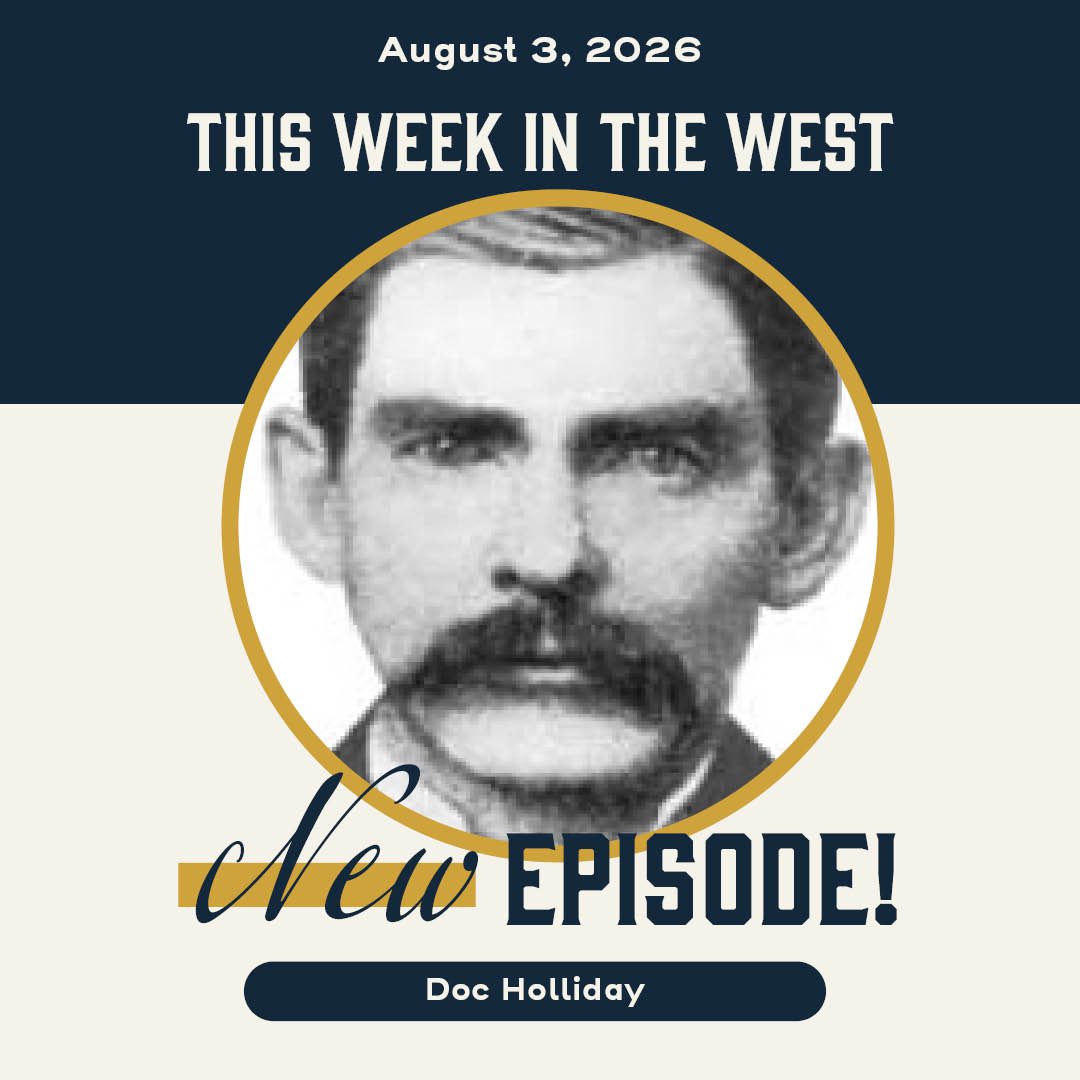
Two important facts about John Henry Holliday don’t really add up to him being an icon of the American West.
First, he was born in Georgia, a state nowhere near the West.
And, of all the jobs he could have had, he chose to be a dentist.
Of course, if he hadn’t been a doctor of dentistry, he never would have been called “Doc” Holliday.
Today we remember one of the most feared gamblers and gunfighters of the frontier, who was born August 14, 1851.
John Henry Holliday was born in Griffin, Georgia, to a respectable Southern family. After college, he set up a practice in his hometown. But like many tales of the West in the 19th Century, Tuberculosis makes an appearance in Holliday’s story.
After being diagnosed with the disease, Holliday was urged to move to the drier climates of the Southwest. He chose to go to Dallas and remain a dentist, but his persistent coughing made it difficult to treat patients, and before long he was making his living as a gambler.
That decision pushed Doc closer to the lawlessness of the West in the late 1800s. He left Dallas after being charged in an illegal gambling ring. He journeyed from city to city, looking for the next card game that would make him some money. He was also using alcohol and opium to deal with his illness.
His hop-scotching around the country found him in nearly all of the most infamous locales of Western history – Deadwood, Cheyenne, Dodge City and Tombstone.
Those last two towns were where Doc Holliday’s fate intersected with another of the West’s most mythical names: Wyatt Earp.
Doc and Wyatt first connected in Dodge City, Kansas. Doc had tried to establish another dental practice but was in a saloon where the two crossed paths. Doc’s card game was interrupted by a scuffle between Wyatt and a group of cowboys. Doc pointed a gun at the ringleader and got Wyatt out of trouble. Wyatt gave him credit for saving his life, and the two became friends.
Fast-forward two years, and both Wyatt and Doc found their way to the town of Tombstone, Arizona, which was booming after the discovery of silver.
By October 26, 1881, Wyatt’s brother Virgil Earp was both a deputy U.S. marshal and Tombstone’s city police chief but had been running into trouble with a group of cattle rustlers and horse thieves called the Cowboys.
Virgil Earp deputized Doc, as well as the two Earp brothers Wyatt and Morgan, and a confrontation finally erupted between the four men and the five members of the Cowboys: Ike Clanton, Billy Clanton, Tom McLaury, Frank McLaury, and Billy Claiborne. It was the shootout at the OK Corral.
What actually happened in those wild few seconds has been clouded by history and Hollywood. Whether it was as dramatic as the moments of the movie “Tombstone” is up for debate, but three of the members of The Cowboys died, at least one killed by Doc Holliday.
Doc and the Earps’ war against the Cowboys would continue until a falling out between Doc and Wyatt happened sometime around 1882.
From there, Doc’s life continued its downward spiral while his reputation spread.
Bat Masterson, another of the legendary names of the Wild West, later wrote this about Doc Holliday.
“While he never did anything to entitle him to a Statue in the Hall of Fame, Doc Holliday was nevertheless a most picturesque character on the western border in those days when the pistol instead of law determined issues,” Masterson wrote. “ Holliday had a mean disposition and an ungovernable temper, and under the influence of liquor was a most dangerous man.”
In the final years of his life, Doc spent more time in poor health while getting drunk, gambling and being accused of more deaths.
He was suspected of the murder of Johnny Ringo, had a murder warrant issued for him in Arizona, and eventually went to trial for the shooting of Billy Allen, an unarmed man in Leadville, Colorado.
Doc claimed self-defense and was acquitted.
Eventually, his declining health brought him to Glenwood Springs, Colorado, where he hoped the famous mineral waters might cure the tuberculosis that had plagued him for years.
They did not.
John Henry Holliday had always imagined he’d make a fine example of the old cowboy saying and “die with his boots on”—likely at the wrong end of a gunfight.
Instead, early on the morning of November 8, 1887, he looked down from his bed at the Hotel Glenwood and saw his bare feet.
Realizing he would not die wearing boots after all, he reportedly smiled, looked at his nurse and said, “This is funny.”
Those were his final words.
He was just 36 years old.
And with that, we’ve sunk our teeth into another episode of “This Week in the West.”
Our show is produced by Chase Spivey and written by Mike Koehler.
Follow us and rate us on Apple Podcasts or wherever you hear us. That helps us reach more people.
Come visit us in Oklahoma City! You can now buy tickets online at thecowboy.org/tickets
Got a question or a suggestion? Drop us an email at podcast@thecowboy.org
We leave you today with some words from Doc Holliday, as said through Val Kilmer in his powerhouse performance in the classic Western movie “Tombstone”:
“There’s no normal life, Wyatt, it’s just life. Get on with it.”
Much obliged for listening, and remember, come Find Your West at the National Cowboy & Western Heritage Museum.