



Howdy folks, it’s the third week of August 2026, and welcome to This Week in the West.
I’m Seth Spillman, broadcasting from the National Cowboy & Western Heritage Museum in Oklahoma City.
On this podcast, we share stories of the people and events that shaped the history, art and culture of the American West—and those still shaping it today.
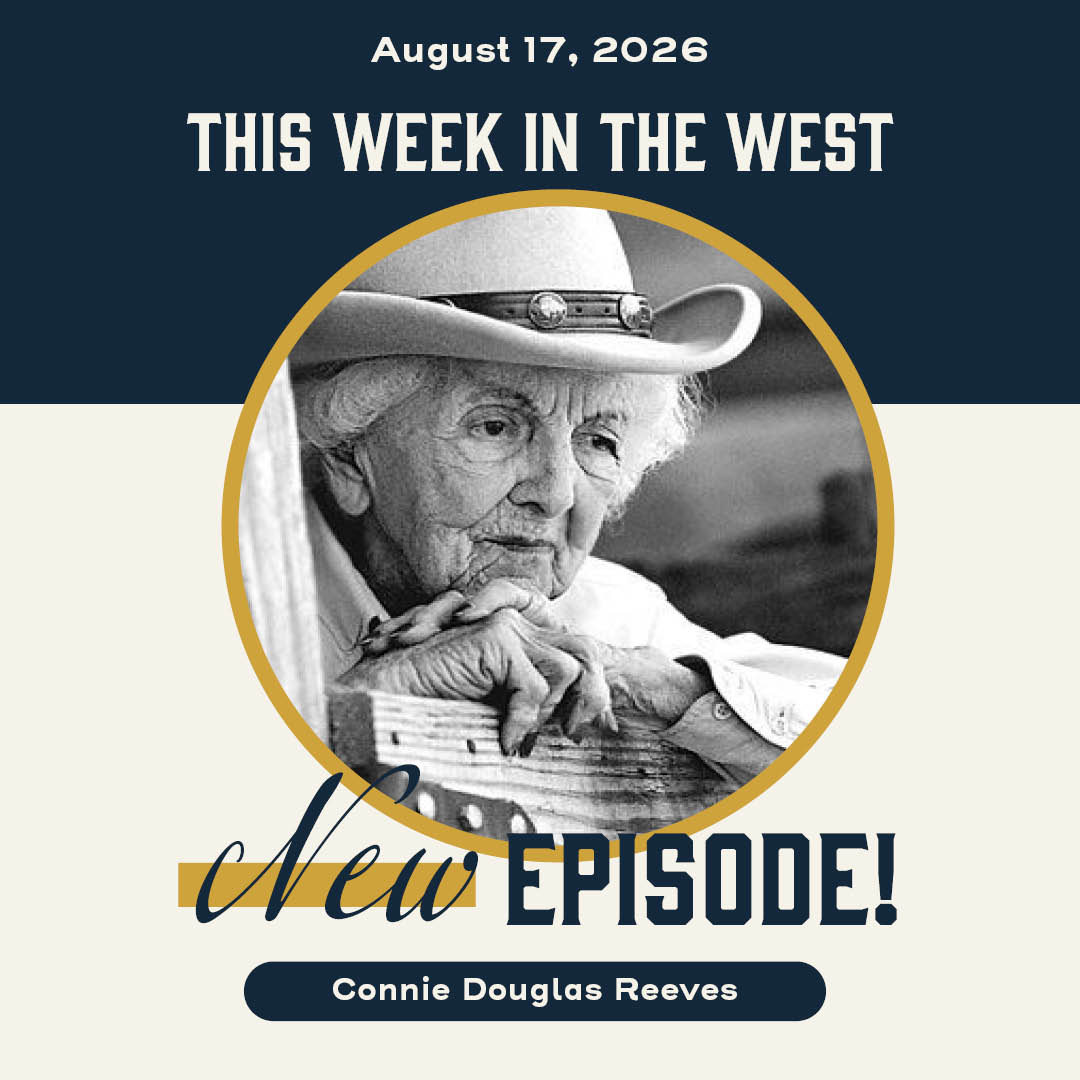
Connie Douglas Reeves had a saying: “Always saddle your own horse.”
A one-of-a-kind cowgirl and a winner of our legacy-defining Chester Reynolds Awards here at The Cowboy, Reeves stuck to her motto for more than a century and left it to 10s of thousands of young women to pass it on.
Today we remember Connie Douglas Reeves on the anniversary of her death, August 17, 2003.
Her saying may have just sounded like practical ranch advice, but Connie Reeves meant something much deeper.
Take responsibility. Do hard things yourself. Don’t wait for someone else to solve your problems.
It was advice she lived every day for more than a century.
She was born September 26, 1901, in Eagle Pass, Texas, where the Rio Grande and the traditions of the West shaped her childhood. Her father was a district judge. But it was her grandfather, who had been raised on a ranch, who introduced her to horses.
She later joked that she was sitting on horseback before she could even sit up by herself. By age five, she owned her own horse.
But growing up, she didn’t expect her whole life to be spent in the saddle. Connie actually dreamed of becoming a lawyer.
She enrolled at the University of Texas School of Law, becoming one of the first women ever admitted to the program. But the Great Depression doomed her family’s finances and forced Connie to leave before earning her degree.
She found her purpose by becoming a teacher, and that’s where the West started to work its way back into Connie’s life.
At Thomas Jefferson High School in San Antonio, she taught physical education and created something that had never existed before: She organized theschool’ss “Lassos”—a Western-themed girls drill team.
It was the early 1930s, and Connie was inventing a concept that would become an ingrained part of Texas culture.
For the Lassos, the girls wore cowboy hats, Western jackets and carried real ropes. They learned to spin lassos in perfect unison.
Soon, the group was famous throughout Texas, performing not only at athletic events but conventions and civic celebrations.
She’d already started to make an impact on young cowgirls, but there was more to come. To supplement her teaching salary during the Depression, Connie worked evenings as a riding instructor.
Her skill caught the attention of Camp Waldemar, a girls’ summer camp nestled along the Guadalupe River in the Texas Hill Country.
In 1936, she accepted a position as head riding instructor.
She expected it might last a summer or two.
Instead, it became her life’s work.
For the next sixty-seven years (YES, that’s right, 67 YEARS), Connie Reeves returned every summer to Camp Waldemar.
Generation after generation of girls arrived nervous, uncertain and often afraid of horses.
She patiently taught them how to mount, ride and care for the animals that often outweighed them by more than a thousand pounds.
It has been estimated that more than 30,000 girls learned to ride under her guidance.
Of course, like many a wise Western sage, Connie wasn’t just teaching how to ride the range. For generations of young women in Texas, she was sharing lessons in responsibility.
Self-confidence.
Perseverance.
And always saddling their own horse.
At Camp Waldemar, Connie met Jack Reeves, who had worked as one of the camp wranglers. They married in 1942.
Together they managed thousands of acres of Texas ranchland for decades, raising sheep, goats and cattle while continuing their work at Camp Waldemar.
Not long after the wedding, Connie’s mother unexpectedly visited the ranch.
She found her daughter sitting in the dirt counting freshly docked lamb tails—a practical way ranchers counted newborn sheep.
This was hardly the elegant life she had imagined for the judge’s daughter.
Connie loved telling the story because after that surprise visit, her mother always called before coming.
Eventually, even she came to love ranch life and her devotion to horses never faded.
She often joked she’d been bucked off a horse at least once every year of her life.
Broken bones became almost routine. A horse shattered one of her legs so badly she needed pins and specially built boots for the rest of her life.
At age ninety-two (YES, that’s right, 92!), she was leading riders when a disturbed hornets’ nest caused horses to buck.
Connie suffered broken ribs, a broken wrist, a collapsed lung and dozens of hornet stings.
When workers’ compensation paperwork listed her birth year as 1901, insurance representatives assumed it had to be a clerical error.
Surely no ninety-two-year-old woman was still working as a horseback riding instructor. But Connie was.
Recognition for her years devoted to the West soon followed. She entered the National Cowgirl Hall of Fame in 1997.
A year later, our museum honored Connie with the Chester A. Reynolds Memorial Award for her extraordinary contributions to preserving the heritage and spirit of the American West.
She was the first woman ever to receive that prestigious honor.
Even after turning one hundred, Connie continued riding.
She proudly participated on horseback in the parade celebrating the National Cowgirl Museum’s new home in Fort Worth.
Then came one final ride.
In August of 2003, Connie climbed aboard her favorite horse, a twenty-eight-year-old paint named Dr. Pepper.
For reasons no one could explain, the horse threw her over its head.
She suffered a broken neck. Twelve days later, she died.
She was 101. Yes, that’s right, 101.
And with that, we’ve climbed down off the saddle of another episode of “This Week in the West.”
Our show is produced by Chase Spivey and written by Mike Koehler.
Follow us and rate us on Apple Podcasts or wherever you hear us. That helps us reach more people.
Come visit us in Oklahoma City! You can now buy tickets online at thecowboy.org/tickets
Got a question or a suggestion? Drop us an email at podcast@thecowboy.org
We leave you today with the words of Connie Douglas Reeves herself from an interview with National Public Radio at age 100: “Sometimes I’ll just get on the horse and go down to the river. We’ll just ride up and watch a little baby fawn nursing or watch the birds in a nest.
“As long as I’m alive, I’m going to be trying to ride a horse.”
Much obliged for listening, and remember, come Find Your West at the National Cowboy & Western Heritage Museum.