
Howdy folks, it’s the fourth week of August 2026, and welcome to This Week in The West.
I’m Seth Spillman, broadcasting from the National Cowboy & Western Heritage Museum in Oklahoma City.
On this podcast, we share stories of the people and events that shaped the history, art and culture of the American West—and those still shaping it today.
Pauline Slovensky was a first-generation American in the early 20th Century who had spent most of her young life in Wisconsin, far from the wilds of the West.
She was just 13 and visiting some family friends at their home in Texas.
They wanted to see just how brave their visitor was and invited her to climb onto the back of a bucking bronco.
She jumped at the chance and didn’t let go. She was hooked, transforming that moment of teenage fearlessness into an astonishing, death-defying Hall of Fame career.
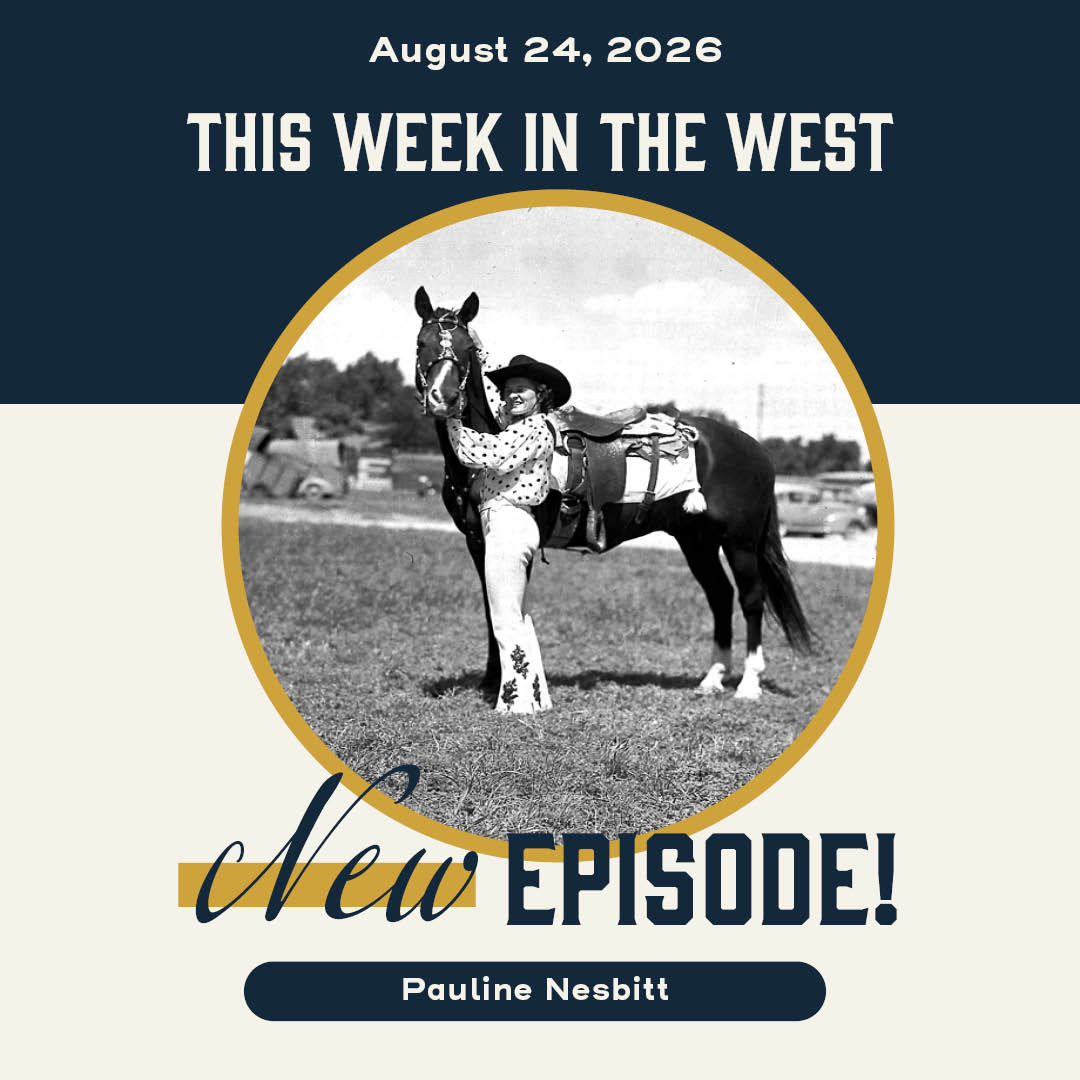
Today we remember Pauline Nesbitt, who would become one of the best female rodeo trick riders of the 20th Century. She was born this week, August 24, 1905.
Pauline was one of 11 children born to Slovakian immigrants Stephanus and Maria Slovensky. They lived on a farm in Wisconsin before that fateful trip to Texas.
After her thrilling first experience, Pauline kept working on her riding skills. By age 17, she was entering rodeos as a bronc rider, at a time when women’s bronc riding was still a featured competitive event.
But it was at a rodeo in San Antonio when Pauline saw Tad Lucas, the pioneer of women’s rodeo, and was inspired.
Lucas’ breathtaking trick-riding routines transformed speed, balance and horsemanship into an art form, and Pauline began to imagine what that would be like.
Instead of merely staying on a bucking horse for a few seconds, she wanted to wow the rodeo crowds and perform impossible feats while at full speed.
In the 1920s and 30s, rodeo was experiencing a heyday. Large indoor arenas packed with spectators hosted rodeos from New York to California, and outdoor events overflowed with crowds. Rodeo fans wanted to see as many thrilling moments as they could.
Pauline quickly became a huge attraction.
She was interviewed by the St. Louis Post-Dispatch for a cover story in 1936. They called her “a half-pint cowgirl in lavender britches, gold satin blouse and a 10-gallon hat.”
Her signature performances featured shoulder stands atop a galloping horse, daring vaults, under-the-belly maneuvers and breathtaking transitions performed with flawless timing.
There were no helmets. No protective padding. No safety harnesses.
By the 1930s she was appearing at the nation’s premier rodeos.
She impressed audiences at the well-known rodeos like the Cheyenne Frontier Days, Fort Worth and Denver, not to mention getting eyeballs in the East at legendary venues like Madison Square Garden and Boston Garden.
She even traveled internationally, performing in Australia alongside fellow cowgirl Alice Greenough during the Wild Australian Stampede.
She wasn’t the only one in the family entertaining the masses, though. In 1927, Pauline married rodeo clown Jimmie Nesbitt, one of the sport’s most recognizable entertainers.
For more than two decades, they traveled the rodeo trail together.
When the rodeo season ended, the couple returned to their ranch near Nowata, Oklahoma, where they raised cattle and horses.
In Nowata, Pauline trained her own horses and worked out new and more daring tricks.
Pauline won the Cowgirls’ Trick and Fancy Riding championship at the Fort Worth Southwestern Exposition and Fat Stock Show Rodeo for six consecutive years—from 1937 through 1942.
In 1938, she also earned recognition as the World Champion Trick and Fancy Rider.
While she won, Pauline also turned up the dial on the showmanship, making her own performance costumes and becoming a Western fashion icon.
In 1941, she modeled women’s Western wear for the Sears Roebuck catalog alongside famous cowgirls like Tad Lucas and Polly Mills.
At a time when millions of Americans shopped through those catalogs, Pauline helped define what an authentic Western cowgirl looked like.
“I try to wear a different suit every performance, especially if there is more than one a day,” she said in the St. Louis newspaper article. “Nothing picks me up like a bath and change of outfit. I wish I could show you my hats, but most of them are at the cleaners.”
But there were some bruises and broken bones beneath the glamour.
Perhaps the most remarkable example came during a rodeo in Idaho. While performing one of her under-the-belly tricks, Pauline was kicked by her horse. The impact fractured three vertebrae.
Most people would have required immediate hospitalization, but Pauline not only finished the performance, but she also drove to the next rodeo in Colorado.
There, doctors fitted her with a back brace. Rather than ending her season, she buckled the brace beneath her costume and continued competing.
Pauline retired from competition in 1948.
Pauline passed away in Nowata, Oklahoma, on November 7, 1996, at the age of ninety-one.
Recognition followed in the years after her death.
In 1999, she was inducted into the National Rodeo Hall of Fame here at The Cowboy. In 2011, she entered the National Cowgirl Hall of Fame.
And with that, we’ve fearlessly finished another episode of “This Week in the West.”
Our show is produced by Chase Spivey and written by Mike Koehler.
Follow us and rate us on Apple Podcasts or wherever you hear us. That helps us reach more people.
Come visit us in Oklahoma City! You can now buy tickets online at thecowboy.org/tickets
Got a question or a suggestion? Drop us an email at podcast@thecowboy.org
We leave you today with the words of Pauline Nesbitt in a 1942 interview with her hometown newspaper, the Nowata (Oklahoma) Daily Star: “I guess I was kinda the black sheep of the family. My folks didn’t like it then, and they don’t like it now. But I don’t have any regrets. It’s been fun, and it has its compensations.”
Much obliged for listening, and remember, come Find Your West at the National Cowboy & Western Heritage Museum.