


Howdy folks, it’s the third week of December 2025, and welcome to This Week in The West.
I’m Seth Spillman, broadcasting from the National Cowboy & Western Heritage Museum in Oklahoma City.
On this podcast, we share stories of the people and events that shaped the history, art and culture of the American West—and those still shaping it today.
We’ll start with a little-known fun fact: The cowboy in our museum logo has his own amazing story to tell.
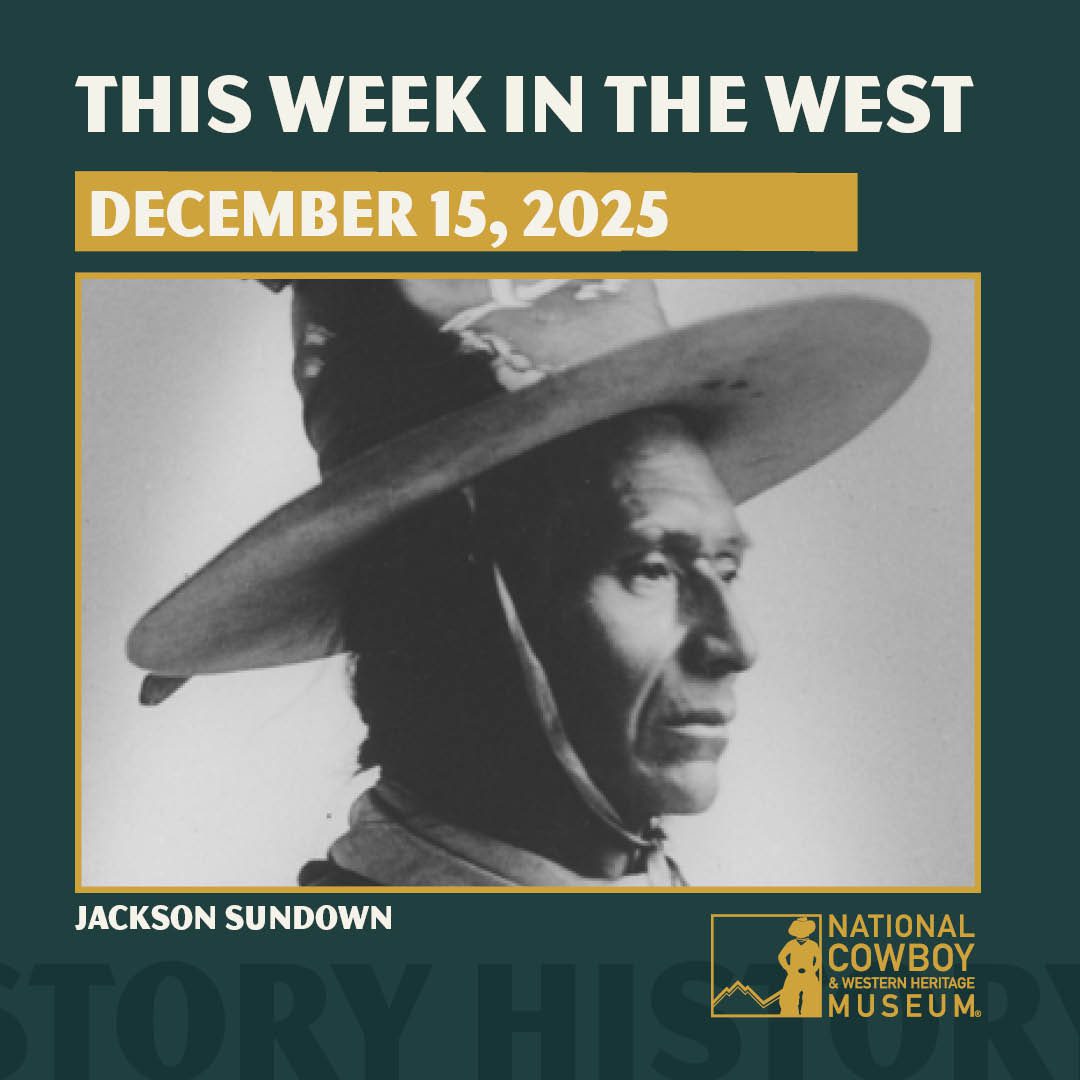
The silhouette of a cowboy with thick wooly chaps, belt buckle, bandana, and wide-brim cowboy hat, is based on a photograph of Jackson Sundown: one of the great rodeo competitors of the early 20th century and a full-blooded member of the Wallowa (wuh – lau – wuh) Band of the Nez Perce tribe.
Today, we remember the legendary Jackson Sundown, who died this week, December 18, 1923.
Sundown was already in his late 30s when he developed a reputation around the Northwest as an excellent horse trainer. He lived with his wife on a ranch in Idaho, where they bred, raised and sold horses. Looking to make some extra money, he began competing in rodeos.
But as we’ll find out, Sundown had already lived a pretty full life before he set foot in a rodeo arena.
That’s why it’s all the more remarkable that in 1911, at age 48, he climbed on the back of a saddle bronc at the Pendleton Roundup and made it to the event’s finals.
He eventually became such a winning competitor in bronc riding that other competitors dropped out when they saw his name on the entry list. Rodeo organizers would instead hire Sundown, who, by his 50s, was a popular draw for the crowd, and he would put on riding exhibitions.
But Pendleton is where he continued to add to his legend.
Jackson Sundown made for a wild sight even before getting on the back of a horse. He was known for wearing bright shirts and orange Angora chaps. He wore his hair in the traditional style of his tribe, with a pompadour and braids on the side.
He’d fared well at Pendleton in 1914 and 1915. In 1916, Sundown was 53 but showed no signs of slowing down. He had two qualifying rides and drew the horse Angel for his third.
He climbed atop the Bronc, and his chaps were flapping, up and down, up and down. Sundown held on with all he had, spurring the horse to make it buck even harder. Eventually, Angel came to a standstill, having been ridden into submission.
The crowd went wild, and Jackson was awarded the Broncho Busting title. He was given a $350 trophy saddle and the All-Around Cowboy belt. He was the first Native American to win the championship.
The Oregon Daily Journal quoted Sundown saying, “Many years I ride and many times I win money, sometimes little, sometimes plenty much. But never did I get first place before.”
It was an incredible summit for a life that years earlier had been spent on the run.
He was born Waaya-Tonah-Toesits-Kahn (with a Nez Perce name meaning Blanket of the Sun) in 1863.
By the age of 14, he was active in the Nez Perce War of 1877, but unlike Joseph and many of his tribe members, Sundown escaped the U.S. Army cavalry and fled to Canada.
Some legends say Sundown hid there for two years with a group of Sioux, including Sitting Bull. Eventually, Jackson returned to the United States, working as a ranch hand and living first in Washington, then on the Flathead Reservation in northwest Montana and the Nez Perce Reservation in Idaho.
But those few moments of glory at Pendleton cemented Jackson Sundown’s legendary status. Author Ken Kesey wrote about the run in his book “The Last Go Round” and the photos he took that day in Pendleton live on.
It was only seven years after that incredible day that he developed pneumonia and died in 1923. Jackson Sundown was 60.
And with that, the sun has set on another episode of “This Week in the West”
Our show is produced by Chase Spivey and written by Mike Koehler
Follow us and rate us on Apple Podcasts or wherever you hear us. That helps us reach more people.
You can follow us on social media and online at nationalcowboymuseum.org.
Got a question or a suggestion? Drop us an email at podcast@thecowboy.org
We leave you today with the words of Al Fonburg, a manager at the Pendleton Roundup in the early 1900s: “(Jackson Sundown) stole the show, for not only was he a great rider, but he made a striking appearance as well. He was 6 feet tall and slim and straight as an arrow … and he sat on a horse with such nonchalance that the crowds went wild. I never saw him show nervousness or irritability, nor did his regal bearing or natural courtesy ever desert him.”
Much obliged for listening, and remember, come Find Your West at the National Cowboy & Western Heritage Museum.