





Howdy folks, it’s the fourth week of December 2025, and welcome to This Week in The West.
I’m Seth Spillman, broadcasting from the National Cowboy & Western Heritage Museum in Oklahoma City.
On this podcast, we share stories of the people and events that shaped the history, art and culture of the American West—and those still shaping it today.
He was on an obsessive race against time, progress, disease and the actions of the United States government.
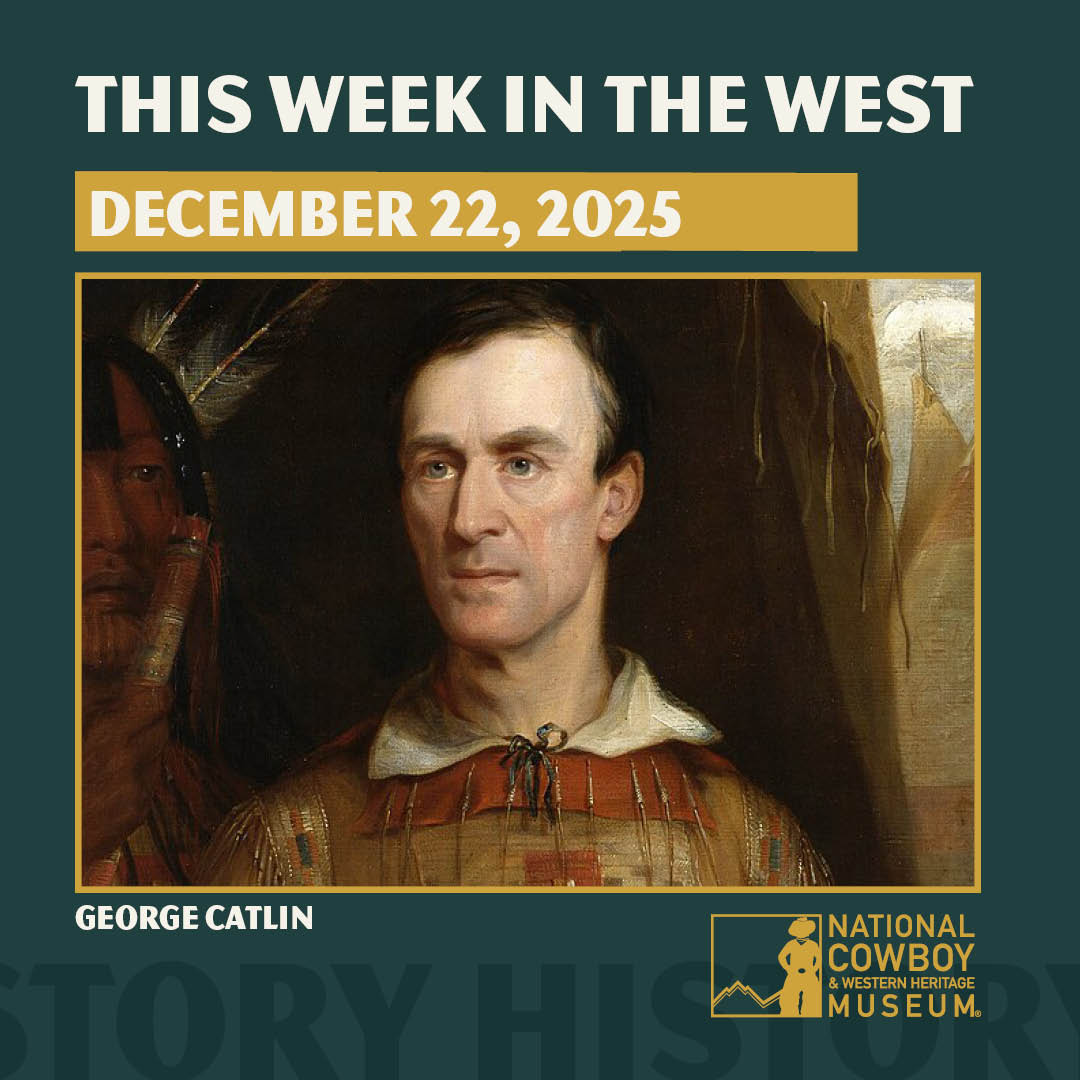
And during all that time, George Catlin could not … would not stop painting.
The result was his legacy: Hundreds of paintings of Native American tribes before their lands and cultures were impacted by Western expansion. George Catlin knew his work deserved a place in history when he died this week, December 23, 1872.
Catlin was born in Pennsylvania in 1796 to a family that would rather he not have become a painter. They pushed him toward the law, but he insisted that art was his passion. He reluctantly became a lawyer in his 20s but quickly quit. He had taught himself enough about painting that he soon made a living as a portrait artist.
The frontier had always intrigued him, and he had heard his family tell stories of the Native people they had met beyond the boundaries of the young United States. Catlin was just a child when Lewis and Clark opened America’s eyes to what lay West of the Mississippi. As he grew older, the artist was determined to learn more.
So, in 1830, he packed up and traveled to St. Louis as part of a government-sponsored expedition. Catlin was determined to learn first-hand from William Clark himself. He met with Clark and laid out his vision: to paint members of as many Native tribes as possible.
However, Catlin knew that the native people were already vanishing due to disease and American settlements. It would worsen for them as the government pushed them further West while decimating the Bison population.
Over the course of several years, Catlin visited more than 50 tribes, including the Sioux, Blackfoot, Crow, and Cheyenne. He traveled as far as the Plains and the Rocky Mountains, sketching and painting hundreds of portraits and scenes of everyday life.
“If my life be spared, nothing shall stop me from visiting every nation of Indians on the Continent of North America,” Catlin said.
When he did paint them, Catlin treated his native subjects just as he did his Philadelphia portrait customers. His collection of paintings depicts the native people gazing out into the world, dressed in traditional attire with adornments in their hair, sometimes with paint on their faces, and holding special objects in their hands.
In 1832, he had traveled thousands of miles up the Missouri River, in some cases following the steps of Lewis and Clark, to add to his collection of portraits. In his writings, he consistently spoke of the stature and nobility of his subjects.
“The several tribes of Indians inhabiting the regions of the Upper Missouri, and of whom I spoke in my last Letter, are undoubtedly the finest looking, best equipped, and most beautifully costumed of any on the Continent,” he wrote to a friend.
But he continued to worry about the encroachment of White settlers on Native Americans. His work in the early 1830s coincided with the passage of the Indian Removal Act and forced relocations like the Trail of Tears.
“I have, for many years past, contemplated the noble races of red men who are now spread over these trackless forests and boundless prairies, melting away at the approach of civilization,” he wrote.
By 1837, Catlin had created over 500 paintings, which he compiled into his “Indian Gallery.” He took the paintings on tours of Europe, and while the reception there was positive, his American exhibition fell flat, throwing Catlin deeply into debt.
Catlin sought to sell his Indian Gallery to the U.S. government to preserve his life’s work. Despite multiple efforts to convince officials in Washington, D.C., his attempts were unsuccessful.
By 1852, due to mounting personal debts, he was forced to sell the original gallery, which had grown to 607 paintings. The industrialist Joseph Harrison acquired the collection and stored it in Philadelphia.
For the last 20 years of his life, Catlin worked to recreate his collection, producing more than 400 new paintings. This recreated body of work became known as the “Cartoon Collection,” as the pieces were based on the original outlines he had drawn in the 1830s.
Catlin died on December 23, 1872. He was 76.
Seven years later, the original Indian Gallery was purchased by the government for preservation. It is now part of the Smithsonian’s collection.
And with that, we’ll close the portfolio of another episode of “This Week in the West.”
Our show is produced by Chase Spivey and written by Mike Koehler.
Follow us and rate us on Apple Podcasts or wherever you hear us. That helps us reach more people.
You can follow us on social media and online at nationalcowboymuseum.org.
Got a question or a suggestion? Drop us an email at podcast@thecowboy.org
We leave you today with the words of historian Brian Dippie, who has written extensively about Catlin: “For all of the criticism of Catlin, especially the modern, rather trendy critique that he was an exploiter, his legacy was absolutely priceless. He was a dreamer, but he knew that one day posterity would demand a visual record of the First Americans, and he created it.”
Much obliged for listening, and remember, come Find Your West at the National Cowboy & Western Heritage Museum.