







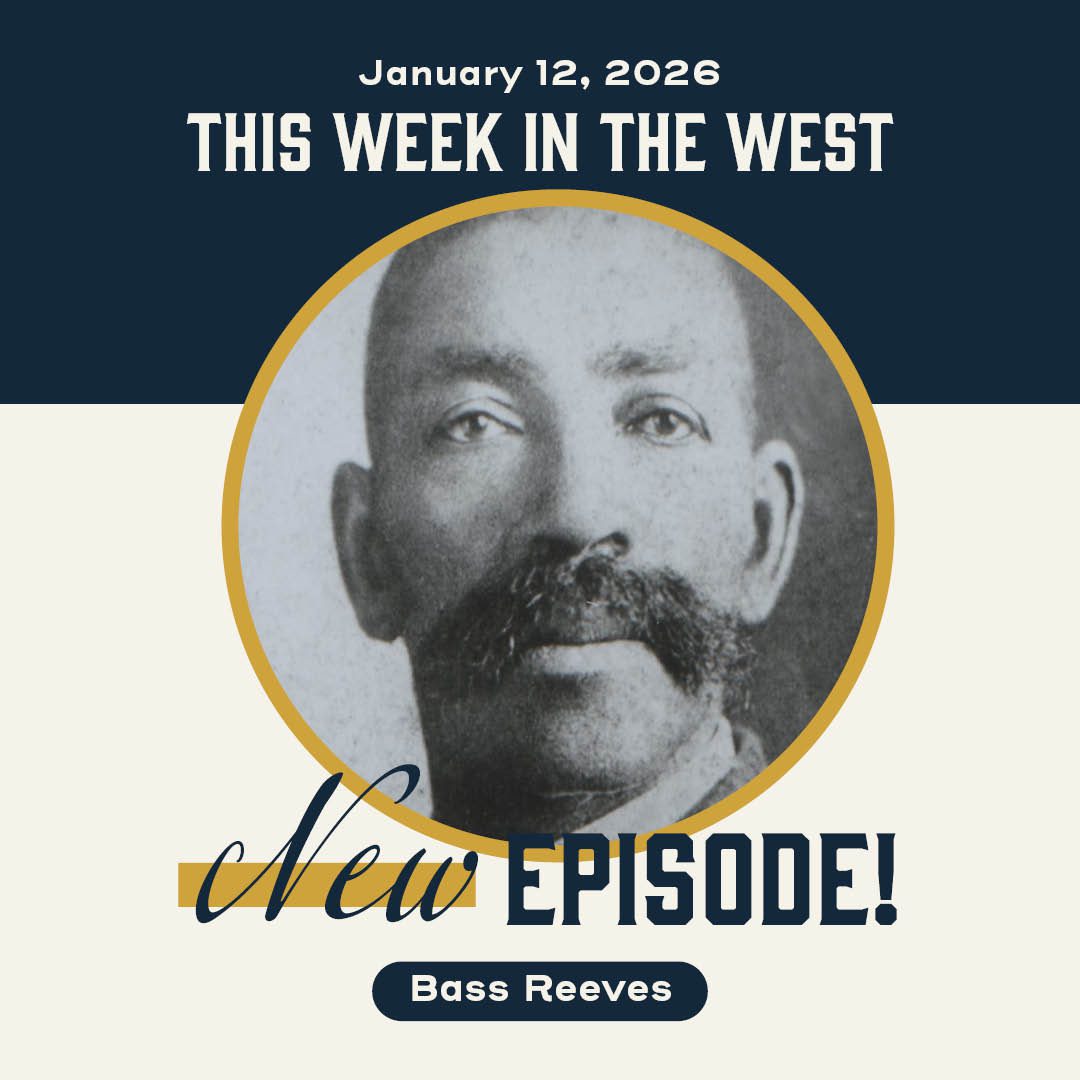
Howdy folks, it’s the second week of January 2026, and welcome to This Week in The West.
I’m Seth Spillman, broadcasting from the National Cowboy & Western Heritage Museum in Oklahoma City.
On this podcast, we share stories of the people and events that shaped the history, art and culture of the American West—and those still shaping it today.
The stories of Bass Reeves could have easily been erased from history.
Instead, we remember him today during the anniversary of his death on January 12, 1910, at a time when the legendary Western lawman is getting his just due,
Born into slavery in 1838 in Crawford County, Arkansas, Reeves entered life with no rights, no education and no chance at shaping his own destiny.
But all that would change.
Reeves belonged to Arkansas legislator William Steele Reeves, and later to his son, George Reeves, a Texas sheriff, legislator, and Confederate colonel.
When George joined the Confederate Army at the start of the Civil War, he brought Bass with him. The details of what happened next are hazy, but the story goes like this: At some point between 1861 and 1862, during an argument over a game of cards, Bass Reeves struck George Reeves and fled into the night.
He escaped into Indian Territory, where his life truly began.
Among the Cherokee, Creek, and Seminole people, Reeves found refuge and an education. He learned their languages, customs, and ways of moving across the land. He mastered tracking, survival and diplomacy. When freedom came through the Emancipation Proclamation, Reeves returned to Arkansas with all of these impressive skills.
After the war, he settled near Van Buren, Arkansas, farming and occasionally serving as a scout for federal lawmen working the Indian Territory.
His reputation grew. He became known for his abilities as a tracker and his knowledge of tribal languages made him indispensable.
So when Judge Isaac Parker — known infamously as “The Hanging Judge” — took over the federal court at Fort Smith in 1875 and ordered 200 deputy U.S. marshals to be hired to bring law into Indian Territory, Reeves was an obvious choice.
He was 37 years old and became one of the first Black U.S. Deputy Marshals west of the Mississippi River.
Reeves couldn’t read or write, so he memorized every detail of every warrant before leaving Fort Smith.
We have just acquired one of those warrants in our collection here at The Cowboy, marked with Reeves’ X as a signature.
With a Bible rode in one coat pocket, his warrants in the other, Reeves patrolled more than 75,000 square miles of Indian and Oklahoma Territory for the next 32 years.
The region was notorious as a place for horse thieves, murderers, bootleggers and outlaws to escape to easily. The Indian Territory was as lawless as any place in the young frontier of the United States.
Historians estimate Reeves made more than 3,000 arrests. He killed at least fourteen men in the line of duty, but some accounts say more than twenty. He was never wounded himself, but there are stories of his hat being shot off his head more than once.
Reeves used the standard weapons of his day, Winchester models 1873 and 1892, and a Colt Single Action .45 Peacemaker, but it wasn’t firepower as much as cunning that made Reeves’ legend.
He used disguises and planning to capture fugitives who had eluded capture. Nothing was going to stand between Reeves and bringing someone in, even if that someone was his son.
In 1902, Reeves received a warrant for his son, Benjamin “Bennie” Reeves, accused of murdering his wife, Castella Brown. Reeves could have refused the assignment. Instead, he asked for the warrant. He rode out, found his son, and brought him in. Bennie was convicted, sentenced to life at Fort Leavenworth, and served eleven years before being released for good behavior. He lived the rest of his life as a model citizen — a testament, perhaps, to the hard but honest justice delivered by his father.
Reeves himself was once charged with murdering his own cook during an expedition. It was an accident, he testified, which happened while cleaning his gun.
The case of United States v. Bass Reeves made its way to Judge Parker’s courtroom. Reeves was defended by former U.S. Attorney W. H. H. Clayton, a friend and colleague. His spotless record helped lead to an acquittal.
When Oklahoma became a state in 1907, Reeves, then 68, joined the Muskogee Police Department.
He served two more years before Bright’s disease forced him to retire. By 1910, he had died.
The stories of Reeves’ exploits quickly fed the country’s appetite for Western tales.
He used disguises and a strict moral code, which is said to have inspired The Lone Ranger.
Art T. Burton, the leading historian of Reeves’s life, puts it plainly: “We can’t prove that Reeves was the inspiration for the fictional character, but he is the closest person in real life to resemble the ‘Lone Ranger.’”
Reverence for Reeves’ adventures faced a revival in the 1990s. In 1992, he was inducted into the Hall of Great Westerners here at The Cowboy.
He became the subject of movies and TV shows in the years that followed, including the 2023 series “Lawmen: Bass Reeves,” created by Taylor Sheridan and starring David Oyelowo.
Today, there’s a statue of Bass Reeves in Muskogee, and primarily because of Reeves, Fort Smith is home to the U.S. Marshals Museum, which opened its doors in 2023.
And with that, we’ve added to the legends with
another episode of “This Week in the West.”
Our show is produced by Chase Spivey and written by Mike Koehler.
Follow us and rate us on Apple Podcasts or wherever you hear us. That helps us reach more people.
Come visit us in Oklahoma City! You can now buy tickets online at nationalcowboymuseum.org/tickets
Got a question or a suggestion? Drop us an email at podcast@nationalcowboymuseum.org
We leave you today with the words of actor David Oyelowo, who portrays Reeves: “Reeves is, to me, in that echelon of overcoming insurmountable odds to achieve unbelievable things, despite all of the challenges that were in his way.”
Much obliged for listening, and remember, come Find Your West at the National Cowboy & Western Heritage Museum.