

Howdy folks, it’s the second week of March 2026, and welcome to This Week in The West.
I’m Seth Spillman, broadcasting from the National Cowboy & Western Heritage Museum in Oklahoma City.
On this podcast, we share stories of the people and events that shaped the history, art and culture of the American West—and those still shaping it today.
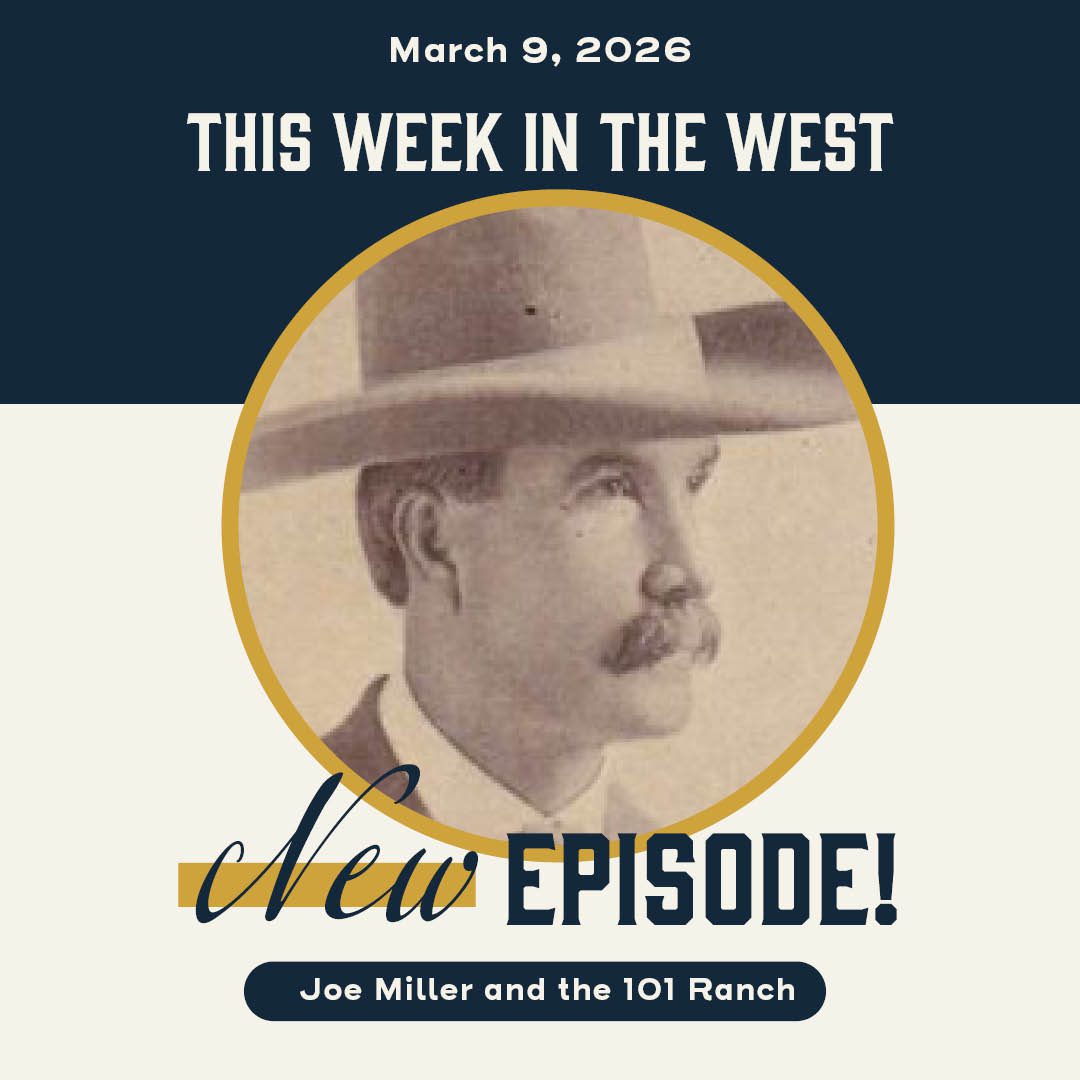
When Joe Miller Sr. was born, the story of the American West was still being written.
But it would be Miller, a cattleman’s son raised in Ponca City, Oklahoma, who would build a sprawling operation defining how the country would come to see the days of frontier trails, rowdy boomtowns and heroic cowboys.
We remember Miller, one of the founding brothers of the famous 101 Ranch, on the week of his birth, March 12, 1868.
Joe’s father, Colonel George Washington Miller, was a Civil War veteran who migrated west after the conflict, driving cattle north from Texas and steadily building a reputation as a capable and aggressive operator.
In 1881, he adopted a new cattle brand — 101 — a simple mark that would soon burn itself into the history of the West.
After being pushed out of the Cherokee Outlet in 1893, the family leased land from the Ponca Tribe near present-day Ponca City, Oklahoma. Once they took root, the Millers prospered and grew. The 101 Ranch ballooned to more than 110,000 acres, stretching across northeastern Oklahoma and becoming the largest diversified farm and ranch in America.
When Colonel Miller died in 1903, the future of that empire fell to his sons — Joe, Zack, and George Lee.
Joe Miller was the eldest and quickly emerged as the driving force. He was an exceptional horseman, a tireless promoter and a man who believed in the value of spectacle. While his brothers focused on livestock and finances, Joe focused on his vision: that there was a romance in the West that people wanted to see.
And he intended to show it to them.
So, before Disney had Disneyland, Joe Miller built the self-contained world of the 101 Ranch.
It became an attraction and a self-contained world. The Ranch had its own electric plant, dairy, cannery, tannery, mills and store.
Crops ranged from wheat and corn to orchards and experimental hybrids. Buffalo grazed alongside cattle. Oil wells pumped beneath grazing land.
Visitors couldn’t stay away; they included presidents, royalty and celebrities.
But what truly set the 101 apart was what happened when the Millers put their people — cowboys and Native performers alike — on display.
In 1905, Joe Miller helped organize an exhibition known as Oklahoma’s Gala Day. Audiences were captivated not just by ranch work but also by the drama: the speed, danger, skill, and showmanship of frontier life.
By 1907, the 101 Ranch Real Wild West Show was touring nationally, and soon internationally.
Unlike many Wild West shows of the era, the Millers employed Native Americans as paid performers, representing dozens of tribes including the Ponca, Osage, Kiowa, Comanche, Apache, Sioux and others. The performers brought authentic horsemanship and cultural presence to the show.
The cast reads like a Who’s Who of Western giants.
Bill Pickett became one of the show’s biggest stars, astonishing crowds with the bulldogging technique he invented. Will Rogers, Tom Mix and other future stars passed through the 101 on their way to fame.
Even Geronimo appeared, famously killing a bison from the front seat of a moving car during one performance.
The show traveled to Mexico, Canada, South America and Europe. In 1914, the 101 Show performed for King George V and Queen Mary of England. For audiences around the world, the 101 Ranch Show created an indelible image of the American West.
At the same time, the ranch itself continued to innovate. In 1908, oilman Ernest W. Marland partnered with the Millers to explore oil on ranch land. The discovery of oil in 1911 re-invented the 101 yet again and helped launch what would become the Marland Oil Company, later known as Conoco.
The Millers also embraced early motion pictures, leasing horses, equipment and performers to film companies and helping shape the look and feel of Western cinema that Hollywood eventually ran with.
But Joe Miller’s ambition cut both ways.
The Wild West show business was volatile and unforgiving. Railroad accidents, illness among performers and rising costs plagued the operation. World War I disrupted touring. Motion pictures, rodeos and circuses competed for audiences. Joe’s intensity and volatility strained relationships with his brothers and his cast.
By the 1920s, the economics no longer worked. In 1926 alone, the show lost nearly $120,000.
Joe Miller died on October 21, 1927, on the ranch. Within two years, his brother George had also died, leaving Zack Miller alone to hold together an empire.
The Great Depression delivered the final blow. In 1931, the 101 Ranch went into receivership. Land was divided. Equipment auctioned. Buildings were torn down and the self-contained city vanished almost overnight.
Today, an 82-acre portion of the ranch is preserved as a National Historic Landmark. State Highway 156 is named 101 Ranch Memorial Road. Bill Pickett and other ranch hands are buried near the White Eagle Monument.
We have many artifacts here at The Cowboy that help keep the history of the 101 Ranch Alive, including a saddle owned by Joe Miller, covered in more than a million dollars’ worth of jewels and precious metals.
The Millers helped transform the working West into performance, and in doing so, helped turn the cowboy into an icon.
As historian Michael Wallis has written, the 101 Ranch didn’t just reflect the American West — it helped invent it.
And with that, we’ve 86’ed another episode of “This Week in the West.”
Our show is produced by Chase Spivey and written by Mike Koehler.
Follow us and rate us on Apple Podcasts or wherever you hear us. That helps us reach more people.
Come visit us in Oklahoma City! You can now buy tickets online at thecowboy.org/tickets
Got a question or a suggestion? Drop us an email at podcast@thecowboy.org
We leave you today with the words of Zack Miller, recalling the heyday of the 101 Ranch during a 1928 Interview: “We figured it wasn’t much harder to do things in a big way than it was to worry along in a small way. We figured it was no worse to fail big than to fail little; but ever so much better to win big.”
Much obliged for listening, and remember, come Find Your West at the National Cowboy & Western Heritage Museum.